
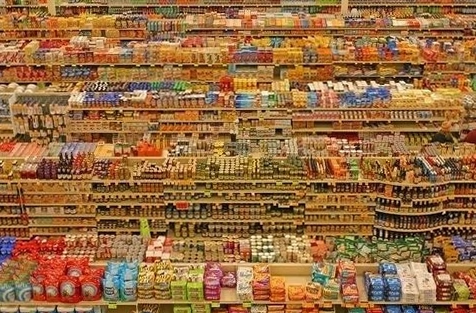
Walk through any supermarket aisle in 2026 and the packaging reads like a marketing poem: “artisanal crackers,” “humanely raised chicken,” “farm fresh eggs,” “premium ice cream.” These words feel reassuringly specific, as if they carry the weight of a federal inspector’s stamp. But the distance between a label’s promise and its legal guarantee varies wildly — and that gap can cost you money at the register and confidence in your cart.
Understanding what these words actually mean before paying a 30% premium for them is the difference between shopping on trust and shopping with knowledge. Here is a field guide to the labels that showed up in our kitchen-testing pantry, decoded with the help of federal rules, industry standards, and a healthy dose of skepticism.
All Natural: The Most Flexible Word in Food Labeling
When a package of chicken tenders claims to be “all natural,” it sounds like a promise about how the animal lived and what went into the feed. The reality is more modest. The FDA has never written a formal rule defining “natural” for most human foods. Its longstanding policy holds that the term generally means nothing artificial or synthetic has been added that wouldn’t normally be expected in the food.
That’s it. No farming practices, no animal welfare standards, no nutrition promises. A bag of chips fried in heavily processed oil can legally carry a “natural” banner as long as the ingredients themselves qualify as natural under that narrow policy.
When Natural Meets Legal Reality
Food Labeling advocates have pushed for a stricter federal definition for years, but the policy has remained unchanged. A 2026 consumer survey conducted by the International Food Information Council found that 67 percent of shoppers still believe “natural” means something about how the food was grown or raised. Regulators do not share that interpretation.
Marketers know this. The term is a price signal, not a quality signal. If you care about what’s actually in the package, the Ingredients list is the only place carrying legal weight. “Natural” tells you almost nothing about sugar content, processing methods, or nutritional value.
Artisanal and Handcrafted: Style Words With Thin Legal Anchors
There is no federal recipe for what makes a food “artisanal.” No rulebook defines the size of the workshop, the skill of the maker, or the number of hands involved. The word exists as a style descriptor, conjuring images of small-batch precision even when the product came from a massive industrial facility.
The same applies to “handcrafted.” Federal rules do not give shoppers a universal definition across all food categories. On meat and poultry, the FSIS requires labels to meet generic approval standards — meaning they cannot be false or misleading — but the word alone doesn’t tell you how much manual labor actually went into the product.
What’s the workaround? Look for specifics. A label that says “handcrafted in small batches using traditional methods” paired with a detailed brand story carries more weight than the word in isolation. The law requires labels to be truthful; it doesn’t require them to be informative.
Farm Fresh and Humanely Raised: Complicated Claims With Real Teeth
“Farm fresh” has a secret: the word “fresh” already has legal baggage. The FDA defines “fresh” in certain contexts, especially when it suggests a food is unprocessed or unpreserved. The full phrase becomes a layer cake of overlapping regulatory meanings.
“Humanely raised” sits in a different regulatory space entirely. While there is no single federal animal-welfare definition that every meat package must obey, the FSIS treats animal-raising claims as special claims requiring approval before use on covered products. That means producers cannot simply print the phrase and hope it sticks.
Looking Beyond the Label
What you want to see is a named third-party certification. Certified Humane, Animal Welfare Approved, and Global Animal Partnership each maintain published standards that auditors enforce. Without one of those names attached to the package, the claim relies on the producer’s own interpretation.
The consistency question matters here: a 2025 Consumer Reports audit of humanely raised labels found that nearly a third of packages using the phrase had no verifiable certification behind them. That doesn’t mean the claims were false — it means the evidence was invisible to the shopper.
No Additives and Gourmet: Reading Beyond the Front Panel
“No additives” sounds like a clean sweep, but FDA regulations actually define chemical preservatives and generally require added preservatives to be identified by function on packaged foods. A front-label claim doesn’t replace the Additives declaration in the ingredient list — that’s where the real information lives.
If a product makes a “no additives” claim, the ingredient list is legally the more accurate source of truth. Check for the functional names: preservatives, emulsifiers, stabilizers, colorings all have to be declared when they’re present.
“Gourmet” is a similar case. A current eCFR search shows no specific federal standard of identity for the term in ordinary human food. Federal misbranding law still applies, so the word cannot make an otherwise deceptive label acceptable — but it doesn’t promise a particular quality level for Nutritional Information either.
Premium: The Price Tag Has No Federal Checklist
“Premium” powder on a box of ice cream or a jar of marinara makes the product feel like an upgrade, but the word does not come with a universal federal definition for ingredients or nutrition. The label still has to comply with all applicable rules and cannot be false or misleading.
The practical takeaway: compare the ingredient list and the Serving Size and Calories information before assuming a premium version is structurally different from the standard one. Sometimes the premium difference is real — better fat content, more expensive oils, a slower process. Sometimes it’s just the word “premium” printed in a nicer font.
Healthy: The One Word With Actual Federal Teeth
This is the clear exception in the labeling landscape. Health Claims like “healthy” have detailed federal criteria under the FDA’s updated rule first announced in December 2024. Foods carrying the claim must include qualifying amounts from recommended food groups and meet specific limits for added sugar, saturated fat, and sodium.
The transition timeline matters for shoppers in 2026. Manufacturers can already use the new criteria, but they have until February 25, 2028 to fully comply with the updated definition. That means right now, you’ll see both old and new “healthy” claims on shelves, and the range tells you which manufacturer is jumping ahead.
The updated criteria raised the bar meaningfully. A bowl of sugary cereal that met the old 1994 standard now needs to include a meaningful amount of a recommended food group and stay under tighter limits. This is the rare case where the label word truly got more trustworthy.
Made With Real Fruit and Grass-Fed: Specific Claims With Missing Links
“Made with real fruit” can be a surprisingly thin claim. The FDA’s flavor-labeling rules address what happens when a product uses the name or image of a fruit as a characterizing flavor. Depending on what supplies that flavor — fruit juice concentrate, puree, extract — labels may need additional wording like “flavored” or “artificially flavored.”
The ingredient list will tell you whether it’s fruit juice concentrate or whole fruit puree or just natural flavor compounds. The color and texture of the product often give the truth away faster than the front label.
The Grass-Fed Shift
Grass-fed beef had a USDA Agricultural Marketing Service standard for years, but AMS withdrew that voluntary standard in 2016. That withdrawal did not make the term lawless — it transferred oversight to the FSIS, which treats animal-raising claims as special claims requiring approval and documentation.
What does that mean in practice? A producer claiming grass-fed must substantiate it with records of the animals’ diet. The claim needs to be truthful and supported. But the specific definition of what percentage of grass qualifies as grass-fed can vary from producer to producer, unless a third-party certifier is named.
Making Labels Work For You Instead of Against You
The thread running through every one of these terms is the same: a label word is a doorway, not the whole room. The Expiration Date, the ingredient list, the serving size, the nutrition panel — those are the rooms. The marketing claim is just the first impression.
Here is a practical checklist to bring on your next shopping trip:
- 🍎 Start with the Ingredients list — it’s legally required and factually reliable for what’s actually in the package
- 🥕 Check the Serving Size honestly — many “snack packs” count as two or three servings, which changes the Calories math
- 🥩 Look for named third-party certifiers (Certified Humane, Animal Welfare Approved) rather than standalone adjectives
- 🥖 Read the Expiration Date context — “sell by” and “use by” are not the same thing
- 🧂 If a food label claims “no additives,” verify in the Nutritional Information and ingredient panel rather than taking the front of package at face value
- 🌱 Understand the difference between Organic and Non-GMO — organic covers farming practices including GMO prohibition, while Non-GMO makes no claims about pesticides or farming systems
The next time a package leans on an impressive word, read one layer deeper. Some terms carry detailed definitions that genuinely protect you — “healthy” is the shining star. Others depend on broader truth-in-labeling rules, which is real but looser. The small print was never trying to catch your eye. That’s exactly why it tells you more.

Hi, I’m Landon Brooks. I am the editor-in-chief of Cook and Design, but for the first decade of my working life I was actually a product designer in New York.