
| Sections / Where this goes 🧭 | Key notes / What to remember 💡 |
|---|---|
|
|
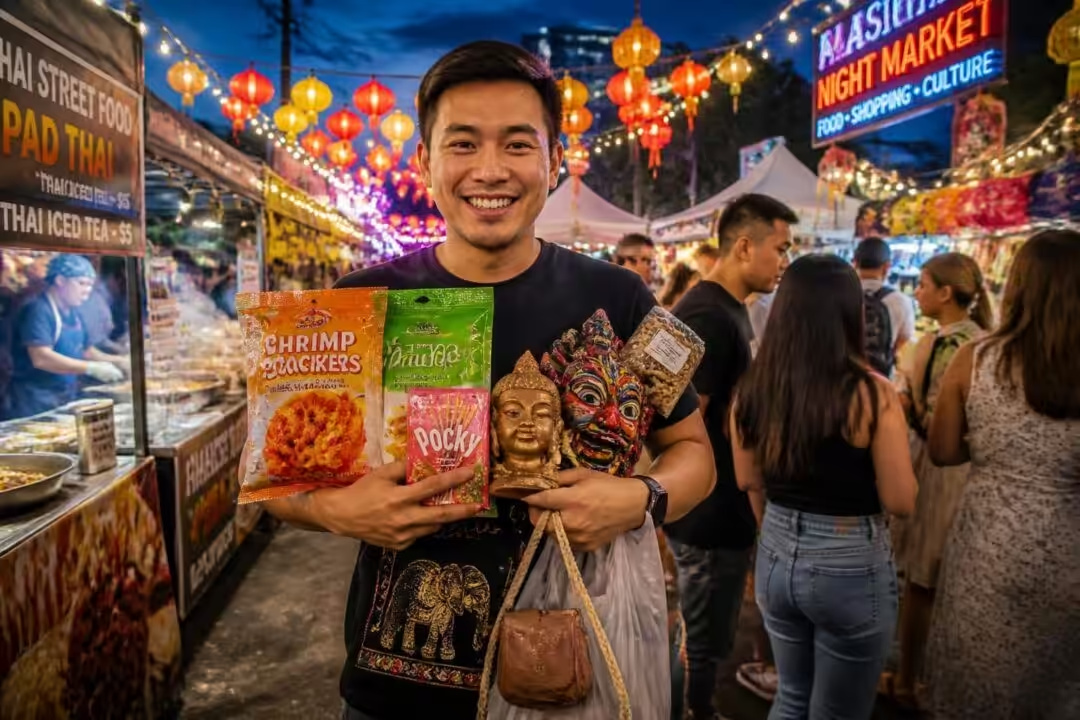
Night markets aren’t only about eating; they’re about movement, light, and decision-making under pressure. Richmond Night Market, widely billed as North America’s largest, is the rare place where a $25 budget can still feel like abundance—if the choices are designed, not improvised. The goal here isn’t to chase everything; it’s to build a tight, satisfying mini-itinerary where flavor, value, and memory land at the same time.
Exploring North America’s Largest Night Market: Richmond Night Market Scale, Season, and Layout
Richmond Night Market in British Columbia runs as a seasonal outdoor event, typically operating Friday through Sunday from April to September, with added dates around select holidays. That schedule matters because it shapes the entire experience: warm evenings, long lines, and a rhythm that’s closer to a festival than a farmers market. It’s also one of the reasons the market draws such a massive audience—organizers and local tourism sources routinely cite over one million visitors per year, a number that helps explain the crowd dynamics on a prime Saturday night.
The setting is not a single aisle of stands. The market is spread across a large outdoor footprint—often described as roughly 18 acres—near the area around Number 3 Road and Bridgeport Road, with the market address commonly listed as 8351 River Road. That scale is felt immediately in how the food is arranged: rows of hawker-style stalls where heat, steam, and frying oil become part of the air. The sensory profile is the point—smoke from grills, sugar from waffle irons, chili from spice shakers—each lane with its own microclimate.
Food is the headline. Sources frequently note 100+ food vendors, with the overall stall count reaching into the hundreds once retail is included. The selection leans strongly Asian (as a nod to the classic night market model), but it’s not limited to tradition. Visitors can expect a spectrum: recognizable comfort foods, regional specialties, and mashups engineered for maximal crunch, pull, or drip. The market’s best bites often share one trait: they’re made in front of the customer, which turns dinner into a small performance.
That performance extends beyond food. Live performances and carnival-style games create a constant background hum. A major add-on in recent seasons has been the Skyrush Zipline, described by organizers as a 600-foot ride that sends riders over the lights and lanes. Whether or not that’s on the agenda, the zipline changes the vibe—suddenly the night market isn’t just horizontal wandering; it becomes vertical spectacle.
In 2026, the market’s seasonal storytelling has also leaned into big cultural moments—such as World Cup energy in the region—showing up as themed inflatables and photo-friendly installations. Those details matter for anyone who cooks and designs at home, because they clarify what the market is really selling: not merely snacks, but an environment built for shared memory. The key insight is simple: Richmond Night Market is big enough that the smartest approach is to treat it like a neighborhood—pick a few “addresses” to visit instead of trying to “see it all,” and the experience gets instantly better.
What $25 Can Get You at Richmond Night Market: Exchange Rate Math, Entry Costs, and Timing Hacks
A $25 budget sounds limiting until the currency conversion quietly expands the canvas. For many U.S. visitors, spending at Richmond Night Market happens in Canadian dollars, so the buying power depends on the exchange rate at the time of travel. A commonly cited example puts $25 USD at about $35.42 CAD, which can feel like finding extra bills in a jacket pocket. That difference doesn’t make everything “cheap,” but it can turn one snack into two, or one food purchase into a food-plus-souvenir night.
The first subtraction is admission. Standard entry is often listed around $7 CAD, with a later-night rate around $5 CAD after 10 p.m. Certain groups—like children under 7 and seniors 60+—are often eligible for free admission, which can reshape family budgeting. The practical takeaway is that the night market is designed to reward off-peak timing. Arriving later can reduce both the ticket cost and, frequently, the intensity of the lines at the front gate.
Then there’s the temptation of big-ticket thrills. The zipline is usually priced around $25 CAD (with a lower kids’ rate cited around $15 CAD). For a strict $25 USD plan, that’s a budget breaker unless the entire night is being built around the ride. Many visitors watch riders glide overhead and decide the spectacle is enough. That choice isn’t about bravery; it’s about design. Every budget needs a clear “hero.” If the hero is food, the zipline becomes background art.
Transportation is where Richmond behaves like a well-designed city. Parking is often described as free, but public transit is strongly encouraged. The Canada Line SkyTrain to Bridgeport Station puts visitors within a short walk—often framed as about five minutes. For anyone who’s cooked through a dinner rush, this is familiar logic: remove friction at the start, and the whole system flows better. SkyTrain reduces the hunt for parking, shortens the pre-entry stress, and can make the night feel more like a planned outing than a scramble.
In 2026, affordability gets another lever: a summer happy hour window has been promoted for the season, running opening night through a late-September endpoint in some announcements. During that window, visitors may see drinks around $7 CAD and select food items under $10 CAD, along with vendor-specific discounts. The important detail is that discounts at a night market are rarely uniform. One stall may mark down a signature item to create a line; another might bundle snacks. Budget success comes from noticing which vendors are clearly “running a special” and letting that steer the choices rather than fighting it.
To make the math tangible, it helps to treat $25 USD as a mini production schedule: entry, one statement food, one playful texture food, and (if there’s room) one small object from retail. The core insight: timing is the cheapest ingredient—choose it well, and the rest of the night tastes better.
To see the market’s visual scale and crowd energy before going, this kind of search is useful:
Watching a recent walkthrough helps set expectations: the lanes are tighter than they look in photos, and lines can form fast for items with strong “texture theater” (cheese pulls, stacked skewers, extreme crunch). The next section turns that into a concrete $25 eating plan.
What $25 Buys in Food: Rotato, Cheese Coin, and Sushi Taco as a Smart Night Market Trio
Night market eating is less about a single perfect dish and more about building a sequence. The best $25 plan is one that balances salt, fat, heat, and novelty, while avoiding the classic mistake: spending too early on something merely “fine” and losing room for the stall that would have been unforgettable. A simple strategy works: do a scouting lap, pick three targets, then buy on the second lap when cravings are informed by actual smells and visuals.
A strong first target is the rotato: a spiral-cut potato on a stick, fried until the edges crisp, then hit with seasoning. Pricing often lands around $10 CAD, and that makes sense—oil, labor, and the simple fact that it’s engineered to be carried. The rotato is not subtle; it’s a crunchy-salty platform that behaves like a snack and a side dish at the same time. The smart move is to share it. One person holds, both people pull off coils, and the snack turns into a social object rather than a private purchase.
Then there’s the cheese coin, a waffle-like round roughly the size of a softball, famously stamped with an image of Queen Elizabeth II. It often sits around $9.99 CAD during a discount window (with a regular price sometimes cited closer to $12 CAD). It can be filled with custard or cheese, and the choice reveals what kind of eater someone is. Custard is comfort; cheese is theater. The “pull” is the point—splitting the waffle and stretching the cheese into an absurd strand that makes strangers smile. For design-minded cooks, this is texture as content: elasticity, shine, and the small drama of the break.
The third anchor—if budget allows—is a sushi taco. It’s a contemporary night market format: tempura-fried seaweed shaped like a taco shell, stuffed with rice, cucumber, and chunks of fish. A spicy salmon version is a common favorite, frequently priced around $10 CAD. This is the bite that makes the trio feel complete, because it brings freshness and spice against the fried starches. The seaweed tempura gives a crisp snap; the rice brings body; the fish provides the clean note that keeps the meal from feeling like a carnival binge.
To make this trio work under $25 USD, the hidden lever is admission timing and sharing. If two friends split a rotato and a cheese coin, then each buys one personal “main character” item—like a sushi taco—the group gets variety without doubling the spend. That’s the same logic used in a well-tested menu: one big salad for the table, one shared starch, and individual mains to keep everyone satisfied.
Here’s a practical shopping list that keeps the night structured (and fun) without turning it into a spreadsheet:
- 🥔 One shared rotato (choose a seasoning you’d actually finish)
- 🧇 One cheese coin for the pull (cheese if the goal is drama; custard if the goal is calm)
- 🍣 One sushi taco as the “fresh” counterpoint
- 💧 🧂 One drink or a water plan (fried foods are thirsty work)
- 🕙 After-10 p.m. entry if the plan is value-first
The point isn’t to copy a specific order; it’s to copy the balance. Fried potato gives crunch, waffle gives chew and richness, sushi taco resets the palate. The insight to carry forward: the best budget nights are built on contrast, not volume.
Watching a close-up video of the sushi taco format is helpful because it shows the structural risk: shells can shatter if overstuffed. The best stalls tend to nail the rice-to-fish ratio so the taco holds together long enough to enjoy. Next up: how to handle the retail and activity side without accidentally spending the whole budget on a cute object.
Beyond Food at Richmond Night Market: Shopping, Games, Zipline Spectacle, and Budget Boundaries
Night markets are designed to separate visitors from their money in small increments. After food, the second gravitational pull is retail: rows of bright booths selling toys, gadgets, accessories, and the kind of charming clutter that feels like a prize for surviving the crowd. The trick is that retail is where a $25 plan can collapse. One or two impulse buys can cost more than the entire meal strategy.
A useful example of “worth it, but controlled” is the blind-box mini figure—specifically sets like Mofusand Marine Life Meow figures that have circulated through the market’s retail lanes. At around $15 CAD (often roughly $10 USD depending on exchange), it’s not a throwaway purchase, but it can be a meaningful souvenir because it carries narrative. Blind boxes are a tiny ritual: choosing a box, opening it, reacting to what you got, and letting that object anchor the memory of the night. That’s design doing emotional work.
Still, it’s important to name the boundary: if the night’s budget is $25 USD total, a $15 CAD retail item is only reasonable if food choices are shared or if entry was discounted. Otherwise, the souvenir becomes the meal. For many visitors, that’s not the trade they intended to make—especially when the food stalls are the main event.
Games are the third lure. Carnival-style booths—like small “fishing” games with plastic fish—offer a momentary break from eating and walking. But games are often structured for repeat plays. One round rarely feels like enough, which makes games a stealth expense. A designerly rule helps: avoid spending money on outcomes that aren’t repeatable at home. A plush toy might be cute, but a unique snack you’ll never find in your neighborhood can feel more valuable later.
The zipline sits in a separate category: it’s an attraction with a clear price tag, and for thrill-seekers it can be the highlight. The aerial view of the lights and lanes is genuinely cinematic. For budget travelers focused on food exploration, the smartest move is to treat the zipline as part of the scenery and keep walking. Watching riders glide overhead delivers a little adrenaline at zero cost, and the night keeps its focus.
To make these trade-offs concrete, here’s a compact budget table that shows how different choices can fit (or not) under a $25 USD cap, assuming the approximate exchange of $25 USD ≈ $35.42 CAD:
| Budget line item 🧾 | Typical cost (CAD) 💸 | Why it’s worth it (or not) 🎯 |
|---|---|---|
| Admission (standard) 🎟️ | ~$7 | Non-negotiable unless eligible for free entry; sets the baseline. |
| Admission (after 10 p.m.) 🌙 | ~$5 | Best value lever; can free up a couple extra bites. |
| Rotato (shared) 🥔 | ~$10 | High crunch payoff; ideal for splitting to protect budget. |
| Cheese coin (discount) 🧇 | ~$9.99 | Texture theater; the “cheese pull” is the souvenir photo. |
| Sushi taco 🍣 | ~$10 | Fresh counterbalance to fried foods; feels uniquely night-market. |
| Blind-box mini figure 🧸 | ~$15 | Great memory object, but can crowd out a full extra snack. |
| Skyrush zipline 🎢 | ~$25 | Big thrill, big trade-off; usually replaces the food plan. |
what makes this market special is that it can feel like a theme park even if nothing is purchased beyond entry and a couple foods. Light installations, music, and the stream of people create constant movement. The insight to carry into the final section: the most satisfying night markets are curated in real time—and that requires a strategy for crowds, lines, and decision fatigue.
Exploring Richmond Night Market on a $25 Budget: A Cook-and-Design Survival Strategy for Crowds, Queues, and Flavor
To make $25 feel generous at a market of this scale, the main skill isn’t bargain-hunting—it’s sequence design. The crowd, the noise, and the visual overload can push visitors into reactive buying: the first thing that looks good becomes the thing they get. That’s how budgets disappear without satisfaction. A better approach borrows from professional kitchen thinking: mise en place first, execution second.
Start with arrival timing. Showing up right when gates open (often around early evening) sounds logical, but it can also coincide with the first surge. On busy Saturdays, entry lines can wrap fast. Arriving later can mean cheaper admission and sometimes shorter queues, but it also risks vendors selling out of a signature item. The workaround is simple: decide which matters more—price or availability. If the goal is the fullest selection, arrive earlier and accept the line. If the goal is value and a looser vibe, use the after-10 p.m. window and build the night around fewer, higher-confidence buys.
Once inside, do a first lap without purchasing anything. It’s not about discipline for discipline’s sake; it’s about information. The first lap answers key questions: Where are the longest lines? Which stalls are moving fast? Which foods are being cooked to order versus pre-plated? In a market with hawker-style setups, speed matters because it tells you something about freshness and demand. The most photogenic stall isn’t always the best engineered for throughput.
On the second lap, buy with intention. The highest satisfaction foods at a night market usually fall into three buckets:
- 🔥 Hot-and-crispy (fried potato spirals, tempura shells, skewers fresh off the grill)
- 🧊 Cooling reset (cucumber-forward bites, citrus drinks, lightly dressed seafood)
- 🧀 Texture theater (cheese pulls, stretchy mochi, crackling sugar tops)
A $25 plan works when at least two buckets are represented. The rotato plus sushi taco combination is a perfect example: one scratches the salty crunch itch, the other brings a cleaner finish. Adding a cheese coin turns the night into a story, because it creates a shared moment—someone pulls, someone laughs, someone takes the photo.
There’s also the social design of the market. Many visitors come with a friend or a small group, and that’s a hidden advantage. shared purchasing multiplies variety. One person can grab the rotato while another secures the sushi taco line, then everyone swaps bites. The market becomes a tasting menu without the restaurant price tag. If a friend is about to move across the world—say, off to a new life in France—those shared bites can carry more weight than a single “best” dish. The food is the medium; the memory is the product.
Finally, manage the retail zone with a rule. Before entering, choose one:
- 🛍️ No retail (food-only night, maximum tasting)
- 🎁 One souvenir cap (one blind box or small item, hard limit)
- 🎯 Hunt list (one specific object you truly want, nothing else)
This rule prevents the common ending: walking out with a bag of trinkets and wishing there had been one more snack. With the rule in place, the market stays what it’s best at—an edible spectacle built from heat, light, and craft. The insight that closes the loop: $25 doesn’t buy everything at Richmond Night Market, but it can buy the right three things—and that’s how a night becomes memorable instead of merely busy.
Hi, I’m Landon Brooks. I am the editor-in-chief of Cook and Design, but for the first decade of my working life I was actually a product designer in New York.



8 Comments
The two-laps strategy is pure sustainability thinking—observe before consuming. Great approach.
Love how this frames the night market as a design problem—scouting, contrast, and a solid plan for taste and movement.
Nice optimization. The two-lap strategy is basically a cache buffer for your wallet.
Bonjour Landon, the two-lap strategy feels like iterating on a build before deployment. Smart budgeting under pressure.
Good piece, Landon. Like planning a wiring run, you laid out the circuit before the crowd hits. That two-lap tip is pure gold.
A night market as a design system? The two-lap rule is pure UX.
Love the emphasis on designing your night market experience—smart budgeting and two laps are key. It’s all about making spaces work for people.
Love the two-lap strategy — scouting then buying is classic cost-benefit optimization. The food builds look solid.
Les commentaires sont fermes.