| In this story 🧭 | Key notes to keep 🗒️ |
|---|---|
|
|
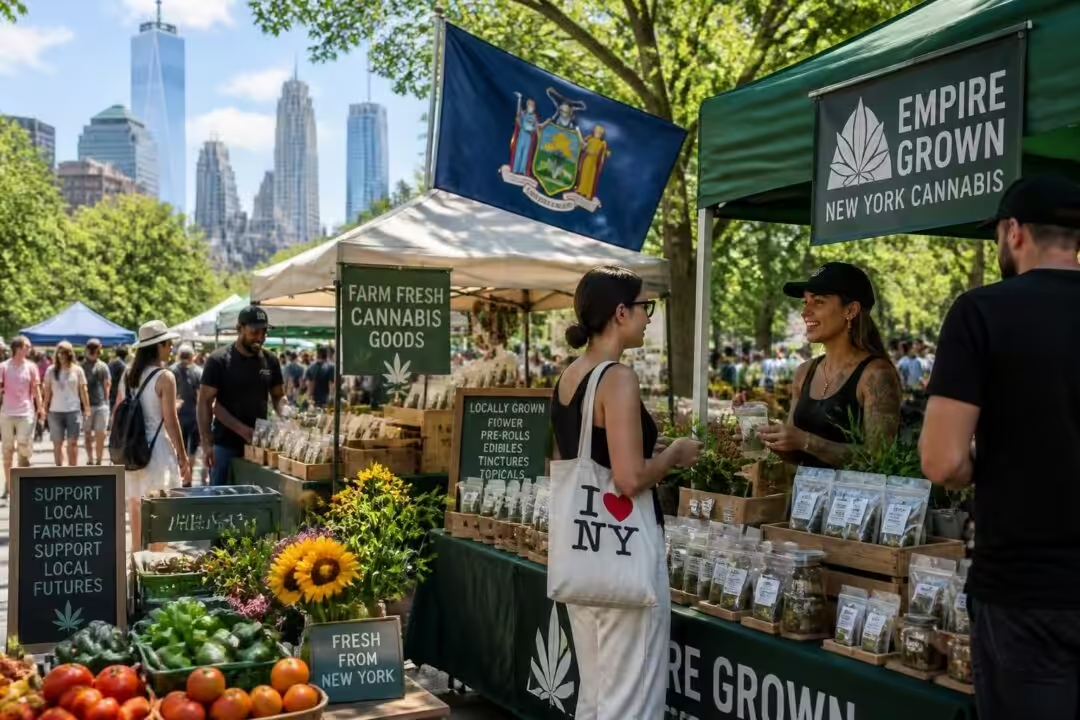
On paper, this is a narrow policy tweak: New York has expanded permission for state-licensed cannabis microbusinesses and certain dispensaries to sell at approved farmers markets, pop-ups, and community events. In practice, it changes where New Yorkers will encounter cannabis—moving it from destination storefronts into the same weekend lanes where people buy heirloom tomatoes, sourdough, and bunches of herbs. That shift is cultural as much as commercial, and it raises a design problem that food people instantly understand: how do you add a new category to a beloved market ecosystem without flattening what makes it feel local, human, and safe?
Small New York businesses get a green light to sell cannabis at farmers markets: what the law changes
New York legalized adult-use recreational cannabis in 2021, but legalization is only the first layer. The harder work is building a market that’s legible to shoppers and survivable for small operators. The new development: Governor Kathy Hochul signed legislation expanding the state’s event-based sales permissions—often described as “showcase” permits—so microbusinesses and participating dispensaries can operate pop-up retail at approved public markets and community events.
Here’s the practical meaning for a Saturday morning: a licensed microbusiness—think small cultivation paired with in-house processing and branded products—can apply to sell in a market setting where foot traffic already exists. For many small operators, that foot traffic is everything. A storefront lease in New York can turn into a monthly stress test; a stall fee and a tent are a different kind of risk.
It also matters what the law does not do. Microbusinesses are permitted to sell their own products only at these events. That constraint can feel limiting until it’s viewed through a trust-and-traceability lens. at a farmers market, shoppers often want to know: Who made this? Where was it grown? What’s the story? Restricting sales to a microbusiness’s own goods keeps the chain clear—and supports the “meet the maker” energy markets are built on.
From “showcase” concept to market stall reality
New York had already created a path for event sales in March 2025, when showcase-style permissions allowed larger licensed adult-use dispensaries to present products at certain events. What changed with the newer bill—introduced in spring by state Senator Michelle Hinchey—was the explicit extension of that opportunity to smaller license types, especially microbusinesses, so they can access the same kind of consumer-facing moments previously easier for bigger operators to afford.
Supporters frame it as leveling the playing field: larger cannabis corporations have bigger marketing budgets, broader distribution relationships, and often more polished brand infrastructure. Farmers markets, by contrast, are an equalizer because the core currency is conversation and sampling culture (in cannabis, that may be smell jars, terpene education, packaging demos, and staff guidance rather than consumption). The “stall” becomes a human-scale showroom.
And there’s a seasonal logic to it. Summer market season in New York isn’t just shopping; it’s social life. If a state wants regulated products to win against unregulated ones, meeting people where they already are is strategic. The insight that hangs over the whole policy is simple: access isn’t only about how many stores exist—it’s about how often a legal option shows up in a normal day.
Key insight: moving regulated cannabis into farmers markets turns compliance into a public-facing design challenge—if it feels trustworthy and neighborly, it can change buying habits.
Expanding market opportunities for cannabis microbusinesses: why farmers markets matter for survival
For microbusinesses, this policy is less about novelty and more about cash flow. The legal market is now large enough that “being licensed” doesn’t automatically mean “being seen.” New York’s Office of Cannabis Management has reported the statewide legal market surpassing $2.5 billion in total sales, with more than $1.5 billion attributed to 2025 alone. Those numbers sound like a tide that lifts all boats—until the math hits a small operator’s ledger.
Retail shelf space is scarce, marketing is expensive, and consumers are still forming habits. A farmers market booth functions like a live product page where the staff can answer questions in real time: What does “full-spectrum” mean here? How should a beginner read THC percentages? Why does this gummy feel different than another? The educational labor that would cost a brand thousands in digital ads can happen in a five-minute chat.
Consider a hypothetical upstate microbusiness, Hudson Valley Saffron & Sun, that grows sun-reared cannabis and produces a limited run of solventless edibles. The product is excellent, but the brand is small. A market stall gives them three advantages that a traditional route doesn’t:
- 🧺 Immediate feedback loops: shoppers ask for lower-dose options, clearer onset guidance, or different flavors—input that can shape the next batch.
- 📍 Localized distribution without a distributor: a microbusiness can sell where their neighbors already shop, instead of paying to reach them online.
- 🧑🤝🧑 Trust-building through presence: the person who grew it is often the person explaining it, which is rare in modern retail.
That third point is the farmers market superpower. Markets are not optimized for scale; they’re optimized for relationship. Cannabis, still new enough to carry stigma and confusion, benefits from exactly that environment—provided the presentation is respectful and compliant.
Competing with “big cannabis” without pretending to be big
Large multi-state operators can buy attention. Microbusinesses tend to earn it. The risk is trying to mimic corporate branding in a setting that rewards authenticity. A well-designed stall at a market doesn’t need neon signage or gimmicks; it needs clarity: dosage info, responsible-use reminders, and staff trained to guide without pressure.
There’s also a pricing reality. Shoppers at a farmers market will pay more for a tomato if they believe in the farm. They may do the same for cannabis—if the craft story is specific (cultivation method, batch size, testing standards) rather than vague “premium” language. The market aisle punishes fluff.
And crucially, this can be a bridge for operators who are licensed but not yet ready for a full storefront build-out. A pop-up stall is a way to test merchandising: which package sizes move, what questions repeat, what signage confuses. That’s product design thinking, applied to retail.
Key insight: farmers markets can act as a low-overhead launchpad where microbusinesses learn what their customers actually need—before committing to permanent retail costs.
To understand how this fits into the broader public conversation, it helps to hear how regulators and communities describe “showcase” events in practice.
How cannabis sales at farmers markets can stay safe, regulated, and neighbor-friendly
a farmers market is a high-trust environment. People bring kids, dogs, visiting parents. The vibe is open-air and communal, which means a cannabis booth has to be intentional about boundaries. The policy goal, as framed by the governor’s office, is to expand consumer access to safer, regulated products while strengthening one of the state’s fastest-growing industries. “Safer” is doing a lot of work in that sentence, and it’s worth unpacking what it should look like on the ground.
Regulated cannabis is not just about legality; it’s about consistency—packaging rules, lab testing standards, and age-gated sales. At a market, those safeguards must be visible without turning the stall into a security checkpoint. The best vendors will take cues from alcohol tastings and high-end farmers market meat sellers: clear signage, calm staff, and a tidy physical layout that respects traffic flow.
What shoppers should expect at a compliant market pop-up
Farmers markets move fast. People don’t want to decode a wall of jargon. A well-run cannabis pop-up can be both compliant and approachable if it designs the experience around a few non-negotiables:
- 🔞 Age verification handled discreetly, without shaming or drama.
- 🧾 Receipts and batch traceability available, like any legitimate retailer.
- 🧪 Testing transparency explained in plain language—what was tested, and why it matters.
- 📦 Packaging discipline: child-resistant where required, and stored so casual browsing doesn’t become handling.
- 🗣️ Staff trained for “beginner questions” without upselling high-THC products.
Note what’s missing: spectacle. Cannabis doesn’t need to be the loudest booth in the market to be effective. In fact, the more the stall behaves like a thoughtful specialty retailer, the easier it is for the market community to accept it.
Keeping the market ecosystem intact
Market managers have their own job: balancing vendors so the market feels coherent. Add cannabis and there are new considerations—placement, traffic patterns, and neighbors. A bakery might worry about smoke associations; a kids’ music tent might not want to be adjacent. Those concerns are not moral panic; they’re operational.
One smart approach is zoning by intent: place cannabis near other regulated adult products (like cider vendors where permitted) or near wellness-adjacent stalls (topical makers, herbalists), while keeping distance from children’s programming. Another is time-limited participation—specific weekends or hours—so markets can test community response without permanent rearrangement.
The policy’s “approved events” language matters here. This isn’t a free-for-all; it’s permission under a permit structure. That gives market organizers leverage to set additional rules that protect the market’s character while complying with state regulations.
Key insight: the success of cannabis at farmers markets will be judged less by sales volume and more by whether it blends into market life without eroding trust.
For shoppers trying to navigate potency and product types, a clear, responsible education layer is essential—especially with edibles and onset times.
New York legal cannabis market growth meets market culture: numbers, neighborhoods, and logistics
When policymakers talk about “expanding opportunities,” it can sound abstract. New York’s market data makes it tangible. The state reported that legal cannabis sales have exceeded $2.5B overall, and that 2025 alone contributed more than $1.5B. At the same time, the number of licensed shops reportedly jumped from 261 in 2024 to 556 in 2025, including more than 200 dispensaries in New York City.
That growth creates a paradox: more stores should mean easier access, but not every neighborhood has the same retail density—and not every consumer wants to walk into a dispensary. Farmers markets pull from a different behavioral map. They attract shoppers who might be curious but cautious, and they operate in neighborhoods that may not yet have robust retail coverage.
From a city planning perspective, markets are also pop-up infrastructure. They already handle permits, vendor maps, and crowd management. Adding cannabis is a logistical extension of an existing system rather than building a new one from scratch.
| Signal in New York’s legal market 📊 | What it suggests for farmers market cannabis 🛒 |
|---|---|
| 💰 $2.5B+ total legal sales reported statewide | Consumers are buying legally at scale; markets can redirect more purchases into regulated channels |
| 📈 $1.5B+ in 2025 sales | Demand is strong; event sales become a pressure valve for brands fighting for attention |
| 🏪 Licensed shops grew 261 → 556 (2024 to 2025) | Retail expansion is real, but pop-ups help reach shoppers who don’t prioritize dispensary trips |
| 🏙️ 200+ dispensaries in NYC | City markets may become competitive “discovery zones,” while upstate markets can act as first access points |
| 🧾 Permits limited to state-licensed businesses | Market participation can signal legitimacy to shoppers comparing legal vs. gray-market options |
A neighborhood example: the “Saturday basket” effect
Farmers markets work because they bundle errands into a pleasant ritual. A shopper comes for eggs, stays for bread, grabs flowers, then throws in something unexpected. Cannabis can become part of that basket—especially lower-dose edibles or beverages designed for predictable experiences.
Imagine a Brooklyn market where a shopper routinely buys kimchi, mushrooms, and stone fruit. A microbusiness booth nearby offers low-dose, clearly labeled gummies with strain information and testing transparency. The shopper may not have planned to buy cannabis, but the proximity and the calm presentation lower friction. That’s retail design 101: reduce steps, reduce anxiety, increase clarity.
This also changes how brands think about seasonality. Market season has rhythms—peak summer, back-to-school fall, holiday pop-ups. Microbusinesses can plan limited releases like a food producer would: a “late-summer citrus” edible run, or a winter topical drop. Not gimmicks—just products that acknowledge how people actually live.
Key insight: farmers markets turn cannabis from a standalone errand into an add-on purchase, which is exactly how many local food categories grow.
What this means for shoppers and local food-adjacent businesses: a practical guide to navigating the new normal
Whenever a new product category enters a shared public space, everyone adjusts—not just the sellers. Farmers markets are ecosystems: produce farmers, prepared food vendors, craft makers, and the market organization itself. Cannabis joining that ecosystem will influence shopper expectations, vendor relationships, and even the sensory experience of the market.
For shoppers, the upside is straightforward: legal access in familiar settings, with regulated products and staff who can answer questions. For nearby vendors—coffee stands, bakeries, jam makers—the calculus is more nuanced. Some will see cannabis as a foot-traffic driver. Others will worry about brand adjacency. The outcome will depend on how thoughtfully stalls are integrated.
How to shop a cannabis farmers market booth like a careful adult (not a tourist)
Most people already have a “market brain”: they ask about sourcing, they compare sizes, they notice packaging. The same habits apply here, with a few extra filters. A shopper who wants to participate responsibly can use a short checklist:
- 🧠 Ask for dose clarity (especially with edibles): how many milligrams per serving, and how many servings per package?
- ⏳ Ask about onset and duration: when will it likely be felt, and how long might it last?
- 🧪 Look for testing info and reputable sourcing signals; regulated sellers should be able to explain them calmly
- 📦 Prefer simple, legible packaging that communicates what it is without marketing fog
- 🚗 Plan for transport and timing: if the day includes driving, skip intoxicating products—buy for later
The last point is the most “market day” reality of all. People come to markets to roam. Cannabis purchases should fit into that plan, not hijack it.
How adjacent vendors can adapt without losing their identity
A prepared-food vendor might wonder: should the menu change? Should staff be trained to answer questions? Should the brand stance be public? The best approach is usually modesty. There’s no need for every stall to react. Instead, market managers can coordinate shared guidelines so that one booth doesn’t create confusion for everyone else.
Some cross-category collaboration may emerge in a tasteful way. A bakery might do a non-infused “late-night cookie box” promotion with a neighboring cannabis microbusiness—separate transactions, separate products, clear boundaries. Or a ceramicist could create a small lidded stash jar that matches the market’s handmade ethos. The point is not to turn the market into a theme park; it’s to let small businesses benefit from proximity while respecting regulations.
And because Cook and Design readers tend to care about both function and form, it’s worth naming the design principle that will matter most: legibility. If shoppers can understand what’s being sold, by whom, and under what rules, the market stays calm. If it feels chaotic or salesy, people disengage.
Key insight: the markets that thrive with cannabis will treat it like any other regulated craft product—clear, quiet, and rooted in community norms.

Hi, I’m Landon Brooks. I am the editor-in-chief of Cook and Design, but for the first decade of my working life I was actually a product designer in New York.