When a kitchen and an editorial office share the same set of rules, something quietly remarkable takes shape. Put a chef and a designer at the same table, and both will talk about mise en place before they talk about the menu. That is the spirit behind a seemingly ordinary invitation: Join Our Team, spotted on Forum Page 68 of the Cook and Design website. It is not a career fair banner. It is not a growth-hacked LinkedIn post. It is an open door into a magazine that believes the test kitchen is a design studio, and that a well-tested recipe is a form of honest architecture.
For the past decade, Cook and Design has built its recipes the way a potter builds a bowl — slowly, with wet hands, and with an eye on the final silhouette. The forum page on our site has always been the humblest corner of that work. It is where readers, recipe testers, and editors trade notes on salt ratios, on the exact shade of brown a sheet pan should be before it gives up its caramel, and on a hundred other microscopic decisions that make a dish feel like yours. Forum Page 68 is the digital watercooler, the place where the team gathers before the bylines are written.
This story is about what that page represents, and the opportunities now open for someone who has ever thought: I want to make food journalism feel less like noise and more like a well-set table.
Inside the Kitchen: What Joining Our Team Really Looks Like
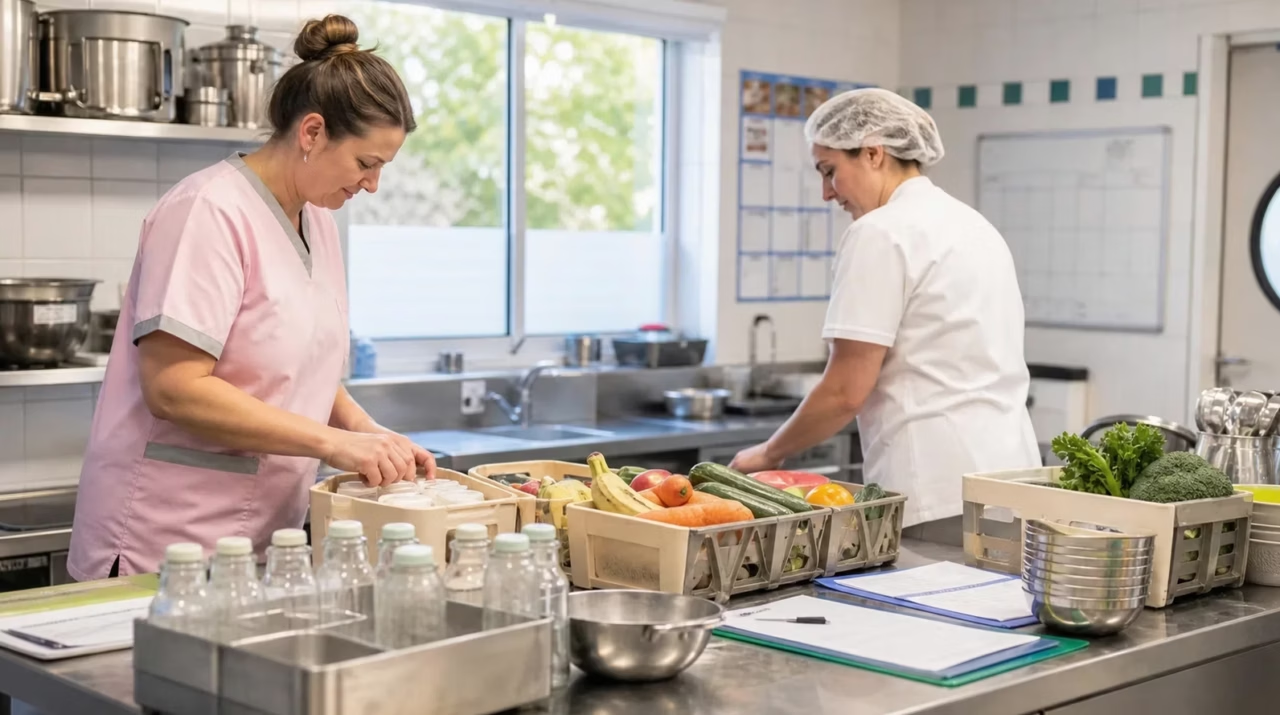
Come for the recipes, stay for the rigor. Every role at Cook and Design begins with a two-week paid trial that has nothing to do with HR theater. The job opening is not posted as a generic request for a “content writer.” It is a request for a human who understands that a headnote can be just as sculptural as a plated dish. The editorial team works in a single open space that smells of toasted sesame oil from morning until late afternoon, and the whiteboard near the fridge is covered with draft notes for a story on Korean wheat noodles. Insights do not arrive in a strategy deck. They arrive when someone burns the onions and remembers exactly what caramelization sounds like.
Take Maya Chen, a product designer from Portland who applied for a junior food editor role eighteen months ago. She had no culinary degree. She had a spreadsheet of one hundred forty tested recipes, a small collection of ceramic bowls she had thrown herself, and an application letter that began with a drawing of a radish. Maya was hired not despite the design background, but because of it. The team needed someone who could think in negative space — who understood that the silence between paragraphs matters as much as the words themselves.
Why a Taste for Structure Predicts Success
Cook and Design hires for a very particular kind of patience. The test kitchen runs on a simple doctrine: every recipe must survive three strangers cooking it in their own homes before it reaches the page. That doctrine shapes the hiring process too. Candidates are asked to write two recipe headnotes, test one existing recipe, and submit a rough sketch of how they would photograph it. This is not a test of perfection. It is a test of how a person responds to a dish that refuses to cooperate halfway through production.
This is why the culture has thrived. A magazine that respects the material of food is a magazine that respects the material of people. Designers, once hired, are given a surprising amount of freedom to reshape workflows. A former product designer on the team redesigned the entire recipe submission template so that it folds like a paper menu. Another, who had been a line cook in Chicago, introduced a system of color-coded labels for the test kitchen fridges — not as a gimmick, but as a way to reduce waste and confusion during busy shooting days. Join Our Team is not a command. It is an invitation to bring your full set of skills, even the ones that don’t fit neatly into a job description.
The first week of any new role includes a mandatory afternoon spent in the test kitchen, wearing an apron that says “Taste Every Sauce.” It is a rite of passage, a way of aligning the hands before the words. And at the end of that week, every new hire is asked one question: what would you change if you owned this magazine for a day? The best candidates always have a specific answer, and the worst always have a vague one. Precision is not an elite skill. It is the baseline.
Careers With Texture: The Unseen Engine of Collaboration
There is a page on the Cook and Design site that operates a little like a members-only reading room. It is called Forum Page 68, a name borrowed from the binding signature of a printed book — the section where the pages are folded into groups before being sewn together. The name is not a technical accident. The page is the exact center of the magazine, the point where content and community are stitched into the spine. For a long time, it was a quiet weekly newsletter with a thread for subscribers to post their baking mishaps. It has since grown into a vibrant micro-forum where community members post photos of their sheet-pan fish, ask for advice on pairing pickled vegetables with grilled meat, and occasionally mention which new cookbooks they are reading.
The editorial team spends a surprising amount of time there, reading between the lines. Networking is not a separate activity; it is woven into the daily ritual of responding to comments and testing ideas that come from the community. A reader in Ohio once mentioned using a Japanese mandoline upside down to create a fine dice. That tip traveled from the forum page, into the test kitchen, and became a sidebar in a story about quick weeknight dinners. The line between reader and co-creator disappeared, and that is exactly how it should be.
For those interested in building a career here, the forum has become a legitimate audition stage. Several current team members began as regular contributors on Forum Page 68, answering strangers’ questions with generosity and curiosity long before they were paid for it. A food stylist on the current staff originally joined as a commenter who offered gentle suggestions about lighting and surface texture. Another editor was noticed because she kept sharing detailed notes about sourdough hydration levels with absolute strangers, never asking for anything in return. None of that was strategic. It was simply the way she cooked, and the forum made that visible.
Team Building That Starts With a Pot of Rice
Every month, the editorial staff closes its laptops for a communal lunch that is not potluck in the bureaucratic sense. One person chooses a single core ingredient — a grain, a fish, a winter squash — and everyone else builds a dish around it. No rules except the ingredient, and no judgment except the table. These lunches are the most effective team building exercise anyone has witnessed. They require a different kind of listening. The person who brings the fish talks about where it came from; the person who burns the rice learns to laugh and start over; the editor-in-chief always insists on clearing plates, because hierarchy tastes terrible when it leaves a crust at the bottom of a pan.
These sessions are not recorded, and they are not used as performance metrics. They are simply an act of shared vulnerability — the same vulnerability required to test a recipe and fail ten times before writing a headnote that says “this works.” Community is built from those failures, not from polished internal newsletters. And for a new hire, these lunches are also the fastest way to learn how the magazine thinks. Casual talk about a miso caramel sauce often reveals more about editorial priorities than a formal onboarding document ever could.
From Job Opening to Belonging: The First Ninety Days
Maya’s first ninety days at Cook and Design involved far more than writing recipes. She spent a week in the test kitchen observing how each recipe moved from a chef’s notebook to a clear, executable format. She shadowed the photographer on two shoots, learning that natural light is a non-negotiable in the magazine’s aesthetic — and that the best photographs happen at 8:00 a.m. on a foggy day, not under bright studio lamps. She was also assigned the unofficial role of “official pepper grinder” during the communal lunch, a task she initially found mundane. Three weeks in, she understood it was the only job in the room that required her to cross all six words on her tasting sheet — and that moving around the table to grind pepper into each person’s plate was, quite simply, a masterclass in attention.
The first vertical slice of her work arrived in month two: a recipe for braised tofu with gochujang-glazed mushrooms. She wrote it, tested it six times, photographed it, and read the comments on the forum with a hand over her eyes. The feedback was kind, but it was also specific — one reader pointed out that her simmering time of 13 minutes made no sense in a home oven. Maya revised it to 15, retested, and published an update note thanking the reader. That loop — publish, listen, adjust, thank — is the single most important inheritance a new hire receives. It was not mentioned in any job posting, but it appears in every scrap of the magazine’s culture, woven into the grammar of how the team talks about the work.
Networking That Feels Like Breaking Bread
In an industry saturated with schmoozy events and forced LinkedIn connections, Cook and Design takes a slower route. Careers here are built through three channels: the recipes you test, the notes you share, and the way you treat a stranger’s question about how to fix a broken aioli at nine o’clock on a Tuesday evening. Networking is not a transactional exchange in the corner of a conference room. It is the quiet habit of responding to a forum thread with genuine excitement, even when no one is watching.
The magazine hosts two open studio days each year, announced first on Forum Page 68 — long before any press release or newsletter. These are not portfolio reviews. They are open-kitchen workshops where applicants and curious readers can spend an afternoon observing how a story goes from a sketch in a notebook to a fully photographed feature. There is no formal pitching, but conversations at the heavy wooden table often turn toward collaboration. The best pitch the magazine ever received came from a reader who attended one of these afternoons, told the style editor that the vegetable wash basin needed a wooden rack, and left a three-page handwritten proposal for a story about seasonal soup routines in the Pacific Northwest.
That is the kind of networking the magazine believes in. It is long-game, low-temperature, and completely devoid of energy-draining etiquette. It begins with a real question, a real pot of rice, and a genuine interest in how the other person cooks.
Skills That Open Doors in the Editorial Kitchen
For anyone preparing to apply, the following list has been gathered from years of watching people flourish in this environment. It is not a checklist of requirements, but a set of dispositions that make the work sing.
- 🔍 A diagnostic instinct — the ability to taste a dish and name precisely what it needs: a pinch of salt, a splash of acid, or simply a moment of rest.
- 🍚 Respect for repetition — the willingness to test a single recipe seven times without losing interest, because the seventh version is where the truth appears.
- 🧊 Working memory for details — remembering a reader’s dairy allergy, a font preference, or the fact that a colleague doesn’t eat cilantro, and letting that memory shape your decisions.
- 🎨 Visual restraint — understanding that negative space on a plate is as important as the ingredients themselves, and that white space in a layout is not an accident but a choice.
- 🤝 Generosity in feedback — the habit of giving critique that is grounded in observations (“the crust darkened earlier than I expected”) rather than personal taste (“I don’t like dark crusts”).
- 🌱 Humility before the material — respecting that a leek, a piece of fish, or an unfamiliar gochujang knows more about the recipe than the editor does, at least on the first try.
These qualities are also what make the community forum feel so alive. People who cook with diagnostic instinct are often the same people who answer other readers’ questions with precision and warmth. The magazine’s community is not an audience; it is an extended test kitchen that happens to span forty-eight states.
How to Start a Conversation That Outlasts the Application
Maya’s advice to future applicants is simple: do not send a cover letter that begins with your interest in food journalism. Begin with a meal. Describe a dish you made recently, why you made it, and what it taught you about your own patience. Show a photograph of a burnt edge that you learned to love. That is the kind of information that tells an editorial team whether you can hold a narrative in your hands.
There is one more thing every candidate learns during the trial week — the magazine expects you to say no. Decline the extra recipe if your schedule is full. Decline the suggestion to test a dish you are not curious about. An editor who knows her boundaries is an editor who can be trusted with a long-term project. The team building here is not about squeezing everyone into the same mold; it is about making sure the mold itself keeps moving toward something better. Candidates who survive the first months are those who understand that a job at Cook and Design is not a ladder to be climbed, but a table to be set.
The doors of Forum Page 68 are open, and the opportunities live exactly where they have always lived: in the willingness to be specific, to test, to listen, and to share what you know without counting the cost. Take a quiet look at the current openings — and begin with the meal that explains who you truly are. The table will be ready.
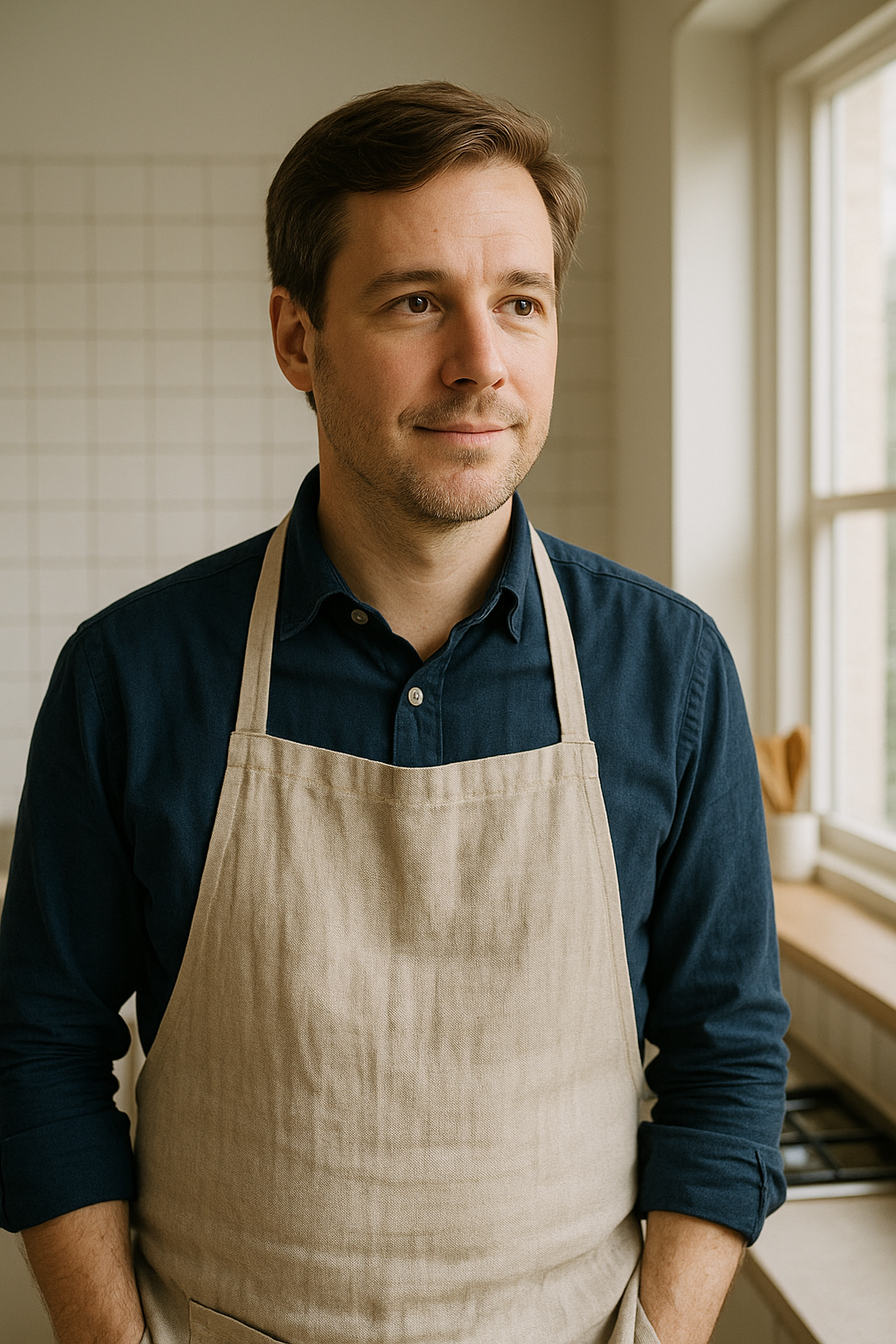
Hi, I’m Landon Brooks. I am the editor-in-chief of Cook and Design, but for the first decade of my working life I was actually a product designer in New York.