
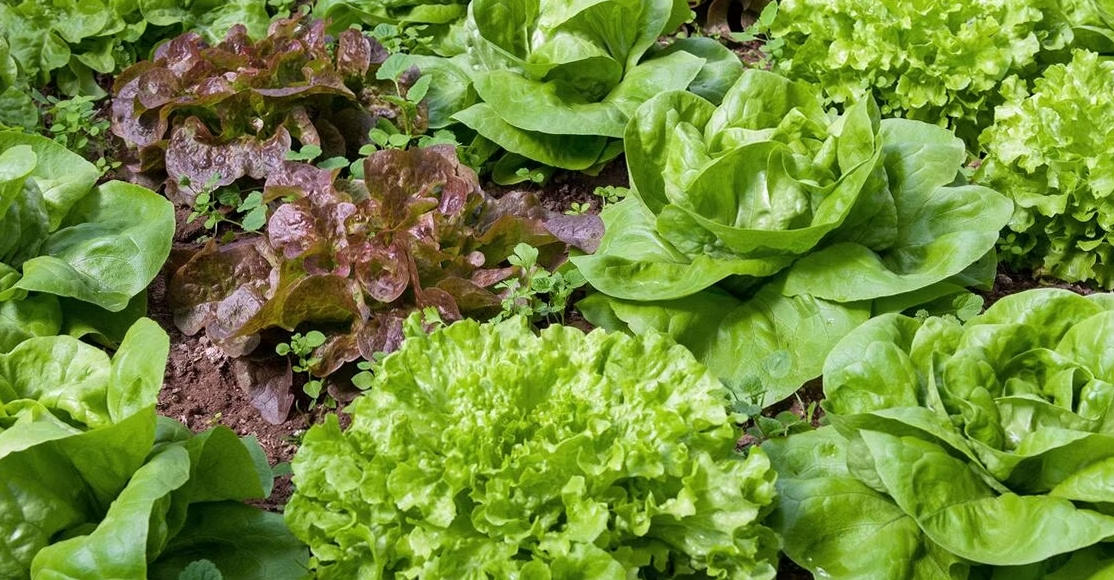
When a food safety scare hits the national news, the instinctive consumer response is to pull back. But what if a public health crisis actually made people more thoughtful about where their produce comes from? That’s exactly what happened for one small Illinois operation, and their story says a lot about how we’re thinking about food in 2026.
Why a Cyclospora Outbreak Changed Everything for One Piatt County Farm
WHITE HEATH, Ill. — The headlines were alarming: Taylor Farms lettuce linked to a multistate cyclospora outbreak, with the CDC investigating cases across 15 states and products distributed to 29. For most growers, that spells disaster. But for Koss Family Farms, nestled in the heart of Piatt County, fear of contamination became the best marketing campaign they never planned.
When Steve Koss and his wife started growing lettuce in a greenhouse back in 2020, they weren’t chasing a trend. “Food safety issues,” Koss said simply when asked why they built the operation the way they did. That core motivation has turned out to be prescient beyond what they could have imagined.
The Unlikely Surge in Lettuce Sales During a Public Health Crisis
Here’s the counterintuitive part: while the cyclospora outbreak pushed many consumers away from supermarket lettuce, Koss Family Farms saw their orders quadruple. In just one month, demand went through the roof. “The last month has been hectic,” Koss admitted, the kind of understatement a farmer makes when the phone won’t stop ringing.
New customers kept citing the same reason for making the switch: “They were extremely worried about the contamination and that side of it.” People were searching for a trustworthy source, and a small Piatt County farm suddenly looked like the safest option on the map.
Inside the Closed-Loop System That Sets This Piatt County Farm Apart
So what makes Koss Family Farms different? It starts with about 2,500 fish swimming in tanks on the property. Their waste becomes fertilizer, broken down by bacteria and microbes into plant food that nourishes the lettuce. The plants, in turn, filter the water by removing nitrogen and phosphorus, and that clean water cycles back to the fish.
It’s a fully self-sustaining aquaponics system—no soil, no open fields, no exposure to the kinds of runoff and wildlife contamination that typically cause cyclospora outbreaks. “It’s all enclosed, [the] environment is pretty well controlled,” Koss said. “So, we don’t have to worry about that stuff.”
Six Years Without a Single Outbreak: A Track Record That Speaks
In the six years since they launched, Koss Family Farms has never had a contamination problem. That unblemished record became their strongest asset when national news started screaming about cyclospora. While industrial-scale operations were scrambling to issue recalls, this small farm in Piatt County could point to a closed environment and a clean history.
What’s striking is how this dynamic is playing out across the broader produce market in 2026. The cyclospora outbreak has exposed vulnerabilities in large-scale, open-field agriculture, and consumers are paying attention in ways they never have before.
The Produce Market’s New Reality: Trust Is the Ultimate Currency
Let’s be blunt about what the cyclospora outbreak has done to the produce market. Major chains pulled lettuce from shelves. Restaurants saw traffic dip. The CDC expanded warnings. It was the kind of multi-state crisis that usually kills a product category for weeks.
But here’s the lesson from Piatt County: when large-scale industrial production loses consumer confidence, the beneficiaries aren’t just the organic grocers in big cities. Local, transparent, smaller-scale operations become the alternative. Koss Family Farms didn’t just survive the panic—they thrived because of it.
Why Consumers Are Rethinking Their Lettuce Sources in 2026
Think about the psychology at play. When you read about a cyclospora outbreak affecting shredded lettuce from a major supplier, you don’t just stop buying shredded lettuce. You stop trusting lettuce altogether. Unless, that is, you can find a source that feels verifiable.
- 🥬 Traceability matters: Consumers want to know exactly where their food was grown, under what conditions, and by whom.
- 🌱 Closed systems feel safer: Indoor growing operations that control water, temperature, and exposure are increasingly viewed as lower-risk.
- 🔍 Small is trustworthy: A farm you can name, visit, or imagine is more reassuring than a faceless industrial processor.
- 💬 Word of mouth spreads fast: When one neighbor finds a safe source, the news travels—often faster than a recall notice.
Steve Koss didn’t need a PR agency to spin his story. He just needed to keep doing what he’d been doing since 2020, and let the news cycle do the rest.
What the Cyclospora Outbreak Taught Us About Food Safety Infrastructure
The CDC’s investigation into the Taylor Farms lettuce outbreak is ongoing, but early patterns point to the challenges of open-field agriculture at massive scale. When hundreds of thousands of heads of lettuce are processed together, a single contamination point can ripple through the entire supply chain.
Koss Family Farms represents a different model entirely. Their production is smaller, their system is closed, and their attention to detail is, frankly, obsessive. That’s not a luxury—in 2026, it’s looking more like the future of food safety.
“Wash your vegetables, that’s the main thing,” Koss advised. “Keep them clean, know what you’re eating and where you’re getting it from and where it came from to get to that point.” It’s simple advice, but it lands differently when it comes from a grower who has built an entire business around that philosophy.
The Economic Ripple Effect on Local Agriculture
The surge in demand did more than fill Koss Family Farms’ order books. It sent a signal to other growers in the region that consumers are hungry for something different. When people in Piatt County and beyond started driving out of their way to buy lettuce from a greenhouse they could actually visit, it demonstrated that the market rewards transparency.
Orders have calmed slightly from their peak, Koss said, but they’re still far above pre-outbreak levels. That suggests something important: this wasn’t just a panic-driven spasm. Some fraction of those new customers are likely sticking around because they’ve discovered a product they trust.
The Expansion Plans: Scaling Up Without Compromising Safety
Growth is on the horizon for Koss Family Farms. The family is planning an addition to their greenhouse that will boost production from 100,000 heads of lettuce per year to roughly 130,000. They’re hoping to have the new space operational within the next three weeks.
That expansion is a bet on the idea that the demand for locally-grown, food safety-conscious produce is more than a passing trend. “We don’t have to worry about that stuff,” Koss said of contamination—and he’s wagering that a growing number of consumers want to share that peace of mind.
How a Family Farm in Piatt County Is Navigating Growth as Demand Rises
Scaling up a closed-loop aquaponics operation requires careful planning. Adding 30,000 heads of annual production isn’t just about building more greenhouse space; it’s about maintaining the delicate biological balance of the system. More plants means more water filtration, which means more demand on the fish population and the bacterial colonies that break down their waste.
If anyone can pull it off, it’s a team that has spent six years fine-tuning every variable. But the expansion also carries a symbolic weight: it positions Koss Family Farms as proof that agriculture and public health can work in harmony rather than in tension.
Practical Lessons for the Everyday Cook
So what should you actually take away from this story? Whether you’re buying from a farmers market in the Midwest or a grocery store on the coast, the fundamental principles are the same.
First, know your source. Ask your market manager where the greens come from and how they’re grown. Second, wash everything—even the beautiful hydroponic lettuce that look pristine. And third, consider supporting farms that prioritize enclosed, controlled environments when it matters to you.
Koss Family Farms saw their lettuce sales increase fourfold in the middle of a crisis that was supposed to make people stop eating lettuce. That’s not just a business success story. It’s a reminder that when the industrial food system wobbles, the alternative doesn’t have to be fear—it can be connection.
The next time you’re standing in the produce aisle, wondering who grew your greens and under what conditions, remember there’s a greenhouse in Piatt County where 2,500 fish are working hard to keep things clean. And that’s a story worth tasting.
Hi, I’m Landon Brooks. I am the editor-in-chief of Cook and Design, but for the first decade of my working life I was actually a product designer in New York.

4 Comments
Bonjour Landon, interesting how fear of contamination made local infrastructure more appealing. Reminds me of how safe bike lanes boost ridership.
Funny how a bug in the system makes you appreciate the clean local patches.
A well-engineered trust network. This case shows how localized systems gain stability exactly when centralized ones crack.
Interesting how a bug in the industrial food system led people to roll their own. Resilient.
Les commentaires sont fermes.