
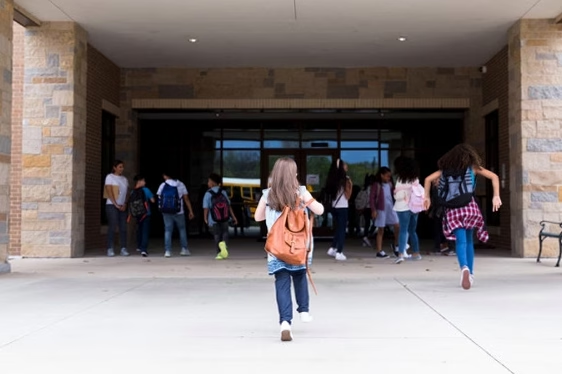
The first week of a new school year carries a particular scent in Central Texas — sunscreen, fresh pavement, and the faint metallic tang of a county still deciding what it wants to become. This week, the back-to-school buzz radiating from Austin ISD’s campuses is sharing the news cycle with something far rarer: Blue Origin‘s slow, deliberate move toward a billion-dollar footprint on the outskirts of Austin. On the surface, these are two very different stories. Look closer, and they become the same story told twice — about growth, and whether a community can set a table big enough to hold everyone.
At a glance:
- 🏫 Education: Austin ISD opened its doors under a new bus hub system, a tightened budget, and the shadow of a state takeover threat.
- 🚀 Space Exploration: Blue Origin appears to be closing in on a Hutto site for a $1 billion manufacturing and logistics campus projected to create around 2,200 jobs.
- 🥗 Community & Technology: The district’s Farm Fresh Network keeps local produce on school trays, even as consolidation reshapes the map of its campuses.
Mid-August in the Texas capital always arrives with a calendar full of firsts. This year, the first day of school and the first serious confirmation of an aerospace super-project collided in the same news cycle, giving local news readers a rare double feature: one story about beginnings, another about blueprints.
Austin ISD’s First Day Carries a Heavier Backpack This Year
🏫 When the doors opened on Tuesday morning, Austin ISD students walked into a district still working through major transitions. School consolidations, a budget deficit, and a reworked transportation system all arrived in the same year, while the state’s takeover threat has kept administrators on high alert. The first day of school usually makes local news for crisp uniforms and nervous parents. This year, it made headlines because the structure underneath those backpacks is shifting.
The new high school bus hub system deserves particular attention. Under this model, students gather at centralized hubs rather than following traditional door-to-door routes — an efficiency play that promised real savings, but demanded a heavy dose of trust from families. Parents voiced safety concerns well before the first bell rang. By mid-morning, district staff were already reviewing how the first runs had played out.
The Bus Hub System Faces Its First Real Test
Transportation is the quiet infrastructure that makes education possible, and Austin ISD’s new hub model is a redesign happening in real time. Think of it less like a route change and more like a kitchen reorganized mid-service: the same ingredients, but every station has been moved. District staff were stationed at the largest hubs, and early accounts suggested the first drop-offs went more smoothly than many had braced for.
Still, consolidation raises the stakes well beyond convenience. When schools close or merge, travel times stretch and communities recalibrate around each surviving campus. A parent watching a bus pull away from a North Austin hub put it plainly: “We’ll see how week three feels, not just day one.” That caution is reasonable — the true measure of any transit redesign is whether it holds once the novelty fades.
Farm Fresh Network Brings the Farmers Market to the Cafeteria
🥗 Amid the logistical jitters, one constant remains: the lunch line. Austin ISD is among the districts that work with the Farm Fresh Network, a program connecting school cafeterias with local farms. It is the kind of initiative that rarely makes a trending list, yet it is quietly reshaping what “school lunch” means in Central Texas.
In a region where food culture runs deep, the cafeteria tray is often the first place a child learns what a real carrot tastes like. The Farm Fresh Network treats that idea with seriousness, bringing seasonal produce into kitchens that historically leaned on frozen and canned goods. It is community work served one tray at a time — and proof that Austin’s relationship with food extends well beyond its restaurants. For a fuller picture of how these programs operate, this deeper look at farm-to-cafeteria partnerships is worth a read.
The visual rhythm of a lunch tray matters more than most people admit. Color, arrangement, even the weight of the plate — each element shapes whether a child reaches for the vegetables or pushes them aside. Design and nutrition are not separate concerns; they are the same meal, plated at scale.
Ride along with the first morning of the hub system to see how the district’s transportation redesign looked as it actually unfolded.
Blue Origin’s $1 Billion Bet on Central Texas Is Getting Real
🚀 Fifty miles up the road, a different countdown is underway. Blue Origin Enterprises LP, the commercial aerospace giant founded by Jeff Bezos, has been running an active search for a massive new operational footprint in Central Texas. Industry sources now point to a site near the Austin suburb of Hutto, where the proposed project — valued at nearly $1 billion — would establish a manufacturing and logistics hub capable of creating roughly 2,200 jobs over five years.

The numbers are striking on their own. The project would require approximately 100 acres, with a 20-acre factory and an 80-acre logistics hub sharing the site. That scale turns a rural corner of Williamson County into something closer to an industrial campus. But the jobs figure is what makes local officials lean in: 2,200 positions in space exploration and advanced manufacturing would ripple far beyond the factory floor.
Hutto’s Quiet Incentive Approval Raises Speculation
Reports indicate Hutto has already taken a significant step by approving an economic development package tied to the project — with some sources placing the investment figure at $650 million. The approval notably moved without fanfare. In suburb-speak, that kind of discretion usually means negotiations remain delicate, and nothing is final until everything is final.
The incentive agreement does not guarantee a signed lease, but it sends a meaningful signal to the market: Hutto is eager to be chosen. Positioned near existing infrastructure and just a short drive from the metro’s core, the aerospace project carries all the markings of a classic Texas land play — patient capital, long preparation, and a community waiting to see what lands in its fields.
What 2,200 Aerospace Jobs Do to a Suburb’s Table
Job creation stories are usually told in square footage and payroll numbers, but the human math is more interesting. Two thousand new aerospace workers mean new rooftops, new restaurants, new supply chains. They also mean added strain on roads, schools, and water systems — the unglamorous infrastructure that decides whether local news begins recording growing pains or steady wins.
For the Hutto area, this echoes a familiar pattern across the metro. Technology companies arrive, the workforce follows, and the small-town character either adapts or slowly dissolves. Blue Origin’s project would rank among the largest of its kind in Central Texas, effectively adding a new industrial district where cotton once grew. The question is not whether the region can absorb it — Austin has absorbed far larger shocks. The question is whether the growth is cooked at the right temperature, or simply turned up to high.
Seen from the ground, a factory is just walls and steel. Seen from a city planner’s chair, it is the skeleton of a future neighborhood.
A closer look at why Central Texas has become the aerospace giant’s preferred landing zone, and what the project could mean for the region’s economic landscape.
Two Stories, One Table: Education and Aerospace Share a Common Root
It would be easy to file this week’s trending news into separate folders — school system struggles on one side, corporate expansion on the other. But the back-to-school buzz and the Blue Origin momentum belong on the same surface. Both are questions of capacity: how many students a district can serve, how many workers a region can house, how many plates a community can set without dropping one.
What to watch in the weeks ahead:
- 🏫 Education: Whether Austin ISD’s bus hub system holds up once the school year settles, and how consolidation reshapes enrollment patterns across the district.
- 🚀 Space Exploration: Whether Blue Origin formally selects Hutto, and what final incentive terms the city and county are willing to put in writing.
- 🥗 Community: How the Farm Fresh Network scales its local produce program as the district’s geography shifts under consolidation.
- 🛠️ Technology: The supply-chain and housing ripple effects set in motion by a 20-acre aerospace factory in the Austin metro.
Austin has long measured itself in growth, but growth without intention is just sprawl wearing a hoodie. This week, the school bell and the rocket test stand were both audible across the region — two clocks, one time zone. The community that can feed its children well and build its future patiently is the one that will still recognize itself a decade from now. That is the recipe, and Austin is stirring it in public for everyone to taste.

Hi, I’m Landon Brooks. I am the editor-in-chief of Cook and Design, but for the first decade of my working life I was actually a product designer in New York.