
Taylor Farms Founder Breaks Silence Amid FDA Investigation: What Changed When the FDA Walked Back a Key Test 🧪
When a federal agency ties a household produce name to a fast-moving foodborne illness event, the story typically follows a familiar arc: an early clue, a public warning, and a scramble to find the source. In this case, the arc jolted when the FDA acknowledged that a laboratory result pointing at Taylor Farms lettuce was a false positive. That reversal did not end the investigation; instead, it widened the spotlight and complicated public trust, because the agency also stressed that its broader case still leaned on epidemiological evidence rather than a definitive lab confirmation.
The outbreak under scrutiny involved cyclosporiasis, an infection caused by the Cyclospora parasite. Reports tied the event to severe gastrointestinal symptoms—often described as “explosive diarrhea”—and the scale was anything but small: more than 7,000 illnesses and nearly 150 hospitalizations were cited in the public discussion as the investigation unfolded. Those numbers, read in a kitchen or a grocery aisle, change behavior quickly. Even people who rarely read regulatory updates begin scanning salad labels and questioning whether “fresh” still means “safe.”
Against that backdrop, Bruce Taylor—founder and CEO of Taylor Farms—chose an unusually pointed posture for an executive in the crosshairs: welcoming additional scrutiny while urging consumers not to abandon fruits and vegetables. The message carries an important nuance. It is possible to insist on rigorous oversight and still argue that the solution is better controls, not dietary fear. For anyone who cooks, that’s a real tension: salads and quick lettuce wraps sit at the intersection of convenience and vulnerability, because they are often eaten raw.
One of the most consequential details wasn’t the lab correction itself but the timeline around it. Late in the week, Taylor Farms had already initiated a voluntary recall of iceberg lettuce sourced from Central Mexico, a move that signals both caution and brand protection. Then the agency’s Sunday statement conceded the positive result should be treated as a false signal. By Monday, however, the FDA emphasized that its investigation still “zeroed in” on shredded iceberg lettuce linked to Taylor Farms operations in Central Mexico, describing the supporting epidemiology as overwhelming. That sequence—recall, reversal, reaffirmation—creates whiplash for shoppers and procurement teams alike.
To make the situation more tangible, imagine a fictional fast-casual chain, Harbor Bowl, whose best-selling menu item is a crunchy iceberg-based taco salad. Even with strong internal hygiene, Harbor Bowl depends on supplier confidence. A single headline can trigger immediate menu adjustments, emergency sourcing calls, and a shift toward cooked greens or cabbage slaws. In moments like these, the technical difference between a test result and population-level tracing becomes more than academic—it determines what gets served for lunch.
The story’s next turn involved communication. Taylor Farms circulated statements emphasizing the FDA’s acknowledgment and apology for the false positive, then followed with updated commitments aimed at reducing uncertainty. The company promised it would not source iceberg from Central Mexico growers for the remainder of the season and said it had deployed internal specialists to investigate “every possible origin” of the contamination concern. The key insight is that, in food safety crises, a company is judged not only by the final answer but by the speed and specificity of its response.
That specificity sets up the next layer: how a produce giant balances transparency, consumer health, and the realities of a complex supply chain—especially when the scientific picture remains incomplete.
Taylor Farms Founder Breaks Silence Amid FDA Investigation: Inside the Company’s Response Playbook 🥬
Food safety responses look simple from the outside—“recall the product, apologize, move on”—but the real work is operational and relentless. Taylor Farms sits at a scale where decisions ripple quickly: founded in 1995 by Bruce Taylor and partners in California’s Salinas Valley, the company expanded into a network of 19 production plants across the U.S., Canada, Mexico, and Western Europe, employing about 25,000 people. At that size, switching a sourcing region or pausing a product line is not a single lever; it’s a synchronized set of moves across growers, processors, logistics providers, and customer brands.
The most headline-grabbing operational choice was the pledge to stop sourcing iceberg lettuce from Central Mexico growers for the rest of the season. That commitment reads as both a safety hedge and a reputation stabilizer. In practical terms, it forces teams to find alternative supply, adjust contracts, and re-calibrate processing schedules to different heads of lettuce that may vary in water content, density, and shelf life. Anyone who has ever tried to keep shredded lettuce crisp for service knows that small differences in raw material can change everything from cutting settings to packaging atmosphere.
Key steps companies typically execute during a Cyclospora-linked investigation 🔎
Even when a company denies a direct causal link, the best crisis teams behave as if the source could still be in the system until proven otherwise. That means chasing down the boring, granular details: wash water logs, sanitizer concentration checks, travel paths of bins, and the hygiene choreography of workers who handle raw product. Cyclospora is particularly tricky because it can be associated with contaminated water or produce handling environments, and detection can be technically complex.
A practical “response playbook” tends to include clear actions that can be communicated to regulators and customers without overpromising. The following list captures the kinds of measures that become non-negotiable when confidence is fragile:
- ✅ Freeze and map inventory by lot code, pack date, and distribution lane to reduce blind spots.
- 🧼 Re-verify sanitation controls, including wash systems, equipment teardown frequency, and contact-time standards.
- 🚚 Reconstruct shipment histories for key accounts to support epidemiological tracebacks.
- 🔬 Run parallel third-party testing to cross-check internal and regulatory lab findings.
- 🌱 Audit farms and water sources with boots-on-the-ground specialists, not just paperwork reviews.
- 📣 Issue updates in plain language so buyers and consumers can act on them without guessing.
These steps look procedural, yet they’re deeply human: someone has to pull records at 2 a.m., someone has to decide whether to dump a batch that “seems fine,” and someone has to face restaurant partners who are furious about wasted menus and wasted trust.
Why the White House meeting mattered 🏛️
Another striking element was the report that a lobbyist was sent for an emergency White House meeting, motivated by frustration about being excluded from the investigative process. Whether one views that as aggressive advocacy or necessary escalation, it shows how quickly food safety becomes political when economic stakes are massive. Large suppliers feed schools, hospitals, national chains, and big-box retailers; a prolonged cloud over a supplier can destabilize pricing and availability across an entire category.
From a culinary perspective, the collateral damage is real. When consumers avoid leafy greens, they often replace them with more processed options. Bruce Taylor’s argument—that people should not be scared away from fresh produce—lands differently when read through a chef’s lens. Fresh vegetables are not just “healthy”; they’re foundational ingredients. The better question becomes: how can the system make raw produce safer without asking the public to give up salads altogether?
The next layer of the story sits in the evidence itself: if a lab test was retracted, how does epidemiology still point toward the same source—and what does that mean for public confidence?
Video reporting and expert commentary have amplified how confusing a “false positive” can feel when the investigation continues.
Taylor Farms Founder Breaks Silence Amid FDA Investigation: Lab Testing vs Epidemiological Data (and Why Both Can Be True) 📊
A single phrase—false positive—can sound like an exoneration, but regulatory science doesn’t work that way. Lab testing and epidemiological tracing answer different questions. A lab test asks: “Was the organism detected in this particular sample?” Epidemiology asks: “When people got sick, what did they have in common?” The FDA’s clarification that it had no positive test results to date, while also citing overwhelming epidemiological data, is a classic example of how these approaches can diverge without either being meaningless.
In produce outbreaks, epidemiology often moves faster than definitive lab confirmation because the suspect foods are perishable. By the time investigators collect product samples from homes or retailers, the exact lots linked to illness may be gone. That makes exposure histories—receipts, loyalty card data, restaurant invoices, and interviews—particularly valuable. If thousands of people across multiple states report consuming the same ingredient from overlapping supply channels, that pattern can be compelling even when lab work is inconclusive.
To keep the logic clear, consider another kitchen scenario. A fictional university cafeteria, Seaside Commons, serves salads to thousands of students weekly. If dozens of students report illness and the only shared item is shredded iceberg from a specific distributor, the commonality matters. Yet if the cafeteria’s remaining lettuce tests negative, that doesn’t automatically prove the earlier batches were clean—only that the tested sample did not show amplification in that moment. That distinction is emotionally unsatisfying, but it’s central to outbreak work.
A quick comparison of evidence types used in produce investigations 🧠
| Evidence type | What it tells investigators | Common limitation | How it plays in public perception |
|---|---|---|---|
| 🧪 Lab testing | Whether a specific sample shows the organism’s genetic signal | Perishable lots may be unavailable; sampling may miss contamination “hot spots” | Feels definitive; a reversal can trigger confusion ⚠️ |
| 📍 Epidemiological tracing | Statistical links between illness and exposures across many people | Relies on memory, receipts, and complex supply mapping | Feels indirect; can be dismissed as “not proven” ❓ |
| 🧾 Traceback records | Where ingredients traveled: farm → processor → distributor → retailer/restaurant | Data quality varies; commingling can blur lot identity | Builds credibility when transparent 📌 |
| 🧫 Environmental assessment | Whether water, surfaces, or handling practices could allow contamination | Findings are often circumstantial, not a “smoking gun” | Reassures when corrective actions are public ✅ |
This table also explains why a company can both challenge a specific test result and still implement sweeping sourcing changes. The test may have been incorrect, yet the broader risk signals—illness patterns, supply overlaps, and uncertainty about upstream conditions—can justify preventive action.
Why communication becomes part of the science 📣
The FDA’s Sunday walk-back followed by Monday reaffirmation created a credibility stress test. Taylor Farms responded by emphasizing the agency’s apology, then pivoting to visible commitments: avoiding Central Mexico iceberg for the season and deploying specialists to investigate. That second move matters because it adds “show-your-work” behavior at a time when the public suspects obfuscation everywhere.
Still, the public’s decision-making is more personal than policy. Parents packing lunches want a simple answer: “Is this safe today?” Restaurants want to know whether to remove an ingredient without wrecking signature dishes. The most useful communications therefore translate uncertainty into action—what is being recalled, what to discard, what to substitute, and what signs to watch for.
The story then widens beyond the outbreak itself, because the founder’s background and leadership style shape how a company behaves under pressure.
To understand the human and business dynamics behind these statements, it helps to see how the company’s leadership story evolved over decades.
Taylor Farms Founder Breaks Silence Amid FDA Investigation: Bruce Taylor’s History, Rivalries, and the High-Stakes Culture of Produce 🧑🌾
Leadership during a crisis rarely begins at the crisis. It is shaped by earlier chapters: mentors, corporate battles, and the kind of operational discipline that either exists before the emergency or doesn’t exist at all. Bruce Taylor’s path into building America’s largest salad producer includes a family-business legacy and a decisive split. Before founding Taylor Farms, he was connected to Fresh International Corp., the produce enterprise associated with his father, Ted Taylor. He served as co-chairman from 1981 to 1994, a period when industrialized salad production and national distribution were accelerating.
Ted Taylor died in 1991, and accounts describe a rift between Bruce and his brother Steve over management style and the company’s future. Whatever the interpersonal specifics, the business outcome is clear: Bruce resigned and soon co-founded Taylor Farms in 1995 in the Salinas Valley, an agricultural region whose identity is tied to lettuce in the way Napa is tied to wine. Steve Taylor later oversaw the family company and led its sale to Performance Food Group in 2001 for around $300 million. Steve died in 2022, a detail that adds gravity to the family narrative but also signals that the “two paths” story is now largely historical rather than an ongoing rivalry.
These details matter because they explain a founder’s instinct in the face of a federal investigation. Someone who has lived through corporate conflict and built a new enterprise from the ground up tends to communicate with a mix of defensiveness and urgency. In this case, the reported decision to send a lobbyist to the White House—seeking engagement and voicing frustration about being excluded—reflects a belief that process and access are as important as press releases. To a founder, being “talked about” without being “talked with” can feel like a strategic threat.
How scale turns a food safety issue into a national supply event 🧩
With 25,000 employees and plants spanning multiple countries, Taylor Farms is not just a brand; it is infrastructure. When infrastructure is questioned, the downstream effects touch many tables: supermarkets, school cafeterias, hospital meal programs, and quick-service chains. Even when specific customers are not named in an update, industry watchers understand that a major salad processor often supplies private-label lines and prepared kits, meaning the same raw ingredient can appear under multiple package designs.
In kitchens, this is where fear can get misdirected. Consumers may swear off all bagged salads, even those from unrelated facilities, because the category “feels risky.” The founder’s message warning against avoiding fresh produce is, in part, an attempt to prevent a nutritional overcorrection. There’s also a culinary truth here: vegetables are easier to eat daily when they’re convenient. If convenience disappears, people don’t automatically switch to washing and chopping whole heads at home; many switch to what’s easiest, which can be less nourishing.
What “deployed specialists” can realistically do on the ground 🧰
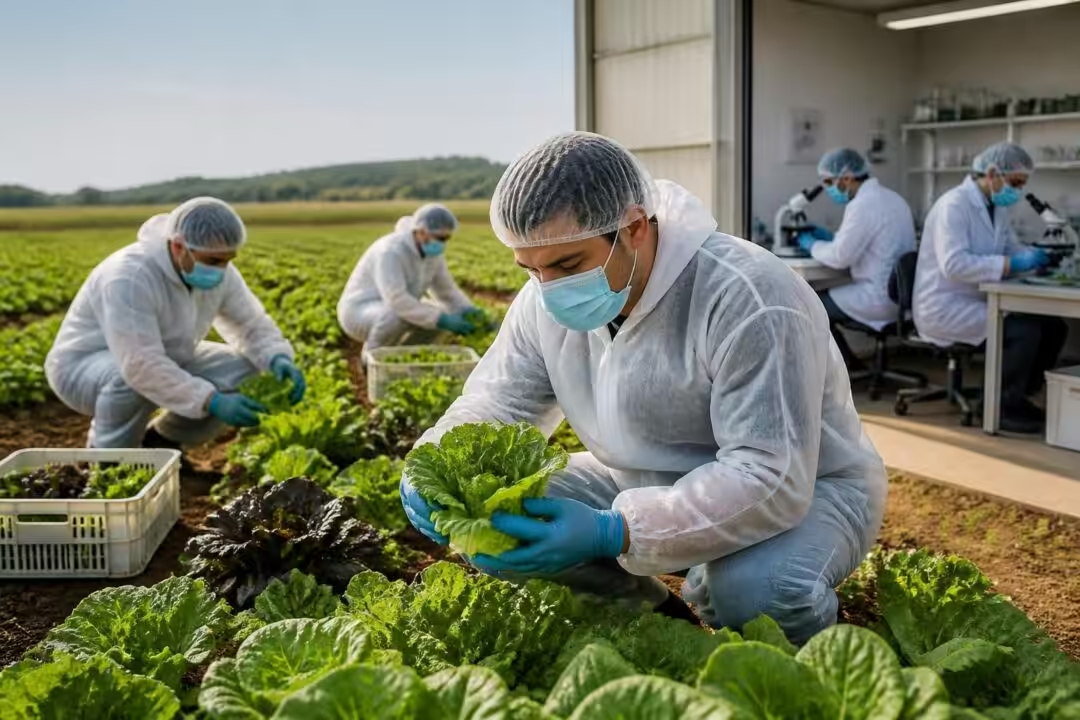
The promise to send internal specialists to Central Mexico to investigate every possible origin is not mere theater if executed rigorously. Specialists can audit irrigation sources, verify worker hygiene facilities, evaluate how harvest bins are cleaned, and check whether transport conditions allow cross-contamination. They can also pressure-test documentation: do timestamps align, do sanitizer records match purchase orders, do farm maps match what is actually planted?
A vivid example helps. A specialist team might discover that a farm uses a clean well for irrigation but a separate surface-water source for equipment rinse-down during peak heat, creating an overlooked risk. Or they may find commingling at a consolidation point where product from multiple fields is staged together, making it harder to isolate a single origin later. These findings often lead to improvements that persist beyond the immediate scandal, which is one reason public scrutiny can sometimes produce long-term benefits.
Ultimately, the founder breaking silence is less about one email quote and more about how a company chooses to operate when answers are incomplete. The next question for consumers and buyers is practical: what should change in how fresh produce is sourced, handled, and enjoyed so that “healthy” doesn’t come with a side of dread?
Hi, I’m Landon Brooks. I am the editor-in-chief of Cook and Design, but for the first decade of my working life I was actually a product designer in New York.