On a foggy July morning at Houston’s William P. Hobby Airport, a white 18-wheeler rolled up to the Southwest Airlines cargo operation. Against the drab industrial backdrop, the truck looked unremarkable — until the cargo doors swung open and a treacle-sweet fragrance flooded the air. Workers moved quickly, hauling pallets from the trailer to reveal the source: mangoes. Not the standard imports stacked in grocery stores, but honeyed, fiberless Sindhris; Chaunsas carrying their famously floral perfume; and mini Anwar Ratols concealing flesh the color of a persimmon beneath taut green skin.
This is the final act of a mango journey that begins weeks earlier in Pakistani orchards, crosses an ocean, passes through a Mississippi irradiation facility, and concludes at Houston-area markets where customers treat each box like treasure.
At a glance — what to remember:
- 🥭 Pakistani mango varieties — Sindhri, Chaunsa, Anwar Ratol — stand apart for intense aroma, silky texture, and profound sweetness.
- ✈️ Every U.S.-bound shipment must detour to Gulfport, Mississippi, for mandatory irradiation — a rule tied to South Asian pest concerns.
- 📲 Dedicated WhatsApp groups alert customers the moment mangoes land, with premium boxes reaching $38.
- 🏪 Houston’s Asian Market in Sugar Land moves roughly 400 boxes weekly, retailing around $33 each.
- 🌏 The 2007 lifting of a decades-old import ban paved the way for South Asian mangoes in American markets.
The Mango Journey Begins in Pakistani Orchards
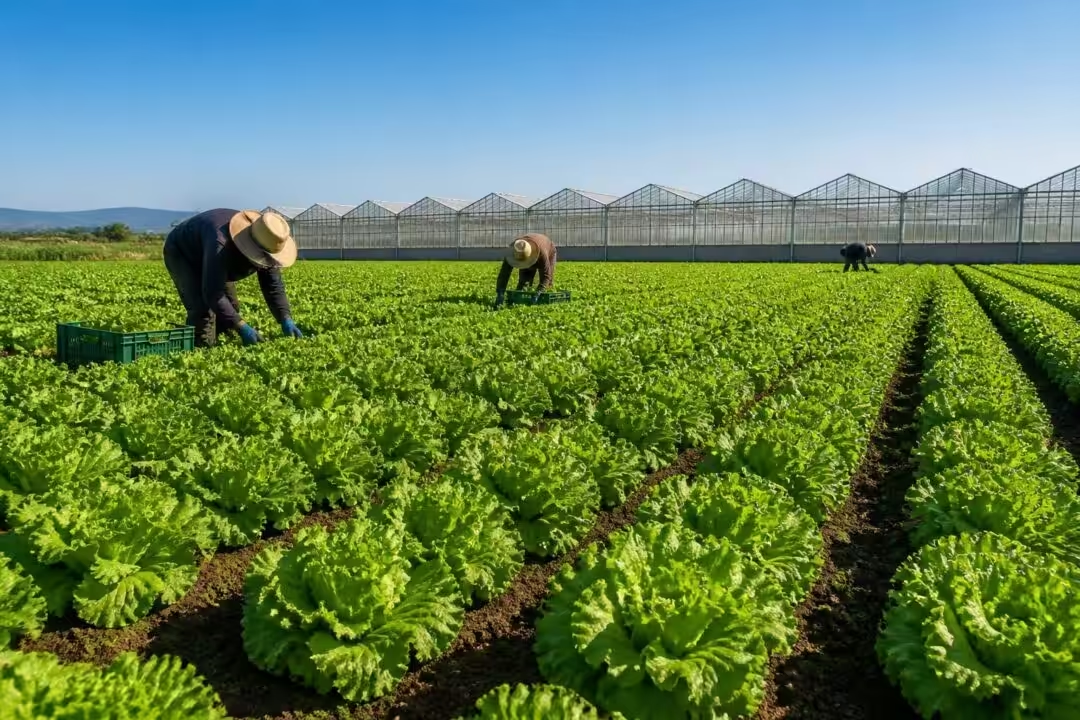
Long before the mangoes reach American soil, the mango journey unfolds in the agricultural heart of Pakistan. Contract farmers — men and women who have often spent generations tending the same trees — monitor their orchards as the heat builds through late spring and summer. The harvest process demands precision: fruit picked too early never develops its signature perfume; fruit picked too late may bruise or rot before reaching the plane.
Zulfikar Momin, chief executive of Pakam Trading and co-owner of Farm Fresh, sources directly from these contract farms, building relationships that span seasons and years. In Pakistan, the fruit is packed into meticulously designed cardboard boxes with mesh-covered holes that allow air to flow in and out. Nothing about the packaging is accidental; each perforation keeps the delicate tropical fruit from sweating during the long journey.
The Harvest Process: Timing Is Everything
Pakistani mangoes are not ripened on the tree the way many consumers imagine. Farmers pick them at a specific stage of maturity — firm, green, and slightly resistant to pressure — then allow the fruit to ripen en route. It’s a delicate balance, one that requires the entire supply chain to move like a well-rehearsed orchestra.
The payoff is a mango that arrives in the United States at the threshold of perfection: fragrant, firm, and ready for the final days of counter ripening that unlock the full depth of sweetness.
Why Pakistani Mangoes Are the Sweetest Mangoes on Earth
Most American supermarket mangoes come from Mexico. They’re reliable, affordable, and consistent. But devotees of Pakistani mangoes insist there is no comparison. The aroma alone is enough to convert skeptics — a scent so intense it stains the air, lingering in a room long after the fruit has been eaten.
Momin puts it plainly: “Among all the sweetest fruit on the earth, our Pakistani mango is the sweetest of all.” It’s a bold claim, but one supported by the sheer diversity of mango varieties grown across Pakistan and India — hundreds of cultivars, many of which never reach Western supermarkets.
Mango Varieties Worth Knowing
- 🥭 Sindhri — honeyed, smooth, and nearly fiberless, with a delicate sweetness that makes it the ideal eating mango.
- 🥭 Chaunsa — famed for its floral aroma and layered richness; many consider it the benchmark for the sweetest mangoes on earth.
- 🥭 Anwar Ratol — diminutive in size, green-skinned, and concealing persimmon-colored flesh; intensely concentrated flavor prized by connoisseurs.
Each variety brings something distinct. Some are so juicy they’re drunk rather than eaten; others dissolve on the tongue with no trace of fiber. India’s harvest season largely wraps up by early summer, but Pakistan’s extends well into the fall — a longer window for those who can’t imagine summer without them. For more ways to handle peak-season tropical fruit, revisit our guide to building a mango tasting board.
For the American cook, these mangoes go far beyond dessert. Their structure holds up in savory salads, their natural acidity balances rich curries, and their fragrance transforms a simple bowl of yogurt into something quietly memorable.
The Supply Chain: How a Delicate Fruit Crosses Continents
Bringing Pakistani mangoes to the United States is a laborious process — and, by necessity, a fast one. After the fruit clears customs in Texas, it boards another truck for Gulfport, Mississippi, home of Gateway America, a food irradiation facility. Texas A&M operates a similar system, but it is currently closed, making Gulfport the mandatory stop for South Asian imports.
Why irradiation? Mangoes from Mexico can undergo hot-water immersion for pest treatment, but that method does not reliably destroy the eggs of insects more common in South Asia. Irradiation provides a definitive solution: a controlled dose of radiation that eliminates any lurking threat without leaving visible traces or altering the fruit’s quality.
Suresh Pillai, a microbiology professor at Texas A&M who works with comparable systems, describes it as a final guarantee. “These are very high end fruits,” he explains. “This is absolutely no visible or any other indication of insects, but they’re given this last treatment process as a guarantee.” For a fruit this valuable, every extra step is worth the cost.
Inside the Airport: Where Mangoes Meet X-Rays
After their Mississippi detour, the mangoes are driven to New Orleans, where roughly two-thirds of the shipment boards flights bound for cities across the country. The remaining boxes continue to Houston’s Hobby Airport, where Southwest Airlines cargo agents handle the final leg.
The scene inside the cargo facility is one of quiet precision. Agent Paula Miller watches each box pass through the X-ray machine, mangoes appearing on her screen as abstracted, semi-translucent orange blobs. Her task: confirm that no contraband hides among the fruit before the boxes board their connecting flights.
Once cleared, the mangoes wait for customers willing to make the trip. Prices reach $38 per box, sometimes holding just five large fruits, sometimes more than ten smaller ones, with bulk orders bringing the cost down. This is the reality of premium fresh produce in 2026 — a global fruit export supply chain that moves a fragile tropical fruit from a Pakistani orchard to an American kitchen in a matter of days.
Houston’s Mango Culture: WhatsApp Groups and the Search for Home
Houston, with its large South Asian population, has become the unofficial American capital of Pakistani mangoes. Specialty companies like Farm Fresh — launched in 2014 — and Richmond-based Mango Mania, founded by Aamir Baweja, have built devoted followings. Baweja grew up in Pakistan, waiting for his parents and uncles to arrive home carrying mangoes with their distinctly perfumed aroma. When the fruit became legal in the U.S., he knew exactly what he wanted to do.
“I know the taste,” Baweja says. “That’s why I am very much confident that if I promote the Pakistani mangoes here in the U.S., everybody can love it.”
Customers track shipments through WhatsApp groups, coordinating pickup times the moment boxes land. At the Asian Market in Sugar Land, manager Vatika Gautam keeps the mangoes right by the front door — her customers, she says with a laugh, “are too crazy about the mangoes.” The store sells roughly 400 boxes each week at about $33 per box, and they routinely sell out. The South Asian grocery aisles reshaping American supermarkets have become destinations in their own right, as our story on the new grocery landscape explains.
What drives this devotion? Momin offers a simple answer: “People would like to have a home taste.” For South Asian Americans, a ripe Chaunsa is not merely a fruit. It’s a memory of childhood summers, of waiting for a parent or grandparent to walk through the door carrying a paper bag that filled the house with sweetness before a single bite was taken.
Standing at Hobby Airport that foggy July morning, Momin leaned down and kissed one of his imported mangoes. It was a small, unguarded gesture — but a telling one. Behind every fruit export statistic, every irradiation certificate, every X-ray scan, there is someone who believes that a mango from home is worth the entire journey.
For the cook who has never tasted a Pakistani mango at its peak, that journey is a challenge worth accepting. Find a box at a specialty market or through one of the WhatsApp networks. Let it sit on the counter until the perfume fills the kitchen. Then taste it, and understand why Houstonians drive across town for the sweetest fruit on earth.

Hi, I’m Landon Brooks. I am the editor-in-chief of Cook and Design, but for the first decade of my working life I was actually a product designer in New York.