
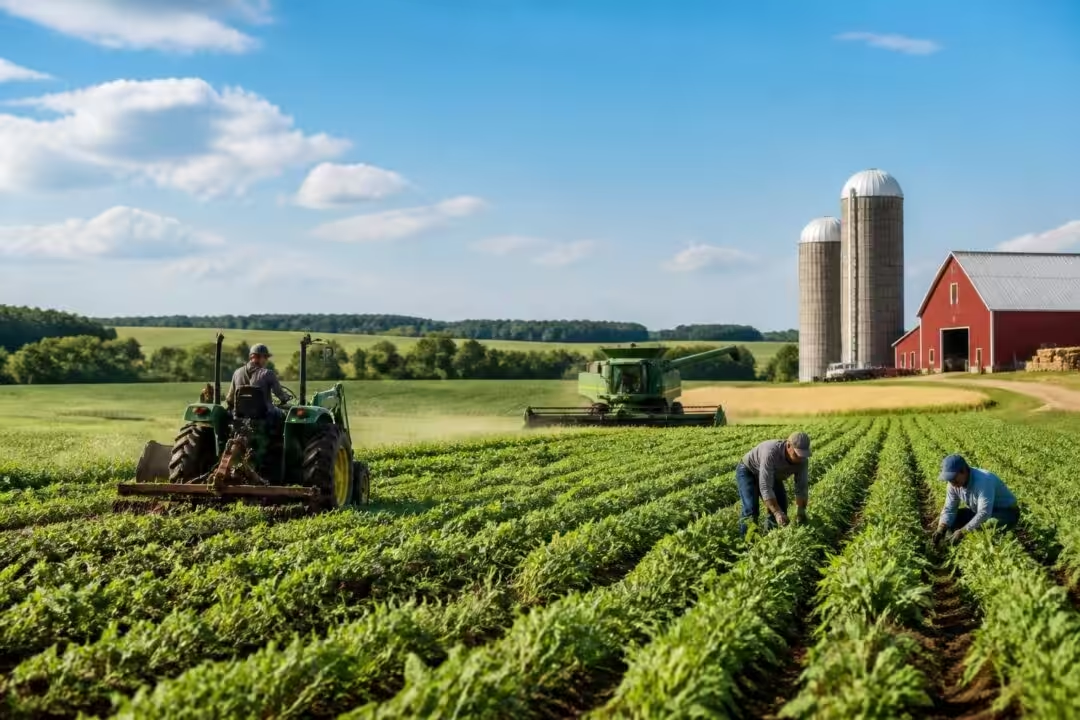
Governor Shapiro Secures Investment to Expand Plainville Farms, Retain Jobs
The commitment of nearly $6 million in Pennsylvania state support lands like a well-timed ingredient in a recipe that was at risk of failing: it stabilizes a legacy turkey operation in New Oxford while reinforcing the broader agricultural economy that depends on it. The package—built around a $5 million Pennsylvania Industrial Development Authority (PIDA) loan and a $1 million Pennsylvania First grant—was positioned to keep Plainville Farms operating, protect 690 full-time jobs, and maintain relationships with 93 independent family farms that raise turkeys for the facility. In practical terms, that means steady paychecks for plant workers, predictable contracts for growers, and continuity for a supply chain that reaches well beyond Adams County. ✅
In Pennsylvania, turkey production carries a cultural weight that feels as familiar as a holiday table, yet it is also a year-round industrial reality. Plainville Farms has been described as the largest producer of organic turkey products east of the Mississippi, a detail that matters because organic processing comes with specialized standards, audits, and customer expectations. When such a facility teeters, it is not only the local plant that shakes—truck routes, feed mills, cold storage schedules, packaging suppliers, and retailer commitments all feel the tremor. The state’s financing structure, therefore, is less a symbolic gesture and more a strategic intervention in a complicated system.
Officials framed the funding as a way to make The Wenger Group the lead investor in Plainville Farms, strengthening governance and ensuring a clearer path for ongoing operations. The Wenger Group is a family-owned, Lancaster-based agricultural organization with deep ties to Pennsylvania’s farm economy. The public framing emphasized continuity: keep the doors open, keep farms producing, keep vendors busy, keep the plant’s skill base intact. That last point matters because processing expertise is not instantly replaceable; it is trained over years, learned through repetition, and refined through safety culture.
A simple thought experiment shows the stakes. Imagine a maintenance technician—call him Marcus—who knows the plant’s chilling systems as intimately as a chef knows the difference between a gentle simmer and a rolling boil. If the plant closes, Marcus doesn’t just lose a job; the region loses a specialist. Reopening later would require rebuilding that knowledge, rehiring, retraining, and re-certifying equipment and processes. The cost of that restart is often higher than the cost of preventing a shutdown in the first place. That is the economic logic behind early intervention. 💡
The announcement also arrived with public attention from state leaders, underscoring that the investment is intended to be seen as an anchor for local confidence. Confidence is not fluffy economics; it affects whether farms take on the risk of raising flocks, whether vendors stock materials, and whether workers choose to stay in a demanding industry. With stability in view, the story naturally shifts from “Will it close?” to “How does it adapt?”—and that sets up the next essential angle: how the money and the ownership structure actually work in the real world.
$5 Million PIDA Loan + $1 Million Pennsylvania First Grant: How the Funding Works
It is tempting to treat public financing as a single check, but the Plainville Farms package is better understood as two distinct tools designed for different tasks. The PIDA loan portion—$5 million—functions like a structured, repayable backbone. Loans of this kind are typically aimed at industrial retention and modernization: equipment improvements, facility needs, and capital expenses that keep a plant competitive. The $1 million Pennsylvania First grant, by contrast, is non-repayable support meant to close a gap—often the gap that prevents a deal from penciling out quickly enough to avert a crisis. Together, they form a financing “braise”: low and steady heat from the loan, with a finishing boost from the grant to bring the whole plan together. 🍲
The state characterized the funding as helping make The Wenger Group the lead investor, which signals a governance and capitalization shift. The Wenger Group had already been involved in the ownership arc: in 2024, it acquired Plainville Farms from a private equity firm known as Regent, with the business operating under a broader investor umbrella, Farm Fresh Turkey Products. That investor group was described as including suppliers, growers, management, and other industry participants—an arrangement that can reflect a community trying to keep a core processor alive by sharing the load. By 2026, the state’s package reinforced a clearer center of gravity: a lead investor with agricultural roots and operational incentives aligned with long-term production.
Why does “lead investor” matter? Food manufacturing is full of decisions that require speed and clarity. When a refrigeration unit fails or when customer demand shifts from whole birds to ground products, the organization needs to authorize spending, alter production lines, and manage staffing without getting stuck in committee-style delays. A lead investor does not eliminate stakeholder voices, but it can streamline accountability—who decides, who pays, who benefits, and who is responsible if something goes wrong.
To ground this in something tangible, picture a hypothetical upgrade: installing more energy-efficient chillers to handle organic turkey volumes while meeting strict temperature controls. The PIDA loan can support that long-life equipment, while the Pennsylvania First grant can offset immediate transition costs such as contractor mobilization, engineering, or compliance documentation. The payoff is not just lower utility spend; it can also reduce downtime risk, improve food safety margins, and make staffing more predictable. Those are the unglamorous details that keep plants open.
Below is a simplified snapshot of the commitments and what they are intended to protect—shown as a practical map of impact rather than a political headline.
| Funding / Stakeholder | Amount | What It Helps Secure | Why It Matters |
|---|---|---|---|
| 🏦 PIDA Loan | $5,000,000 | Facility stability, capital needs, competitive operations | Supports long-term viability rather than short-term patchwork |
| 🎯 Pennsylvania First Grant | $1,000,000 | Closing financing gaps for retention and transition | Speeds up action when timing is critical |
| 👷 Jobs retained | 690 | Existing full-time roles at the plant | Protects household income and preserves specialized skills |
| 🚜 Family farms supported | 93 | Growers supplying turkeys to the facility | Maintains farm continuity and rural economic stability |
| 🚚 Vendor & logistics partners | 300+ | Packaging, trucking, cold storage, and services | Prevents a chain reaction of losses across the region |
The more revealing question is not “How big is the number?” but “How quickly can stability return?” When financing is structured to move decisively, it helps keep contracts intact and prevents talent from scattering. That sets the stage for the next layer: the supply chain that starts on farms and ends at a consumer’s plate.
Saving 690 Jobs in Adams County: What “Remaining Operational” Really Means
When officials say a facility will “remain operational,” it can sound like a simple binary: open or closed. In reality, operational continuity is a hundred moving parts working in rhythm—like a professional kitchen service where timing, sanitation, staffing, and deliveries must align. For Plainville Farms, the promise to keep the plant running protects 690 full-time jobs that represent multiple layers of skill: line workers trained in organic handling, quality assurance teams versed in audit readiness, mechanics keeping equipment safe, and logistics coordinators balancing inbound and outbound schedules.
Those jobs also form a social ecosystem. In a community like New Oxford, one worker’s shift schedule influences a spouse’s childcare needs, a local diner’s breakfast rush, and a school district’s enrollment stability. It is not sentimental to say that a plant anchors everyday life; it is simply how local economies operate when a single employer is large enough to shape routines. Keeping the facility open reduces the stress that often pushes experienced workers to leave the industry entirely.
State leaders announced the financing amid a visit to a Chambersburg turkey facility connected to Plainville Farms, with participation from the Department of Community and Economic Development and the Department of Agriculture. That detail matters because it underscores a broader footprint: the company’s operations and relationships are not confined to one address. The New Oxford complex—located on York Road—sits within a network that includes growers, transport corridors, and regional processing capacity. If one node collapses, the rest of the system has to scramble.
Consider a case-style scenario. A packaging supplier—call it Keystone Wrap & Print—runs custom labels for organic turkey products. Organic labeling standards are not negotiable; an error can trigger costly product holds or rework. If Plainville Farms stops ordering, Keystone must either lay off staff or pivot to less specialized work with lower margins. Meanwhile, the trucking partner that hauls refrigerated product loses predictable routes, which can shrink a fleet and reduce service availability for other food businesses. Multiply that dynamic across the 300+ vendor and logistics partners described as connected to Plainville Farms, and the ripple effect becomes obvious. 🌊
There is also a reputational layer. A plant that closes and reopens later may face skepticism from buyers who need reliable year-round supply. Retailers, distributors, and foodservice companies build menus and promotions months in advance. If a supplier becomes unreliable, those customers may lock in alternatives—even if the original plant returns. That is why continuity is often more valuable than a dramatic “comeback.” The state’s intervention is best understood as protecting reliability in a market that rewards consistency.
Plainville Farms’ CEO, Matt Goodson, publicly framed the moment around legacy and community impact—language that resonates because the region’s turkey tradition is both economic and cultural. Protecting “family-sustaining jobs” is not just about wages; it is about preserving the dignity of specialized work and the stability that allows people to plan their lives. The most important insight is that job retention here is not passive; it requires deliberate coordination of capital, leadership, and supply contracts, which leads directly to the farm-side story.
Supporting 93 Independent Family Farms: Strengthening Pennsylvania’s Organic Turkey Supply Chain
The headline number of 93 independent family farms is easy to skim past, yet it may be the most consequential figure in the entire announcement. Organic turkey production is not a plug-and-play commodity; it depends on long planning horizons, careful animal husbandry, certification discipline, and stable processing outlets. Without a dependable buyer like Plainville Farms, growers cannot simply reroute birds like parcels in a mail system. Turkeys have strict timelines, and processing capacity—especially organic-capable capacity—cannot be conjured overnight.
In practical terms, a farm raising turkeys for an organic program has likely invested in specific inputs and practices: verified feed sources, recordkeeping protocols, and sometimes facility changes that support animal welfare requirements. If the processing plant disappears, those investments become harder to recover. That’s why preserving the processor is also a farm preservation strategy. The state’s financing package, paired with the ownership stability under The Wenger Group’s leadership, effectively shores up the “last mile” for farm products: the point where livestock becomes saleable food.
To keep the story human-scale, imagine a grower family outside Adams County—call them the Millers—who budget the year around flock placements and processing dates. Their loan payments, equipment purchases, and seasonal labor needs tie back to whether the processor will take birds when promised. If a shutdown forces delays, the farm faces cascading costs: extra feed, overcrowding risk, and potential animal welfare problems. In a tough scenario, the farm may be forced out of organic production altogether, losing the premium pricing that justified the extra work. The processor’s stability, therefore, helps lock in the farm’s business model.
Organic turkey also rides on consumer trust. Shoppers paying more for organic products expect consistent standards and traceability. Maintaining that trust requires a chain of custody that is auditable from farm to facility to final packaging. When the state emphasizes that the project keeps Plainville Farms operational, it also implicitly supports that trust architecture: keeping the same certifications active, the same quality systems staffed, and the same supplier relationships documented.
The web extends beyond farms and into the broader “food region” identity of Pennsylvania. Agriculture and manufacturing have long powered the commonwealth’s economy, and state leaders have pointed to the importance of keeping those sectors competitive. In the broader context of 2026, when consumers are increasingly attentive to supply reliability and production ethics, maintaining a major organic turkey processor east of the Mississippi provides strategic positioning for Pennsylvania brands and retailers.
A list helps clarify what exactly is being protected across the farm-to-plant continuum:
- 🧾 Contract certainty for growers planning flocks months ahead
- 🌾 Organic compliance continuity through stable processing and audit readiness
- 🚛 Predictable logistics for live haul, refrigerated transport, and cold storage
- 🧰 Regional service businesses (equipment maintenance, sanitation suppliers, packaging)
- 🍽️ Customer trust tied to consistent quality and traceability
What makes this investment especially notable is that it treats agriculture as a system rather than a set of isolated businesses. Once that system is stabilized, the spotlight naturally moves to how ownership and leadership choices shape day-to-day decisions inside the plant and across the network of partners.
The Wenger Group Acquisition and BusinessPA Strategy: A Playbook for Keeping Plants Open
The Wenger Group’s role in Plainville Farms is a study in how local-rooted ownership can align with public economic development goals. This is a family-owned organization based in Lancaster, operating in a sector where long-term relationships are often more valuable than short-term financial engineering. In the Plainville Farms timeline, the company’s acquisition from a private equity owner in 2024 marked an early step toward stabilization, but the subsequent state-backed financing proposal sharpened the deal’s ability to keep the facility operating with confidence.
The state’s economic development framing—often associated with teams such as BusinessPA—leans on a recognizable principle: when a major employer is at risk, the public sector can act as a catalytic partner, not by running the company, but by improving the economics of retention. In return, the community retains jobs, the tax base remains steadier, and the supply chain avoids disruption. Critics sometimes question whether such tools “pick winners,” yet the counterargument is pragmatic: allowing a large processor to collapse can cost more in unemployment impacts and lost business activity than a carefully structured retention package.
From an operational standpoint, the combination of Wenger’s agricultural DNA and state financing can enable the unflashy investments that protect competitiveness. A turkey plant is a world of stainless steel, sanitation schedules, temperature controls, and strict timing. Small improvements—better line efficiency, safer material handling, upgraded cold storage coordination—can determine whether a facility earns or loses major customer contracts. The investment helps keep those improvement pathways open.
It also matters that Plainville Farms is not just any poultry operation; it holds a distinctive position in organic turkey production. That market segment tends to be less forgiving of inconsistency. Buyers expect documentation, and consumers expect the brand promise to be honored. A stable ownership structure can keep those systems funded and staffed. In the language of the food world, this is mise en place on a regional scale: having every element ready so service doesn’t collapse when pressure hits. 🔧
A useful way to understand the broader economic strategy is to track what the state says it is protecting: not only the direct workforce and farms, but also the 300+ vendor and logistics partners—many located in Pennsylvania. That suggests an intent to multiply the impact of each public dollar across secondary businesses that would otherwise lose revenue. When those partners stay active, they keep hiring, investing, and training, which improves resilience for other manufacturers as well.
To make this tangible, consider a hypothetical vendor coalition meeting in New Oxford after the financing announcement. A refrigeration contractor schedules preventative maintenance with more confidence. A trucking firm keeps drivers on stable routes rather than reallocating them out of state. A local community college continues promoting industrial maintenance programs because graduates will still have a place to work. These are not dramatic headlines, but they are exactly how regional economies avoid slow decline.
The key insight is that the Plainville Farms package works best when viewed as a coordinated menu of actions—ownership clarity, targeted capital support, and supply chain reassurance—designed to keep a critical food-manufacturing asset viable in a competitive era.
Hi, I’m Landon Brooks. I am the editor-in-chief of Cook and Design, but for the first decade of my working life I was actually a product designer in New York.
6 Comments
That funding adds the right weight to the baseline, Landon. Nice.
Smart infrastructure investment that stabilizes the rural supply chain and protects livelihoods.
Smart money targets the system, not just the site. When the supply chain stays whole, communities stay whole.
Smart investment for regional resilience—protecting jobs and supply chains is infrastructure too.
This investment keeps the voltage stable across the entire agricultural network.
Nice piece, Landon. Interesting how financial scaffolding can hold up a regional supply chain better than any physical structure.
Les commentaires sont fermes.