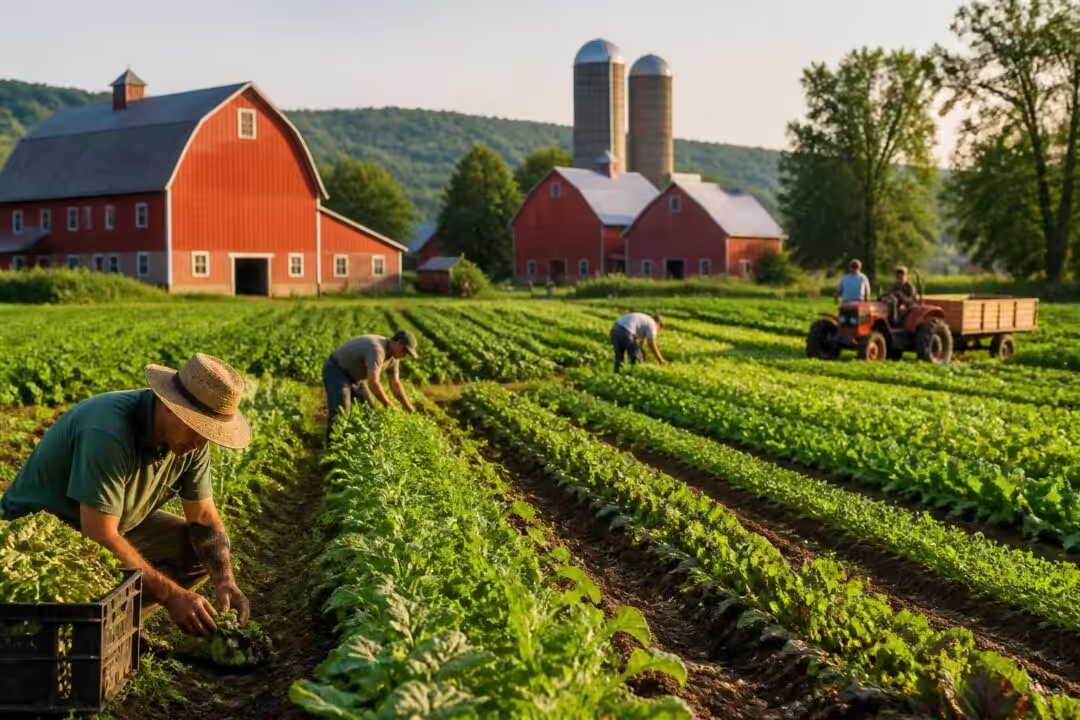
Securing Jobs and Growth in Adams County: How $6 Million Keeps Plainville Farms Operating
In a borough the size of New Oxford, a single processing facility can feel less like “a plant” and more like a heartbeat. When state officials confirmed that nearly $6 million in public financing would be used to keep Plainville Farms running, the number wasn’t just budget math—it translated into shifts that continue on Monday mornings, paychecks that still land on Fridays, and barns that don’t go dark. The package combines a $5 million loan through the Pennsylvania Industrial Development Authority (PIDA) with a $1 million Pennsylvania First grant, supporting an ownership structure that positions The Wenger Group as lead investor. ✅
The aim is practical: prevent a closure that would have rippled outward across Adams County and beyond. In the state’s framing, the project preserves 690 full-time jobs, protects relationships with 93 independent family farms supplying turkeys, and stabilizes a network of 300+ vendor and logistics partners—from refrigerated carriers and packaging firms to sanitation services and maintenance crews. In food manufacturing, those “supporting” partners often determine whether a facility can operate smoothly or becomes a constant scramble for parts, drivers, and compliant materials.
There is also a strategic layer. Plainville Farms is frequently described as the largest producer of organic turkey products east of the Mississippi. That matters because organic meat supply chains are narrower and more fragile than conventional ones, requiring specialized feed sources, certification practices, animal welfare standards, and dedicated processing lines. If a large organic processor stalls, the market doesn’t automatically absorb the volume; instead, farmers can be stranded mid-cycle, and retailers face empty shelves during peak demand periods like Thanksgiving and winter holidays. 🦃
To make the stakes more tangible, consider a familiar thread in rural communities: a hypothetical grower family outside New Oxford that has raised poultry for decades. Their business model relies on predictable placement schedules, stable pickup times, and clear quality specs. A shutdown would force them to either pivot to a different buyer—if one exists—or exit altogether. That’s why a preservation investment isn’t merely “keeping a building open.” It keeps a rhythm of work intact, from hatchery coordination to feed delivery routes to processing-line staffing.
The state announcement arrived during a visit by senior officials to a Chambersburg turkey facility connected to Plainville Farms’ footprint, highlighting that the supply chain and workforce extend beyond a single zip code. The message was consistent: public financing can serve as a bridge when a viable company needs capital certainty to reorganize ownership and operations. The next section looks closely at how the loan-and-grant design works—and why that structure is built for accountability rather than headlines.
$5 Million PIDA Loan + $1 Million Pennsylvania First Grant: The Financial Mechanics Behind Plainville Farms Preservation
A mixed package—part loan, part grant—signals two separate goals: provide affordable capital while requiring performance. The PIDA loan functions like patient financing meant to support industrial and agricultural development where private capital may be cautious. By contrast, the Pennsylvania First grant is typically designed to catalyze a project with public-benefit outcomes like job retention, facility upgrades, or competitiveness improvements. Put together, the package reduces immediate pressure on cash flow while encouraging long-term stability. 💼
The practical effect is that The Wenger Group, a family-owned agricultural organization based in Lancaster, can anchor the investment plan and be treated as a lead investor in Plainville Farms. This matters because food processing is capital intensive: equipment maintenance, refrigeration systems, wastewater management, food-safety monitoring, and workforce training create costs that don’t pause during ownership changes. If a transition is underfunded, the facility may drift into deferred maintenance, higher downtime, and eventually lost contracts.
Although the package is described broadly as supporting continued operation, it is helpful to think about what “continued” means in a plant setting. It means overtime is planned rather than improvised. It means spare parts are stocked instead of ordered in panic. It means quality assurance teams can run routine verification rather than triage. It also means vendors can extend standard terms because they trust the buyer will be there next month. Those are not abstract concepts; they are the day-to-day knobs that decide whether production stays steady.
Where the money shows up on the floor: operations, compliance, and throughput
When a facility is known for organic production, compliance is not optional. Certification, segregation of product streams, and traceability systems require disciplined processes and frequent documentation. A stable financing plan supports predictable staffing in areas that are often understaffed during transitions: sanitation, lab testing, preventive maintenance, and logistics scheduling. 🧪
For a chef-minded reader, there’s a culinary parallel: a restaurant cannot serve a consistent menu without a dependable prep team, stable suppliers, and working cold storage. A turkey plant scales that reality into thousands of moving parts. If refrigeration falters or sanitation schedules slip, the consequences can be immediate—reduced output, product holds, or lost customer trust. A loan-and-grant structure helps prevent those “one bad week” moments that can spiral into long-term damage.
Even the choice to emphasize job retention (rather than only job creation) reflects how communities actually function. retained employment stabilizes housing, keeps schools funded, and supports local businesses that depend on predictable spending. The financing is therefore also a bet on economic continuity: less disruption, less outmigration, more confidence among small contractors who rely on plant-related work.
With the mechanics clear, the next angle is human: what 690 jobs truly represent in a rural manufacturing corridor, and why policy makers increasingly treat food processing as critical infrastructure rather than a background industry.
For additional context on state economic development tools and plant retention strategies, readers often look up public briefings and interviews featuring Pennsylvania’s business development programs.
Saving 690 Full-Time Jobs: Workforce Stability, Skills, and Community Spillover Effects
The number 690 can sound like a statistic until it’s translated into roles: line operators, maintenance technicians, quality assurance specialists, shipping coordinators, wastewater system operators, supervisors, and safety trainers. In a facility tied to organic products, additional expertise often sits in labeling, segregation protocols, and documentation practices. When state leaders describe the investment as preserving jobs, they are also preserving a specialized skills ecosystem that cannot be rebuilt overnight. 👷♀️
Manufacturing work in food processing has changed dramatically over the last decade. Plants now rely more on digital temperature monitoring, traceability systems, automated packaging, and data-driven preventive maintenance. That creates a workforce that is part hands-on, part technical—exactly the kind of “middle-skill” employment many regions struggle to maintain. Losing such jobs can hollow out a community’s ladder of opportunity, especially for workers who do not want to relocate to larger metro areas.
What job preservation means beyond the plant gates
A stable payroll supports secondary spending: grocery stores, mechanics, childcare providers, diners, and hardware shops. It also stabilizes municipal tax revenue, which influences everything from road maintenance to emergency services. When a large employer disappears, the first wave is layoffs; the second wave is quieter—small storefront closures, reduced school enrollment, and families delaying major purchases.
To illustrate, consider a fictional logistics dispatcher—someone who coordinates refrigerated truck pickups across multiple counties. If a plant closes, that dispatcher may not simply “transfer.” The routes vanish, the relationships with drivers disappear, and a regional carrier can downsize. In turn, the local shop that services those tractors sees fewer appointments. The economic chain is long, and it bends quickly when a hub is removed. 🚚
There is also a morale dimension that public announcements rarely capture. When a facility is rumored to be closing, employees stop making long-term plans: apprenticeships are postponed, home repairs are delayed, and younger workers begin searching elsewhere. A credible investment package, especially one backed by the state, can reverse that psychology. It tells workers and vendors that it’s reasonable to commit to the next year—training schedules, equipment orders, even a lease renewal.
Importantly, the funding is not described as a blank check. The public framing emphasizes outcomes—keeping the facility operational and retaining jobs—implying a focus on measurable community benefit. That is a crucial distinction in 2026 debates about economic development: residents want to know not only that money was spent, but that it anchored a durable plan.
The next section moves upstream to the farms. Because without the 93 independent family operations that supply turkeys, even the most modern processing lines sit idle—and a regional food identity disappears with them.
Protecting 93 Independent Family Farms: Organic Turkey Supply Chains and Rural Resilience
Preserving 93 independent family farms is not just an agricultural talking point; it is an economic strategy. Family growers operate on thin margins and long planning cycles. They commit to feed contracts, biosecurity upgrades, and animal welfare requirements months before birds reach market weight. If a processor disappears, the farm cannot simply “hold inventory” the way a factory might store parts. Animals keep growing, costs keep accruing, and the options narrow quickly. 🌾
Organic turkey production adds layers of complexity. Inputs must meet certification standards, recordkeeping must be meticulous, and transitions between buyers can be difficult because each processor may have distinct protocols. That’s why Plainville Farms’ role as a major organic producer east of the Mississippi is so significant: it is a cornerstone for a specific kind of farming that values premium practices and traceable outcomes.
How processing capacity shapes farm decisions
Farmers make infrastructure choices based on confidence. A stable processor relationship can justify investments in improved ventilation, bedding systems, water filtration, and training for animal health monitoring. When the processor is uncertain, farms hesitate to modernize. The $6 million state-backed financing, by helping keep operations steady, indirectly influences whether farms continue upgrading or retreat to survival mode.
There is a culinary implication as well. Organic turkey is often purchased by consumers who care about ingredient integrity and production values. If supply chains break, shoppers may substitute with conventional options, and organic producers lose shelf space that is hard to win back. For food businesses—restaurants, meal-kit services, specialty grocers—consistent supply determines whether organic turkey appears on menus beyond the holiday rush.
To keep the perspective grounded, here is a practical list of what farm preservation often safeguards when a processing hub remains stable:
- 🧾 Predictable contracts that allow families to plan feed, staffing, and barn cycles without constant renegotiation.
- 🚜 Local service economies (equipment repair, bedding suppliers, electricians, veterinarians) tied to ongoing poultry activity.
- 🛡️ Biosecurity consistency because stable pickup schedules reduce last-minute changes that can increase disease risk.
- 📦 Certified organic continuity since shifting to a new buyer can require new documentation processes and audits.
- 🏘️ Intergenerational viability—the difference between a next generation taking over or leaving the farm behind.
Farm preservation also connects to land stewardship. When farms remain profitable, they are less pressured to sell acreage for non-agricultural development. In Pennsylvania’s mixed landscape of small towns and expanding suburbs, that stabilizing effect matters for water management, wildlife corridors, and the continued presence of working lands.
From farms, the view naturally shifts to the broader commercial web: vendors, drivers, cold storage, packaging suppliers, and sanitation crews. The next section maps that network and explains why 300+ partners are a major part of the story—not a footnote.
Strengthening 300+ Vendor and Logistics Partners: The Hidden Infrastructure Behind Plainville Farms
When officials cite over 300 vendor and logistics partners, they are describing the invisible scaffolding that makes a food system function. In poultry processing, a facility does not operate in isolation. It depends on packaging suppliers, label printers, chemical and sanitation vendors, maintenance contractors, refrigeration technicians, wastewater treatment support, uniform services, and a rotating cast of transport providers handling live haul and finished product. 🔧
These partners are not interchangeable. Cold-chain logistics, in particular, relies on specialized equipment and strict timing. A delayed pickup can trigger storage constraints, and storage constraints can throttle production. In that sense, supporting Plainville Farms is also supporting the regional “clockwork” of scheduled routes, loading dock appointments, and refrigerated warehouse capacity.
A clear snapshot of the preservation package and who benefits
| Element 🧩 | What it is 💰 | What it stabilizes ✅ |
|---|---|---|
| PIDA Loan 🏭 | $5 million financing tool for industrial development | Facility continuity, capital needs during ownership transition, operational reliability |
| Pennsylvania First Grant 🎯 | $1 million targeted state grant | Job retention focus, project feasibility, faster stabilization for long-term planning |
| Workforce 👥 | 690 full-time jobs retained | Household income, training pathways, regional spending and tax base |
| Farms 🌾 | 93 independent family farms supported | Growing cycles, organic compliance continuity, local agricultural resilience |
| Partners 🚚 | 300+ vendors/logistics firms connected | Cold chain reliability, packaging supply, maintenance services, shipping capacity |
The table clarifies why the story is bigger than a single check. The project reinforces a system where each component depends on the others. A packaging supplier that loses a major customer may reduce shifts; a carrier that loses routes may park trailers; a maintenance contractor may stop stocking parts specific to a plant’s equipment. Over time, those losses make it harder for any future processor to operate in the region because the local support ecosystem has been weakened.
There’s also a competitiveness dimension. Organic products often require distinct packaging runs and careful labeling. If those services are local and stable, the facility can respond faster to retailer needs—seasonal promotions, new SKUs, or changes in consumer preference. That agility can determine whether a brand keeps shelf space in a crowded market.
All of this ties back to the ownership story. The financing supports an arrangement in which The Wenger Group can be the lead investor, reducing uncertainty and enabling partners to plan with confidence. Next comes the timeline and context of how Plainville Farms moved from private equity ownership into a structure led by an agricultural family enterprise—and why that shift matters to long-term preservation.
The Wenger Group and Plainville Farms Ownership Shift: From Private Equity to a Family-Owned Lead Investor
Ownership structures shape business decisions in subtle ways: how aggressively to invest, how to handle downturns, and how deeply to commit to a region. Plainville Farms’ recent history includes a shift away from a private equity owner. The company was acquired from Regent in 2024, with Plainville Farms operating under an investor-led framework known as Farm Fresh Turkey Products. That investor group was described as including suppliers, growers, management, and other industry participants, with The Wenger Group in a leading role even then.
By the time the state-backed financing package was announced, the goal was to make The Wenger Group the lead investor in a way that strengthens operational continuity. Family-owned agricultural organizations often emphasize long-term relationships—especially with growers—because their reputations are built over generations rather than fund cycles. That does not automatically make them perfect stewards, but it can align incentives toward stability, consistent plant investment, and careful handling of supplier networks. 🤝
Why this ownership narrative matters for preservation
In food processing, uncertainty is expensive. Retailers and food-service buyers demand reliability; they do not want to renegotiate supply every quarter. An ownership transition can prompt customers to hedge, placing smaller orders or shifting to alternative brands. When a lead investor with deep agricultural roots is clearly identified—and supported by a concrete financing package—it sends a signal to the market that continuity is the plan, not a temporary patch.
There is also an internal culture element. Plant employees notice when ownership is distant or frequently changing. They notice whether training budgets are trimmed, whether maintenance is delayed, and whether safety upgrades are prioritized. A stable lead investor, paired with public financing designed to keep the facility operating, can reinforce an internal message: keep sharpening skills, keep focusing on quality, keep building a future here. ⭐
State officials underscored the broader economic development context by highlighting how targeted projects can protect legacy industries—agriculture and manufacturing—that have powered Pennsylvania for generations. The announcement was echoed through public channels and reinforced during on-site visits by leaders including DCED Secretary Rick Siger and Agriculture Secretary Russell Redding, signaling that the deal is being treated as more than routine paperwork.
Plainville Farms leadership also framed the moment around continuity and legacy. CEO Matt Goodson emphasized Pennsylvania’s long history in turkey production and described the investment as a way to keep team members working, keep independent farmers producing, and keep communities connected to a regional food identity. That combination—public financing, a committed lead investor, and an explicit focus on jobs and farms—creates a sturdier foundation than any single element could provide alone. The next phase of the story is how that foundation can translate into practical improvements that consumers, workers, and growers can all feel in everyday life.
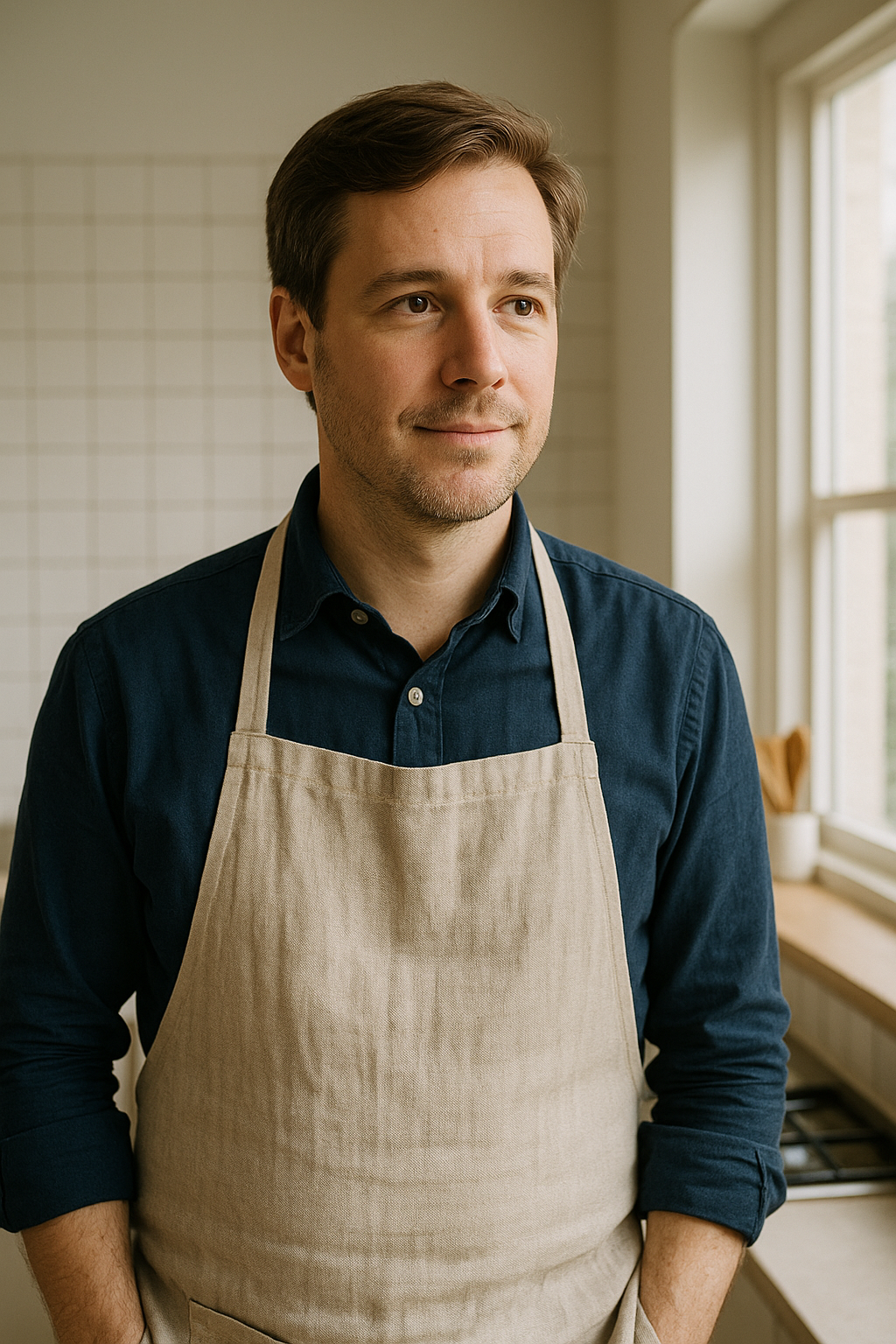
Hi, I’m Landon Brooks. I am the editor-in-chief of Cook and Design, but for the first decade of my working life I was actually a product designer in New York.