
Man Uncovers Surprisingly Simple Method to Make Money Locally: The Farmers’ Market “Small Batch Treat” Playbook
At summer farmers markets, the biggest crowds rarely form around raw produce alone. They gather around ready-to-eat items—snacks that feel festive, photograph well, and can be eaten while strolling. That observation is exactly what pushed one local money-making method into the spotlight: a specialty treat stand that turns simple ingredients into a fast-moving product people happily buy on impulse 🍓.
A video circulating on X amplified this idea after a creator visited an Idaho farmers market and claimed a chocolate-covered strawberry vendor was pulling in several thousand dollars per market day with only a few hundred dollars in startup costs. The numbers became the headline, but the more useful detail was the mechanism: a simple, repeatable, local micro-business that thrives on foot traffic, presentation, and a product that feels “special” even when it’s made from familiar ingredients.
To keep the idea concrete, imagine a fictional pair of former restaurant workers—Tessa and Marco—who wanted out of unpredictable shifts but didn’t have the cash (or patience) to build a full food brand. They choose a market stand because it has one powerful feature: customers are already there. They don’t need to “create demand” from scratch; they just need to capture attention and convert it into a purchase.
Why chocolate-covered strawberries became the poster child 🍫
The product checks every box a market snack should. It’s portable, it’s visually striking, and it signals indulgence without requiring a sit-down meal. Even better, it supports flavor creativity—dark chocolate with sea salt, white chocolate with citrus zest, chili-lime dusting—without drastically changing the underlying cost.
That “tiny twist” approach is straight from the kitchen mindset: take an ingredient people already trust and add a signature note. a farmers market is full of shoppers who love novelty, but they still want low-risk choices. Chocolate strawberries are familiar; a “strawberry flight” of three coatings makes it feel new.
The real business model: speed + consistency + story
market success depends on moving a lot of units in a short window. A stand that sells hundreds of servings in a day isn’t relying on one big spender; it’s winning on repetition. The operational secret is not complicated: build a workflow that produces consistent quality and keeps the line moving ⏱️.
Then add a story customers can repeat: “These are made in small batches,” “seasonal berries,” “three signature flavors,” or “local fundraiser day.” People enjoy buying something they can talk about while they eat it.
The next section shifts from the concept to the math and practical setup—because a simple method only stays simple when the numbers are understood.
Make Money Locally With Farmers Markets: Practical Startup Costs, Pricing, and Profit Math That Actually Works
The viral claim centered on big daily revenue, but a grounded approach focuses on unit economics: what it costs to produce one serving, what it sells for, and how many servings can be made and sold within market hours. When those three pieces line up, a local stand can become a reliable weekend income stream 💵.
Consider a realistic “serving” as a cup or tray with a set number of dipped berries, or a skewer bundle. Pricing varies by region, but the logic doesn’t: customers pay for convenience + experience + presentation. That’s why a product made from simple inputs can still command a premium in the right setting.
A simple profit framework (with realistic assumptions)
If a vendor sells around 400 servings in a day—as stated in the market story—that’s a volume that can produce significant top-line revenue even at moderate prices. The key is keeping food cost controlled and minimizing waste.
It also helps to think like a caterer: ingredients are only part of cost. Packaging, napkins, gloves, signage, market fees, and a backup cooler all matter. Still, compared with opening a shop, a market stand remains one of the lowest-barrier ways to test a local food idea.
| Metric 📌 | Lean Setup 🧾 | More Polished Setup ✨ |
|---|---|---|
| Upfront tools 🧰 | Basic dipping tools, containers, cooler | Extra coolers, display risers, branded signage |
| Typical startup range 💳 | $150–$300 | $400–$900 |
| Price per serving 🍓 | $6–$8 | $8–$12 |
| Estimated food + packaging cost 📦 | 30–45% of price | 25–40% of price |
| What drives profit 🚀 | High volume, fast service | Higher perceived value, repeat buyers |
Those ranges aren’t a promise; they are a planning tool. A vendor who prices too low will get “busy but broke.” A vendor who prices too high might slow the line and lose the impulse buyer. The sweet spot is where customers don’t overthink it.
A checklist that keeps the method “surprisingly simple” ✅
- 🍓 Use one hero product with 3–5 flavor variations (not 20 choices that slow service).
- 🧊 Protect quality with cold-chain basics: ice packs, lids, shade, and a backup cooler.
- 📸 Build a display that sells for you: a sample board, clean labels, and a visible “best-seller.”
- ⏱️ Pre-prep the slow steps at home, finish fast at the market to maintain freshness.
- 💰 Accept tap-to-pay; impulse purchases spike when checkout is frictionless.
One detail from the online debate deserves attention: some commenters criticized vendors for buying berries from a supermarket and reselling them. That criticism fades when the business clearly adds value—through coating, flavoring, food safety handling, packaging, and a consistent eating experience. Shoppers are paying for the transformation, not the raw fruit.
Once the economics are clear, the next challenge is execution: how to run a stand smoothly, safely, and in a way that builds repeat local demand.
Seeing the workflow in action helps, especially for first-timers deciding how to prep and serve efficiently.
Anyone Can Do It Locally: Operations, Food Safety, and Speed Systems That Keep Lines Moving
Making money locally with a market stand is less about culinary complexity and more about repeatable systems. The public sees a charming treat; behind the table, the job is production planning, temperature control, and customer flow. The good news is that these are learnable skills, especially for people coming from restaurants or anyone willing to practice at home.
In the Idaho market story, the vendor described selling hundreds of servings in a day. That only happens when the stand avoids bottlenecks. If one step takes too long—dipping each berry individually to order, for example—sales collapse during peak foot traffic.
How a two-person team can run like a small kitchen brigade 👩🍳👨🍳
A smart layout assigns roles. One person handles finishing and presentation (the “plating station”), while the other manages payments, restocking, and customer questions. When the rush hits, that split prevents the common mistake of both people trying to do everything at once.
Tessa and Marco, the fictional duo, adopt a “batch rhythm”: pre-dip at home, set in chilled trays, then add final drizzles or toppings on-site. Customers still feel like the item is freshly made, but the stand keeps pace.
Food safety and permits without the overwhelm 🧼
Markets often have rules on sampling, handwashing setups, ingredient sourcing, and temperature control. The simplest way to stay compliant is to treat the stand like a mini catering event: gloves when needed, sanitizer accessible, and ingredients stored properly. Clear labeling also matters, especially for allergens like nuts or dairy.
This is where professionalism becomes part of the brand. A clean table, tidy trash system, and consistent packaging quietly signal trust. In a crowded market, trust is what makes a new buyer choose one stand over another.
Handling the “repackaging” critique with value-based positioning
Online debates about “repackaging” miss how most food businesses operate. Restaurants don’t grow their own wheat; they buy flour and transform it. A market vendor can do the same ethically by being transparent and focusing on the craft: flavor development, consistent coatings, attractive presentation, and reliable service.
Even when ingredients come from a grocery store, the real product is the experience. The method becomes truly powerful when vendors buy from local farms, because that strengthens the story and supports the market ecosystem—but it isn’t mandatory to start.
The next section expands beyond strawberries to other local income options that borrow the same formula: low barrier, high foot traffic, and clear value-add.
Surprisingly Simple Local Side Hustles Like the Viral Market Stand (Beyond Strawberries)
The method that made the video so compelling wasn’t only “sell chocolate strawberries.” It was the broader pattern: find a place where people already gather, offer a product or service that removes friction, and make it easy to buy. That template applies to many neighborhood side hustles—some food-based, others service-driven.
Farmers markets are just one type of high-intent environment. Community festivals, youth sports tournaments, craft fairs, and even busy parking lots near popular parks can operate similarly (with permissions). The principle remains: local demand concentrates in predictable windows, and a prepared seller can capture it.
Food and beverage spins that fit the same playbook ☕
Many “small batch” items share the same advantages as chocolate strawberries: they are quick to serve, visually appealing, and feel like a treat. For example, a chilled lemonade stand with seasonal syrups can outperform expectations when it offers something memorable, like basil-citrus or strawberry-hibiscus. The ingredients stay simple; the perceived value rises.
Another proven option is mini dessert boxes—brownie bites, cookie assortments, or pie slices—especially when the stand partners with a local baker. In the Idaho discussion, commenters mentioned a pie vendor as a must-try; that’s a reminder that signature items become part of a market’s identity.
Non-food local income ideas that work for “anyone” 🧩
Not everyone wants to handle food rules, and that’s fine. Many neighborhood hustles require little more than reliability and a clear offer. The best ones are “painkiller” services—tasks people don’t want to do but will happily pay to avoid.
- 🧹 Yard cleanup packages (one-time “reset” visits sell better than hourly vague help).
- 🐶 Pet waste removal subscriptions (un-glamorous, high repeat potential).
- 🪛 Simple home assembly (furniture builds, shelf installs, basic repairs).
- 🚗 Local errand running for seniors (pharmacy pickup, grocery drop-off).
- 📦 Selling used items on consignment for neighbors (take a percentage, handle listings).
These mirror the strawberry stand’s advantage: they are straightforward, locally marketable on community boards, and easy to start without a massive audience. Platforms like neighborhood apps, community bulletin boards, and local coffee shops can be surprisingly effective because they reach the exact people who want local help.
Turning a weekend hustle into a repeatable local brand
What separates a quick cash grab from a real income stream is repeatability. A market vendor who appears every Saturday becomes familiar. A yard-service operator who returns every month becomes trusted. The “simple method” works best when it’s treated like a routine: consistent schedule, consistent offer, and consistent quality.
Next comes the promotional layer—how a single video, a simple post, or a neighbor recommendation can create the kind of momentum that pushes a small local idea into steady demand.
Learning how vendors attract lines—without gimmicks—can be easier by watching real market sellers explain their signage and sampling tactics.
Local Marketing That Makes Money Fast: Foot Traffic, Community Hype, and the “Full Circle” Social Media Effect
The most striking detail in the viral story wasn’t only the revenue claim. It was the “full circle” moment: a creator shared an idea online, and later met vendors who said that content nudged them to leave restaurant work and start the stand. That’s a powerful reminder that local businesses don’t need national advertising; they need localized attention that converts quickly.
In 2026, people still discover neighborhood businesses the old way—walking by, smelling something good, seeing a line. But they also validate purchases instantly by searching the stand name, scanning a QR code, or checking a tagged location. A smart local seller designs for both worlds: the physical booth draws people in, while social content makes the purchase feel “confirmed” ✅.
Foot-traffic marketing: the underrated skill that prints sales 🧠
A market stand is live theater. Customers decide within seconds whether to stop. Visual cues do most of the work: a clean sign with prices, a short flavor list, and an obvious “best seller” label. When the menu is too long, shoppers hesitate; hesitation kills impulse buying.
Sampling can help, but it must be controlled. The goal is not to feed people for free—it’s to remove doubt. A tiny sample plus a strong aroma or visual is often enough to trigger a purchase.
Community proof: why locals trust locals
When someone comments “That market is amazing—don’t miss the pie stand,” it functions like a friend’s recommendation. That kind of community proof is gold. Vendors can encourage it by asking satisfied customers to tag the location, or by partnering with neighboring booths for cross-shoutouts.
Even a simple chalkboard that says “Tag us to be featured” can generate a steady stream of local posts. Those posts don’t need to go viral; they only need to reach people within driving distance.
A practical content approach that doesn’t require being an influencer 📱
Many people avoid social media marketing because it feels performative. The workaround is to post like a craftsperson: short clips of dipping, toppings, packaging, and the finished product lined up. Food content is inherently watchable, and it communicates cleanliness and care.
For Tessa and Marco, the fictional duo, the best-performing post isn’t a speech. It’s a 12-second clip: berries lined up, chocolate drizzle, a sprinkle of citrus zest, then the menu board with prices. The caption is simple: “Saturday market, 9–1, limited batches.” Scarcity isn’t hype; it’s operational truth.
Keeping the method ethical and sustainable
The “repackaging” debate is useful when it pushes vendors toward clearer value-add. The most sustainable local sellers do three things: they price fairly, they stay transparent, and they reinvest into better sourcing as sales grow. That can mean switching to local berries in peak season or upgrading packaging to reduce mess and improve presentation.
When a stand offers consistent quality and a pleasant experience, the community stops arguing about where the strawberries came from and starts asking one question instead: “Are they back next weekend?” That question is the clearest sign the simple method is working.
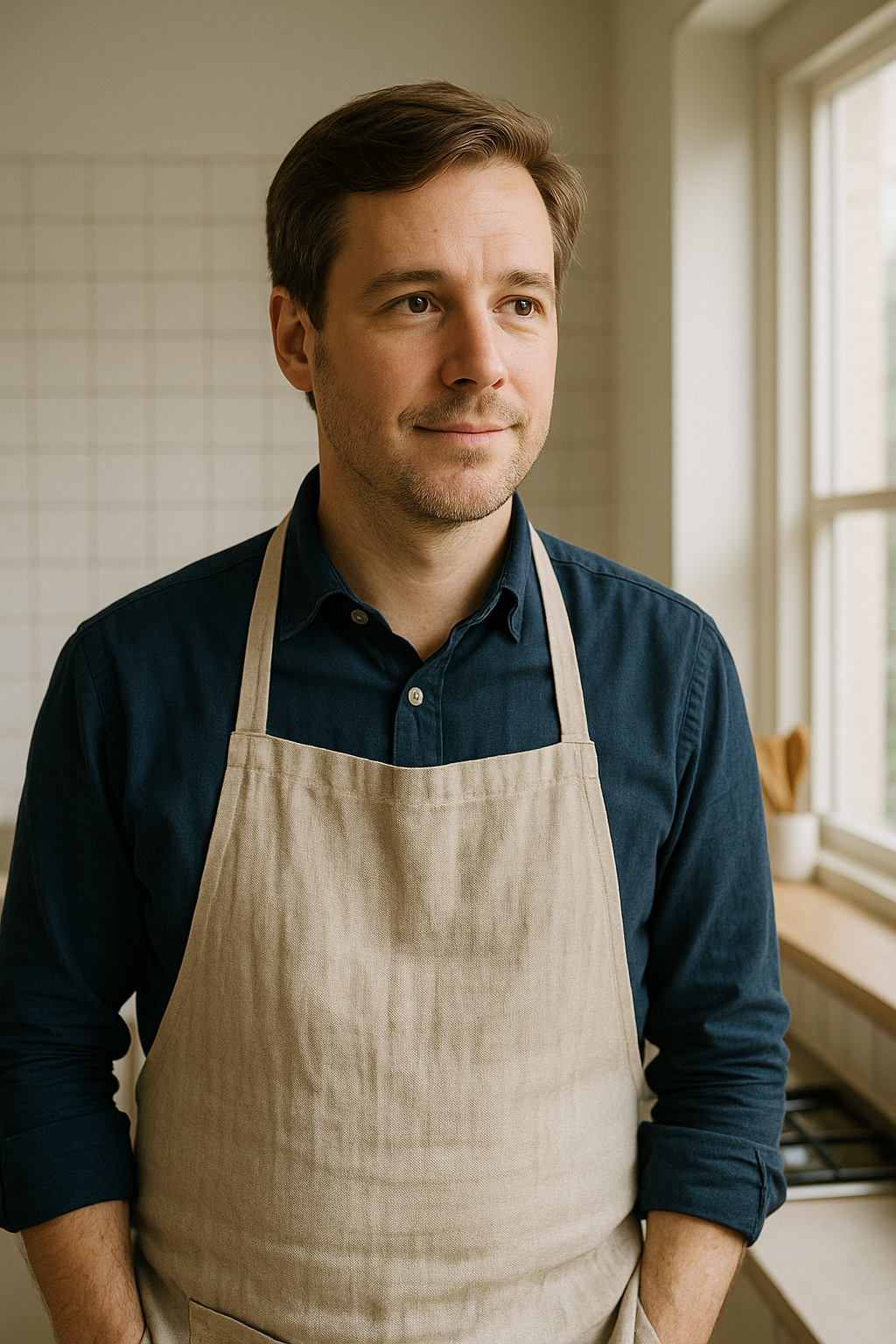
Hi, I’m Landon Brooks. I am the editor-in-chief of Cook and Design, but for the first decade of my working life I was actually a product designer in New York.