
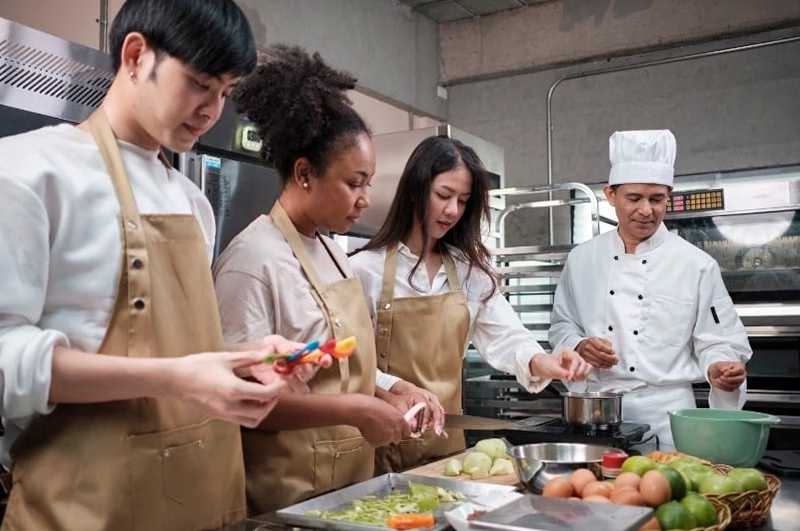
When companies ask why people come into the office, the answer often lives in the pantry. A new survey of 1,000 U.S. workers from ezCater suggests that food has moved from a nice-to-have to a genuine lever for retention and a better office experience. Yet nearly half of employees who shifted from remote to hybrid or fully on-site roles say they received no new perks when those requirements arrived. That mismatch is becoming a quiet risk for employers.
Why Food Benefits Have Become a Retention Cornerstone
The numbers tell a clear story: 47% of workers who moved back to the workplace report that no new incentives accompanied the return-to-office mandate. And 27% of those returning employees say they are more likely to search for a new job if nothing is offered. In a tight labor market, that feels less like a complaint and more like a warning.
Food benefits, specifically, rank as the second most-cited incentive that would bring employees back on-site, trailing only flexible hours and beating generous vacation time. That preference is not trivial. For employers looking to rebuild a strong work environment without rewriting the entire compensation package, a thoughtful food program delivers outsized impact.
Which perks move the needle most for employees?
- 🗓️ Flexible work hours — the top request, giving people control over their day.
- 🍎 Daily or weekly meals — expected by 66% of workers as a recurring benefit.
- 🏖️ Generous vacation time — valuable, but trailing behind food in the ezCater data.
- 🏢 On-site wellness amenities — health-focused perks that gained traction after 2020.
Food also happens to be the most visible perk. A stocked kitchen, a weekly catered lunch, or a bowl of fresh fruit signals that leadership is paying attention to daily comfort, not just quarterly goals.
The Generational Push for Workplace Food
Younger employees are adding pressure. Almost half of hybrid and remote Gen Z workers say food perks would make them more likely to come on-site, a significantly higher share than older generations. For companies building a long-term talent pipeline, ignoring that preference means designing an office experience for the past.
Erin Mittelstaedt, CEO of The FruitGuys, which provides farm-fresh produce to workplaces, sees this shift up close. “COVID really upped the ante of bringing more wellness-focused perks into the office,” she said. “One, because people were worried about health, and two, people wanted to have reasons to make the workplace more enticing and bring people back into the office.”
The result is a work environment where fruit bowls and snack pantries have replaced the water cooler as gathering points. That might sound small, but the cumulative effect on team morale is significant.
How Food Builds Workplace Culture and Employee Engagement
Food operations are community operations. When people line up for a shared meal or reach for the same box of clementines, they interact in a way that no Slack channel can replicate. The ezCater data reinforces this: nearly 70% of employees say socializing with coworkers in the office makes them more productive, and the same share says social time makes them more likely to stay at a company longer.
That connection between food and employee engagement is why companies like The FruitGuys describe their service in relational terms. As Mittelstaedt put it, “Instead of gathering around the water cooler, they’re gathering around the snacks in the pantry, and it’s fostering communication.”
This is not just about keeping people fed. It is about creating moments where colleagues actually talk to each other, which strengthens employee satisfaction and the broader workplace culture. A break room with a well-chosen spread is a low-cost, high-frequency touchpoint.
The Design of a Meaningful Food Program
From a design perspective, the best office food programs feel intentional rather than scattered. That means paying attention to rhythm — daily coffee, weekly catered meals, monthly seasonal offerings. It also means considering the aesthetics: how the food is presented, where it is placed, and how it aligns with the company’s visual culture.
In 2026, employees are no longer impressed by a bin of granola bars. They respond to quality, freshness, and a sense that someone thought about their day. A fruit program with rotating seasonal selections, for example, shows more care than a static candy drawer.
Food as a Signal of Care in the Office Experience
Employers who bring people back without recalibrating the office experience leave connection on the table. The ezCater report frames food perks as part of a broader relationship between companies and employees. When artificial intelligence and productivity tools dominate the conversation, food remains an irreplaceable anchor for human interaction.
The message for facilities and HR leaders is straightforward: food benefits are no longer a nice extra. They are a measurable tool for retention, employee engagement, and a positive work environment. Companies that understand this will find that a well-fed team is more inclined to show up, engage, and stay.
So before revising the remote policy again, it might be worth looking at the pantry. Sometimes the most effective retention strategy is simply a table where people want to sit together.

Hi, I’m Landon Brooks. I am the editor-in-chief of Cook and Design, but for the first decade of my working life I was actually a product designer in New York.




8 Comments
Good data, Landon. Food is the real office plot armor, but 27% job-seekers signal a bug in the RTO strategy.
Food perks are the low-hanging fruit of office retention. Ignoring them is a classic miss.
Food as frictionless UX: a well-designed pantry can smooth the return-to-office flow.
The pantry is the unsung hero of office design—food perks add the right accent color to retention.
The data is clear: perks aren’t optional anymore. 27% attrition risk for zero cost? That’s a poor trade-off.
Food perks as structural reinforcement for office culture—neglect them and watch employee engagement crack.
Food is the social infrastructure that makes office spaces feel like places people want to be. Let’s design for community.
Interesting data point: food as infrastructure for office density. Needs better metrics on commute trade-offs though.
Les commentaires sont fermes.