State-Assisted Acquisition of Central Pennsylvania Turkey Processing Company: How Public Financing Stabilized a Fragile Food Anchor
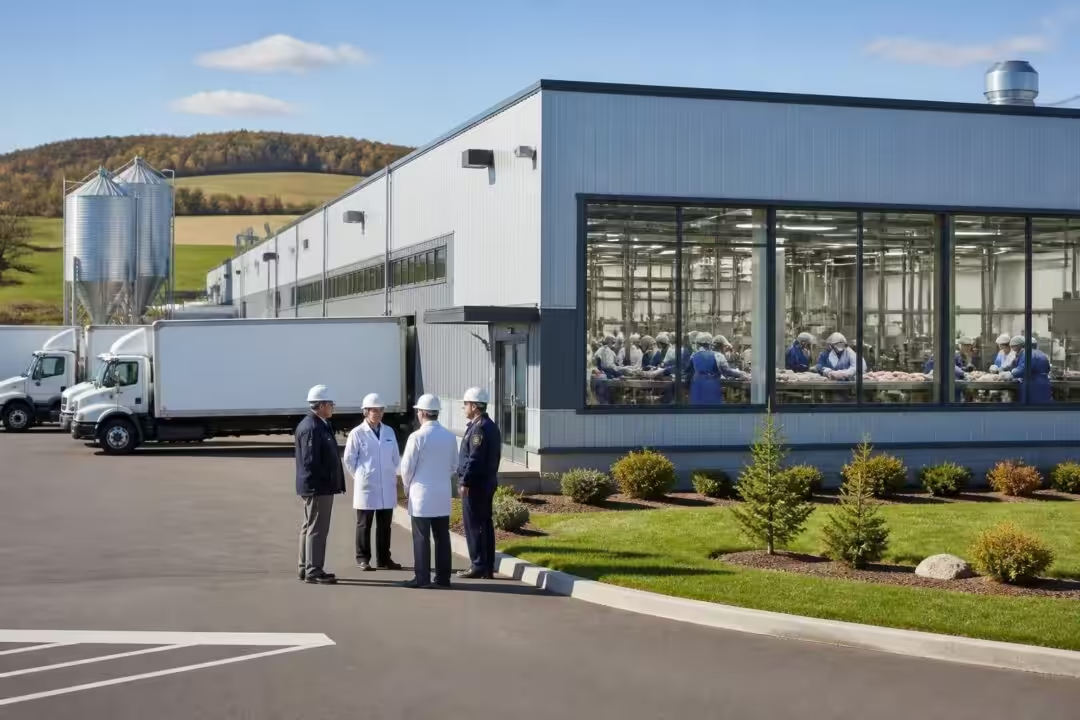
When a turkey processor becomes the kind of place everyone in a region quietly depends on, its potential closure stops being “industry news” and starts feeling like a community emergency. In south-central Pennsylvania, that dependency is easy to taste: Thanksgiving roasts, deli slices in school lunches, smoked turkey legs at county fairs, and the dependable drumbeat of paychecks that keep diners and hardware stores open. The state-assisted acquisition of the New Oxford-area turkey facility—best known through the Plainville Farms name—was framed publicly as a practical rescue: keep the plant running, keep birds moving through the system, keep rural balance sheets from tipping over. ✅
The backbone of the deal, as reported by multiple outlets and echoed in public statements, combined private capital from The Wenger Group (TWG) with Commonwealth support in the form of a $5 million state loan and a $1 million grant. The goal was not a flashy ribbon-cutting; it was continuity. The facility’s operations were slated to remain active, protecting about 690 full-time jobs and supporting 93 independent family farms whose flocks and contracts feed directly into the plant’s schedule.
In 2026 terms, that scale reads like an entire ecosystem, not a single business. It also helps explain why a state would intervene at all. Food processing has become a strategic layer of supply security, especially after years when disruptions—labor shortages, feed price spikes, transportation bottlenecks—proved how quickly a “local” shutdown can ripple into national grocery pricing. The acquisition’s most immediate promise was straightforward: prevent the gap between “uncertain future” and “locked gates” that can appear faster than most policymakers can schedule a hearing. ⚠️
It is tempting to reduce a deal like this to a headline number—six million dollars and a saved payroll—but the real mechanics live in the unglamorous details: maintenance backlogs, refrigeration upgrades, wastewater compliance, worker retention, and vendor confidence. A lender might hesitate if a processor’s recent years have been unstable. A grower might hesitate to place poults if slaughter slots look shaky. The state’s participation can function as a credibility bridge, signaling that the plant is not being left to drift.
A creative way to understand the stakes is to picture a typical week of production as a complicated recipe. If even one ingredient goes missing—drivers, packaging film, USDA inspection coverage, or cold storage capacity—the dish fails. A family farm can raise birds perfectly, yet still lose money if processing access collapses. A line worker can show up on time, yet still lose hours if throughput drops. State assistance, in this context, acted like a stabilizer in a sauce: it didn’t create flavor by itself, but it helped keep the mixture from separating when the heat rose.
What made this acquisition particularly consequential was the combination of immediate job retention and the longer tail of agricultural continuity. The 93 family farms tied to the brand are not interchangeable suppliers that can pivot overnight; their barns, equipment, and husbandry practices are often built around the rhythms of a specific processor. Keeping the plant active protects those farms’ planning horizons, which in poultry are measured in cycles and biosecurity routines, not just in quarterly earnings. The insight that tends to get missed is that stability is itself an economic product—and this deal purchased time for the region to keep producing it.
State-Assisted Acquisition of Central Pennsylvania Turkey Processing Company: Jobs, Farms, and the Human Geography of a Processing Plant
The simplest way to measure impact is to count jobs, and the numbers attached to this acquisition are big enough to shape a town’s weekly rhythm. Preserving roughly 690 full-time positions means more than keeping a single employer afloat; it keeps childcare arrangements, commuting routes, and local retail patterns intact. In regions like Adams County and the wider south-central corridor, a processor’s shifts can determine when coffee shops open early, when mechanics stay late, and how community colleges schedule workforce programs. 👥
Yet the most delicate piece is often the one that sits upstream: the 93 independent family farms connected to the operation. These farms are not merely “suppliers”; they are living infrastructure. A turkey grower’s year is a sequence of tightly managed decisions—litter management, ventilation, vaccination protocols, feed conversion targets, and biosecurity gates that can make a barn feel as controlled as a professional kitchen during a Saturday-night rush. If a processor falters, those farms face a brutal question: where do the birds go?
Consider a working example. Imagine a second-generation grower outside New Oxford—call the family the Klines—who has aligned barn cycles to the plant’s intake schedule for years. Their investments might include upgraded fans, a new generator, and water-line improvements financed with the expectation of steady placement and pickup. If processing access disappears, the Klines cannot simply “store” finished birds. Turkeys keep growing, feed costs keep accumulating, and animal welfare constraints tighten. This is why an acquisition framed around keeping doors open is, for farms, closer to keeping oxygen in the room.
The acquisition also affects a wider ring of partners. Reports tied to the deal referenced hundreds of vendor and logistics relationships—from packaging suppliers to sanitation services to cold-chain carriers. Each partner makes decisions based on perceived risk: do they extend payment terms, dedicate trucks, prioritize service calls? When a state backs a transaction with a loan and grant, it can quiet the panic that causes vendors to pull back at the worst possible moment. In food, confidence often moves faster than cash, and it can evaporate just as quickly.
From a culinary perspective, the human impact shows up at the meat counter. A stable processor can maintain consistent product specs—trim standards, smoke profiles, portion weights—which is exactly what institutional buyers depend on. Schools, hospitals, and senior living facilities typically write menus around reliable proteins. If a plant goes dark, procurement teams scramble, substitutions multiply, and the eating experience degrades in small but meaningful ways. Is it dramatic to say that an acquisition can influence what ends up in a lunch tray? Not really; supply continuity is the hidden author of most “everyday meals.” 🍽️
Labor stability matters, too. Plants do not run on equipment alone. They run on trained hands that know how to keep yields high while meeting safety and quality rules. When a facility’s future looks uncertain, workers understandably look elsewhere, and the loss of experienced staff can create a quality spiral: more rework, slower lines, more downtime. The acquisition’s value, therefore, includes the retention of know-how—skills that take months or years to build and minutes to lose.
As the plant’s ownership shifted to TWG’s leadership role, the most important near-term outcome was not a rebrand; it was keeping the social fabric from tearing. The durable insight is that a processing plant is a map of relationships—farm to dock, dock to line, line to pallet, pallet to truck—and the state-assisted acquisition aimed to keep that map readable for everyone who depends on it.
To ground that ecosystem in practical terms, the following elements typically determine whether a plant-centered community stays resilient after an ownership change:
- 🧑🏭 Worker retention plans (shift stability, training refreshers, attendance incentives) that reduce churn during transition.
- 🚚 Cold-chain reliability (refrigerated trailers, backup refrigeration, scheduling discipline) that prevents product loss and buyer frustration.
- 🌾 Farm placement confidence (clear flock schedules and contract clarity) so growers can plan cycles without gambling.
- 🧼 Food-safety and sanitation continuity (documented procedures, audits, staffing) that keeps buyers comfortable signing long-term agreements.
- 🤝 Vendor trust (predictable payments, transparent volume forecasts) that keeps essential services from tightening terms.
Those levers make the transition tangible, and they set up the next question: how, exactly, do public dollars and private ownership coordinate without stepping on each other’s toes?
State-Assisted Acquisition of Central Pennsylvania Turkey Processing Company: The Deal Structure, Public Tools, and Accountability
In an era when “industrial policy” is no longer a rare phrase, the financing architecture of a state-assisted acquisition deserves close attention. The Commonwealth’s support for this turkey processor’s ownership change was described through two clear instruments: a loan of about $5 million paired with a grant of about $1 million. 💰 The dual structure matters because it signals two intentions at once: repayment expectation (loan) and targeted enablement (grant). The loan suggests the plant should remain economically viable; the grant acknowledges there are transition costs that may not be easily financeable under conventional terms.
Loans can underwrite hard needs—equipment repairs, working capital, safety upgrades—while also giving the state leverage through covenants and reporting. Grants can be scoped to outcomes like job retention, training, or infrastructure work that benefits the broader region. Together, they form a toolkit designed to keep the operation from collapsing during a fragile handoff. This is especially relevant in protein processing, where margins can be tight, capital needs are constant, and any prolonged slowdown can trigger cascading penalties in contracts and logistics.
Public accountability is usually where skepticism gathers, and not without reason. A practical way to evaluate this kind of intervention is to look for measurable deliverables. In this case, the recurring public benchmarks were continued operation, preserved employment (the roughly 690 roles), and support for the network of 93 farms. Those metrics are not abstract; they can be tracked through payroll records, farm placement schedules, and facility production volumes. The essential question is not whether government should “pick winners,” but whether it can purchase stability at a reasonable price compared with the cost of a shutdown.
A shutdown has expensive side effects that rarely show up in a single line item: unemployment claims, lost local tax revenue, increased demand on social services, and the decay of specialized infrastructure. Restarting a protein plant after closure is notoriously difficult because of regulatory requirements, workforce reassembly, and buyer confidence. A state loan and grant can look modest when measured against the long-term cost of abandonment—empty docks, idle wastewater systems, and the slow drift of families out of the area. 🧾
There is also a strategic-food argument that has become more visible by the mid-2020s. Domestic processing capacity functions like a pressure valve during volatility. When supply chains tighten, regions with active plants and contracted farms can keep shelves steadier. When capacity shrinks, shortages can spread even if farms are still raising animals. By assisting an acquisition that keeps lines running, Pennsylvania protected not just rural incomes but a piece of the broader food network that consumers touch daily.
To make the structure easier to grasp, the table below summarizes how stakeholders typically experience such a financing package. It is less about ideology and more about who carries which risk when a plant’s future is uncertain.
| Stakeholder 🧩 | What They Put In 📥 | What They Expect Out 📤 | What Can Go Wrong ⚠️ |
|---|---|---|---|
| Commonwealth of Pennsylvania 🏛️ | $5M loan + $1M grant 💵 | Jobs retained, plant stays open, farms supported ✅ | Underperformance, political scrutiny, limited repayment capacity |
| The Wenger Group (TWG) 🏢 | Equity/lead investment, management oversight 🔧 | Turnaround potential, stable supply relationships, growth 📈 | Integration risk, market shifts, cost overruns |
| Employees 👷 | Skills, time, operational knowledge 🧠 | Stable wages, predictable shifts, safer workplace 🛡️ | Uncertainty, turnover pressure, training gaps |
| Independent family farms 🌾 | Bird production, biosecurity discipline, capital tied to barns 🐓 | Reliable placements/pickups, fair contract continuity 🤝 | No processing slots, price squeezes, cycle disruption |
| Vendors & logistics partners 🚛 | Transportation, packaging, sanitation, maintenance services 🧼 | Predictable volume, dependable payments, long-term accounts 🧾 | Payment delays, volume drops, contract renegotiations |
One subtle feature of state participation is the way it can reshape the negotiation table. With public funds involved, timelines often accelerate, documentation tightens, and performance expectations become explicit. That can be a nuisance for leadership teams, but it can also prevent drift. The practical insight is that the “state-assisted” part of the acquisition is not just money—it is structure, deadlines, and a demand for clarity that can keep a complicated transition from sliding into chaos.
State-Assisted Acquisition of Central Pennsylvania Turkey Processing Company: Operational Modernization, Food Safety, and Product Quality
Keeping a turkey processing facility open is one victory; keeping it excellent is the longer campaign. After an acquisition supported by state financing, the most meaningful changes often occur behind doors the public never sees: maintenance bays, sanitation stations, quality labs, and scheduling offices where throughput is planned minute by minute. For a plant serving national and regional buyers, consistency is currency—especially when consumers in 2026 are quicker than ever to notice quality swings, ingredient changes, or packaging redesigns that feel like corner-cutting. 🔍
Operational modernization is not always glamorous, but it is where stability becomes durable. Refrigeration systems need redundancy so one compressor failure does not become a weeklong crisis. Wastewater treatment must meet strict standards, because a violation can slow or stop operations just as surely as a broken conveyor. Worker safety upgrades—guarding, ergonomics, slip-resistant flooring—reduce injuries that otherwise sap staffing levels and morale. Each of these investments directly affects yield, downtime, and the plant’s ability to keep contracts.
Food safety is the non-negotiable heartbeat. In poultry processing, sanitation is not merely “cleaning”; it is a disciplined choreography that involves validated chemical concentrations, contact times, swabbing schedules, and documentation that can withstand audits. A change in ownership can be a vulnerable moment if procedures drift or if training is uneven. This is where a stable financing package can indirectly help: it can fund additional training hours, third-party audits, or equipment upgrades that reduce contamination risk. 🧼
From a chef’s perspective—without slipping into first-person—the difference shows up in the pan. A turkey breast with consistent moisture retention and trim quality cooks predictably. A smoked product with stable fat content slices cleanly. Process control upstream—chill rates, portioning accuracy, packaging integrity—becomes a dining experience downstream. Restaurants and institutional kitchens don’t have the luxury of guessing; they need proteins that behave the same way every Tuesday.
To illustrate how modernization can ripple outward, consider a fictional regional caterer, “Keystone Hearth,” that supplies boxed lunches for corporate training days and weddings. Before the acquisition, late deliveries and inconsistent case weights might force last-minute menu changes—swap turkey salad for ham, reduce portion sizes, or buy emergency inventory at retail prices. After stabilization, predictable shipments allow Keystone Hearth to plan confidently, reduce waste, and keep recipes consistent. That reliability translates into fewer complaints, steadier margins, and better staff scheduling. The processor’s stability becomes a hidden ingredient in the caterer’s reputation. 🍽️
Another operational angle is the integration of data systems. Many plants have moved toward real-time monitoring—temperature logging, downtime tracking, and inventory visibility that can prevent both spoilage and stockouts. While the public hears about loans and grants, the quiet story can be the creation of better dashboards and clearer decision rights: who shuts down a line, who calls in maintenance, who approves overtime during peak demand. The acquisition created an opportunity to standardize those decisions under new leadership, reducing ambiguity that can waste thousands of dollars in a single shift.
The deeper insight is that food manufacturing is like a long service: the guests might only see the plated dish, but the real success depends on prep lists, clean stations, sharp knives, and teams who trust each other under pressure. Stabilizing ownership with public support can keep that “back of house” running smoothly enough that the entire region benefits from the result—safe food, steady paychecks, and farms that can keep raising birds with confidence.
With operations steadied and quality protected, attention naturally shifts to the next frontier: how a preserved plant can help shape rural development, workforce pipelines, and the future of Pennsylvania’s protein economy.
State-Assisted Acquisition of Central Pennsylvania Turkey Processing Company: Rural Development, Workforce Pipelines, and Long-Term Regional Competitiveness
Once the immediate crisis of “will the plant close?” is removed, the conversation becomes more ambitious: can this facility and its farm network become a springboard for regional competitiveness rather than merely a saved asset? In south-central Pennsylvania, rural development is often described in terms of small businesses and tourism, but protein processing is a different kind of engine—one that converts agricultural capacity into year-round payroll and vendor demand. When a state supports an acquisition, it is implicitly betting that the engine can be tuned, not just restarted. 🔧
Workforce pipelines are central to that tuning. Plants need technicians who can maintain refrigeration, automation, and packaging equipment; quality personnel who understand documentation and sampling; and supervisors trained to manage safety and throughput. A stable employer can partner with vocational programs, community colleges, and adult education centers to build credentials that map directly to better wages. In practical terms, that might look like paid training hours for maintenance apprentices, bilingual safety instruction, or leadership development for line leads who want to move up.
There is also a retention dimension tied to dignity and predictability. When ownership is uncertain, workers often assume the worst and seek more stable options. After an acquisition, management can reduce anxiety by communicating clearly about shift patterns, benefits, and advancement pathways. That clarity becomes a competitive advantage in a labor market where many employers are fighting for the same dependable people. A plant that feels orderly and forward-looking is more likely to keep experienced staff—and experience is the ingredient that makes efficiency repeatable.
Rural development also depends on the health of supplier rings. The acquisition was widely discussed as supporting not only jobs and farms but also hundreds of vendor and logistics partners. That matters because those partners include businesses that tend to be locally rooted: trucking firms, equipment repair shops, industrial laundry services, and packaging distributors. If the processor is stable, those firms can hire, expand, and invest. If it falters, they often cannot replace that volume quickly.
For farms, long-term competitiveness increasingly includes resilience to shocks: biosecurity threats, feed price volatility, and climate-related stresses that affect ventilation and water management. A stable processing partner can help farms adopt better forecasting, coordinate schedules that reduce downtime, and support standards that meet buyer expectations. The benefit is not just survival; it is the ability to keep Pennsylvania-grown turkey relevant in a market where consumers want transparency, reliable quality, and responsible production. 🌾
A useful historical parallel is how regions once organized around steel mills or textile plants had to decide whether to modernize or fade. Food processing is not immune to that choice. If modernization stalls, a facility can become a legacy asset that slowly loses ground to newer plants elsewhere. If modernization accelerates—through capital investment, training, and tighter logistics—the facility can become a magnet for related businesses, from spice blenders to prepared-food manufacturers.
To keep the narrative grounded, imagine a hypothetical “Turkey Innovation Week” hosted in collaboration with local schools and suppliers: plant tours (with strict safety protocols), culinary demonstrations of value-added cuts, and workshops on cold-chain logistics. It sounds promotional, but it can produce practical outcomes: students see a career path, suppliers see growth opportunities, and local leaders see that the plant is not just a payroll line but a platform. 🎯
In policy terms, the state-assisted acquisition becomes most defensible when it triggers compounding benefits: stable employment leading to stable households, stable farm contracts leading to better on-farm investment, and stable vendor demand leading to more local enterprise. The final insight for this section is simple: the best economic development is the kind that already knows how to work—then gets the stability and leadership it needs to keep working for decades.

Hi, I’m Landon Brooks. I am the editor-in-chief of Cook and Design, but for the first decade of my working life I was actually a product designer in New York.