
At a Glance — A New York therapist arrives in Wichita, Kansas, convinced that her clinical training has prepared her to assess any family system. What she discovers instead is a community whose rhythm, values, and communication style challenge everything she thought she knew about family dynamics — and ultimately make her a more curious, more effective clinician.
What to Remember — Geography shapes family relationships more than most clinical frameworks acknowledge. The pace of life and styles of communication are cultural artifacts, not signs of dysfunction. Thriving families do not follow a single template, and asking “Where are you from?” can be more revealing than any standardized assessment.
Some of the most profound lessons in therapy arrive far outside the consulting room. For one clinician, they came in the form of a Chick-fil-A drive-thru line, a Kansas prairie horizon, and a community that spoke its mind without hedging. What follows is a story about moving abroad in the broadest sense — about becoming a cultural explorer in one’s own country, and about how place silently rewires what we recognize as healthy.
From New York Therapy Rooms to Kansas Flatlands: A Cultural Earthquake
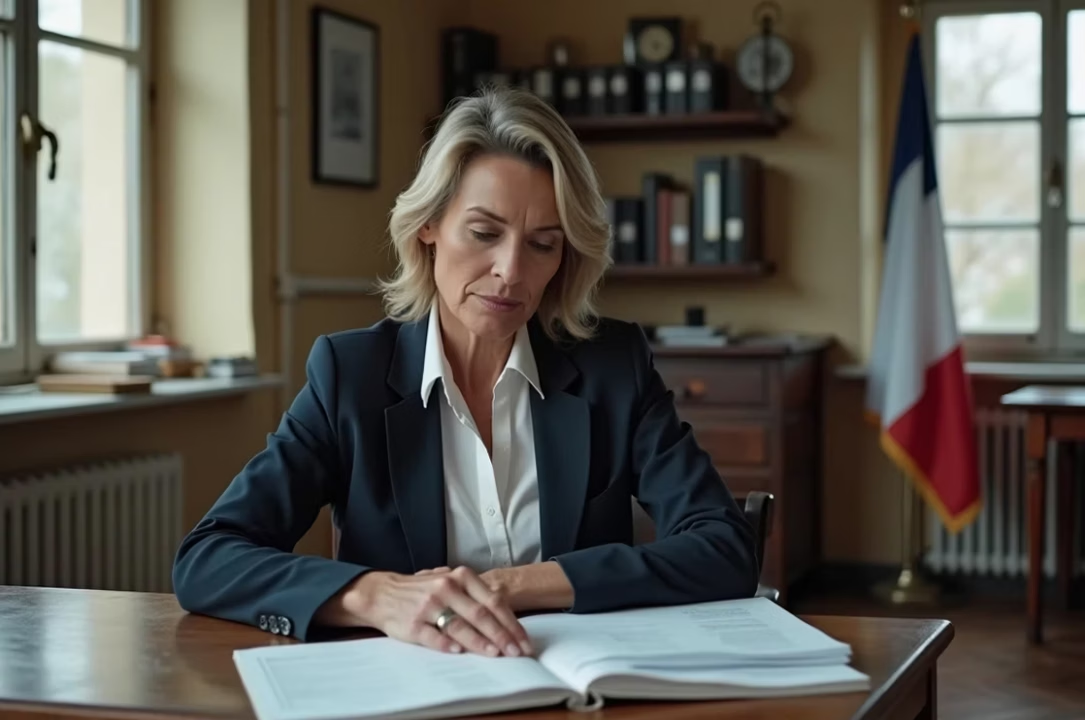
She had just completed her postdoctoral training in New York City, where she worked with children and families across a wide range of settings. The New York therapist was confident she understood family systems. She had the degrees, the supervised clinical hours, and the professional vocabulary to explain how families function under pressure.
Then her husband’s job relocated the young family to Wichita, Kansas — just as their first son was born.
On paper, the move seemed minor: same country, same language, same currency. But the experienced clinician quickly realized she had stepped into a different world, one that would demand a full cultural adaptation of her professional instincts. What she had imagined would be a logistical adjustment became a reckoning with deeply embedded assumptions about what a healthy family actually looks like.
The Tuesday Morning That Broke the Frame
The first clear signal arrived on an ordinary weekday. The drive-thru line at a local Chick-fil-A stretched around the block, packed with oversized SUVs at 10 a.m. Engines idled. No one honked. No one seemed to be in any particular hurry.
In New York, a line like that would have triggered visible frustration — impatient gestures, aggressive lane changes, the quiet hum of collective urgency. Here, it was simply Tuesday. For a clinician trained to read family stress in every hurried gesture, this was the first hint that the rhythm she had learned to recognize as normal was not a universal constant.
Geography Shapes Family Life More Than Degrees Admit
Wichita confronted her with a landscape that dictated everything from food to recreation. Flat vistas stretched to the horizon with no ocean in sight and real tornado threats hanging in the spring air. The terrain itself seemed to demand a different way of being — grounded, weather-aware, patient in a way that coastal city life never required. 🌾
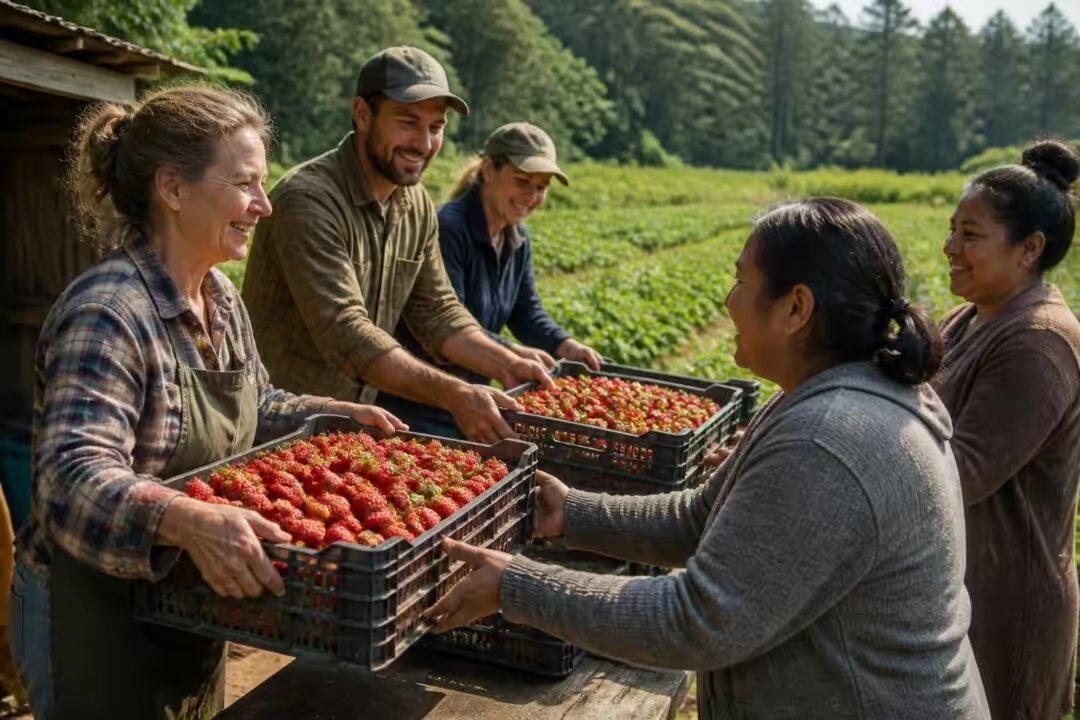
Despite a plethora of farms, fresh produce felt surprisingly scarce in many parts of the city. Sunday mornings were profoundly quiet: no lawn mowers, no delivery trucks, none of the background hum she associated with urban living. Not because nothing was happening, but because people were at church, honoring personal commitments, and exercising a capacity for pause she had rarely witnessed on the East Coast.
In New York City, Sunday mornings meant brunch reservations, crowded sidewalks, and open inboxes ahead of the workweek. The contrast was not merely aesthetic — it was a window into competing definitions of a flourishing family life, shaped by very different family relationships with time, community, and rest.
When Words Are Placeholders Versus Promises
What struck the therapist most was the way people spoke. The naturally unrushed pace of speech, the complete absence of any impulse to fill silence. No one said, “We should get lunch sometime,” without meaning it. If someone promised to call, they called. If they said they would show up, they showed up.
On the East and West Coasts, where she had grown up, she had become fluent in a conversational currency where words often served as placeholders for intentions that might or might not exist. Wichita operated on a different exchange rate entirely: people meant what they said and said what they meant. In the language of therapy, this is congruence — and she was watching an entire community practice it daily.
She began to notice other contrasts. In New York, “How are you?” was a greeting, not a question. In Wichita, it was an invitation to actually respond. A five-minute genuine exchange at a grocery checkout would have felt interminable in a Manhattan café; here, it was simply ordinary behavior.
What a Slower Rhythm Teaches About Family Assessment
Professionally, the therapist did not experience her new life as mere observation. She experienced it as data. Her training had shaped her to recognize healthy functioning against a fairly narrow, unspoken standard — one built almost entirely around the fast, achievement-oriented environment in which she had been educated.
Watching an entirely different rhythm operate successfully, with its own coherence, its own values, its own quiet integrity, was something her training had not prepared her to witness up close. The lesson was not that one rhythm is correct and the other is not. The lesson was that family dynamics do not follow a single template for pace, values, or connection.
A family can thrive while looking almost nothing like the families she had been trained to recognize as thriving. A fast-paced, achievement-oriented household is not inherently dysfunctional. Neither is a slower, more relationship-centered one built around Sunday mornings, Costco runs, and saying exactly what you mean. What matters clinically is whether a family’s own rhythm genuinely works for them — not whether it resembles the one in the therapist’s training manual.
Lessons for Therapists, Parents, and Anyone Who Grew Up Somewhere
- 📍 Familiarity is not health — the family you grew up in sets your baseline, but that baseline is not the universal standard for everyone else.
- 🗣️ Communication styles are cultural artifacts — directness versus conversational indirection reflects community values, not family dysfunction.
- ⏰ Pace is a family value — how a family moves through time reveals what it prioritizes, not what is wrong with it.
- 🏡 Geography is a family member — every place leaves its imprint on expectations, beliefs, and even the way relatives speak to one another.
- 🌍 Curiosity beats certainty — asking where a family comes from matters more than assuming what a family should look like.
The Question That Changed Her Clinical Practice
These lessons followed the therapist long after she left Kansas. Today, based in Pennsylvania, her work takes her into homes across the country. Every family brings its own history, community, geography, values, and way of moving through the world. Those influences do not exist outside the family system — they are woven into its very fabric.
Now, whenever she conducts an intake for a clinical evaluation or a school-admissions strategy session, one of the first questions she asks parents is: “Where are you from?” Not merely where they live now, but about the roots that shaped them long before their child was born.
Why “Where Are You From?” Is a Clinical Superpower
The question disarms, but more importantly, it orients. It tells the clinician whether a family’s rhythm was formed in a dense urban corridor where speed was survival, or in a farming community where patience was the essential tool. It reveals whether a family’s communication style comes from a tradition of directness or from a culture of carefully weighed words.
Consider one mother who explained that she grew up on a farm where silence was companionship. Her daughter-in-law read the same silence as rejection. Neither was wrong — they were speaking different cultural dialects about what closeness looks like. The therapist’s simple question revealed the map before she attempted to read the territory. How many families, she now wonders, have been misread by clinicians who never thought to ask where the family’s patterns came from?
Her training taught her how to recognize patterns. Wichita taught her to ask where those patterns originated before deciding whether they needed to change. This shift from assessment to inquiry transformed her work with family relationships and turned personal growth into the very foundation of her clinical approach. The expat experience — even one that never crossed an ocean — became the most valuable supervision she ever received.
The Imprint of Place: What Every Family Carries
Every place a family has ever lived leaves its mark, whether or not anyone notices at the time. The communities families call home — or once called home — shape expectations, beliefs, and even the way relatives address one another at the dinner table. Understanding a family means understanding and accepting those roots, not as points of comparison but as the very foundation of a healthy dynamic.
By 2026, with remote work having made geographic mobility more common than ever, families are relocating across state lines at rates that would have been unthinkable a generation ago. Each move deposits a new layer of influence onto the family system. The clinician who understands this is better equipped than one who relies solely on diagnostic categories developed in a single cultural context — and the same is true for parents, partners, and anyone navigating a blended sense of home.
The New York therapist arrived in Kansas as a clinician. She left as a cultural explorer — one who now understands that the most important question a professional can ask is not “What is wrong with this family?” but “where has this family been, and how has that place shaped them?”
The families that flourish are not the ones that most closely resemble a textbook model. They are the ones whose own rhythm genuinely works for them — whether that rhythm was learned in Manhattan, Wichita, or anywhere in between. That is the quiet gift of cross-cultural understanding: it teaches us to see families not as problems to be solved, but as ecosystems to be respected.

Hi, I’m Landon Brooks. I am the editor-in-chief of Cook and Design, but for the first decade of my working life I was actually a product designer in New York.