| Key notes ✅ | Sections 🧭 |
|---|---|
| Historic places survive when they keep serving a real daily need 🥕 | 1) The Valley Farm Stand reopening in Boonton Township: what changed and why it matters |
| Restoration is a design problem: materials, circulation, signage, and trust 🪵 | 2) A century of function: from refreshment stop to “milk house” to seasonal farm counter |
| Honor-system selling works when community norms are designed in, not assumed 💵 | 3) The craft of rehabilitation: what “restored the right way” looks like |
| Local government support can be concrete: land preservation + historic grants 🏛️ | 4) Funding, stewardship, and the public-private handshake that kept the land open |
| A farmstand is also a menu: seasonality, cider, apples, corn—and the decisions behind them 🍎 | 5) How a revived farmstand earns loyalty in 2026 kitchens: merchandising, weekly rhythms, and community |
Why this matters this week: Across the U.S., small food institutions are either disappearing under development pressure or returning in smarter, more community-built forms. The reopening of Boonton Township’s Valley Farm Stand—idle since 2000, now rehabilitated by a local family—shows what it takes to revive a place without turning it into a theme park. The story sits right at the intersection of food, design, and civic will: what gets preserved, how it’s funded, and what people actually line up to buy on a summer morning.
Valley Farm Stand Reopening in Boonton Township: a decade-long family project becomes a public gathering place
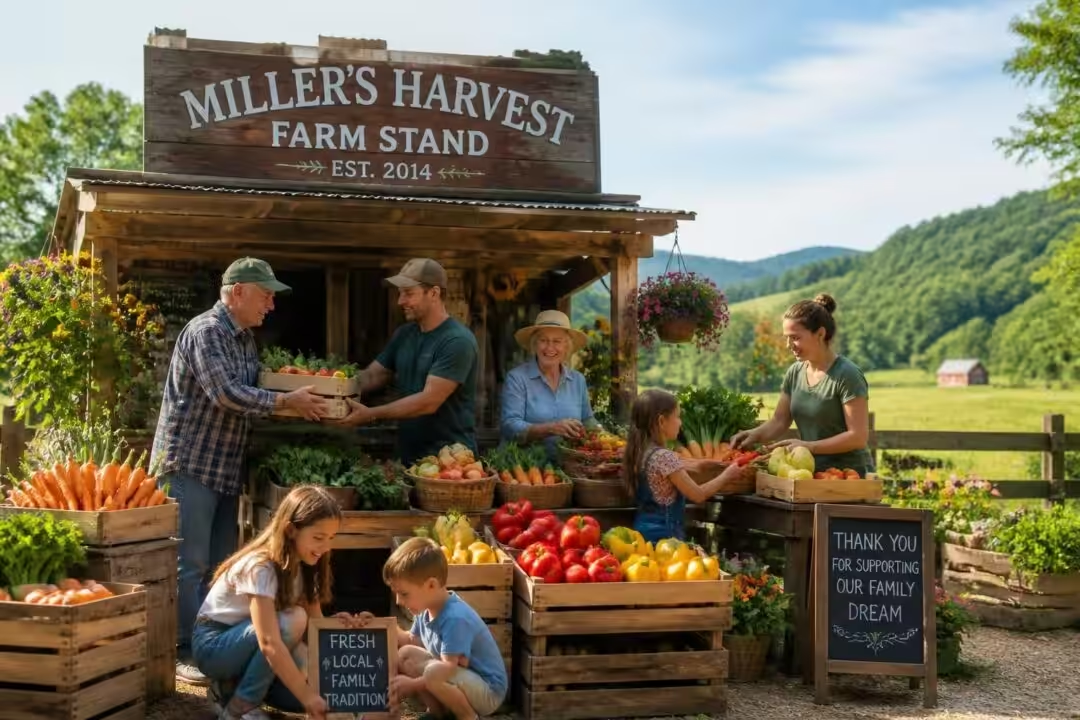
On Powerville Road, the restored Valley Farm Stand reopened with the kind of scene that tells the truth about a community’s appetite: a ribbon stretched across a familiar façade, neighbors leaning in close, and a line forming fast once the first orders could be placed. The ceremony—held July 31 at the farmstand on the Oscar Kincaid Home of History property—wasn’t simply civic theater. It marked the moment a structure that had been closed for a generation started doing its original job again: moving food and conversation through the same small footprint.
Jeff and Colleen Dowling, the local family behind the rehabilitation, cut the ribbon and took on operations with a clear intention: the stand would function as a destination for farm-fresh products, but also as a place where family members can work side by side—today and later, when children and grandchildren want to carry the rhythm forward. That future-facing framing matters. Plenty of restorations freeze a site in amber; this one puts it back into circulation.
Public officials and local stewards showed up because this wasn’t a private business launch in isolation. County leadership, township administration, and the Historical Society of Boonton Township all participated, signaling that the reopening is best understood as a shared win: a preserved property gaining a usable, welcoming front door. When a building has been idle since 2000, the restart is not automatic; it requires political alignment, volunteer patience, and a day-to-day operator who can turn history into a habit.
In 2026, when grocery convenience is nearly frictionless—delivery, curbside pickup, subscription produce boxes—why would anyone choose a farmstand? Because the best ones offer something modern retail keeps losing: context. It’s not just sweet corn; it’s sweet corn with a story, picked within driving distance, handed across a counter that remembers summers. That “why” is what makes a ribbon cutting feel earned instead of performative.
What people are actually lining up for (and what they’re really buying)
The visible reason for the line is seasonal produce; the invisible reason is belonging. A reopened stand allows small rituals to return: stopping after a walk, grabbing apples for a pie, or picking up cider before visiting friends. In design terms, it’s a reactivated node—small, but capable of anchoring recurring movement through a neighborhood.
To make that ritual durable, the operator’s choices have to be specific. A revived stand can’t be everything. It needs a tight product edit, clear pricing, and a service style that matches the building. The Valley Farm Stand’s history—refreshments, dairy, then seasonal crops—suggests a North Star: sell what the land and nearby growers do best, keep the footprint calm, and let the materials speak.
Practical cues that signal “this is for locals, not tourists”
One reason beloved farmstands endure is that they don’t overexplain themselves. They use restraint: a chalkboard list, a neat stack of bags, a cooler that looks like it belongs. A stand that tries too hard often reads like a brand activation. A stand that acts like a kitchen pantry—organized, honest, quietly confident—invites repeat visits.
Insight to keep: The real reopening isn’t the ceremony; it’s the first week when locals start dropping by without thinking about it.
Next, it helps to understand the building as a living tool—one that changed function multiple times while staying recognizably itself.
Historic farmstand story: from 1920s refreshment stop to milk house to seasonal market
Long before “third place” became a phrase in urban planning, farmstands were already doing that work in rural and semi-rural America. The Valley Farm Stand’s origin story makes that plain. Built in the mid-1920s by Oscar A. Kincaid Sr., it began as a refreshment stand—a modest structure where neighbors could stop for root beer and local leaders could talk through community matters. It’s easy to romanticize that, but it’s more useful to see it as infrastructure: a small, social point of sale that helped knit a dispersed population into something like a town.
Then, in 1938, the Kincaids shifted into dairy, expanding the building with a walk-in cooler and turning it into the “milk house” for the Hillside Dairy route. That detail is a master class in adaptive use. Rather than abandoning an existing asset, they updated it to fit an evolving local economy and consumer need. The stand didn’t lose its identity; it gained a new role, and the architecture followed function.
World War II brought another shift. Like many American farm families, the Kincaids returned to general farming during that period, and the stand moved with them—becoming known as Valley Farm, selling seasonal crops and practical goods. The list reads like a calendar for the northeastern kitchen: sweet corn, tomatoes, peaches, apples, cider, Christmas trees, firewood. This isn’t random inventory; it’s a year’s worth of meals and gatherings, mapped onto a single address.
Heirloom apples and the taste-memory problem
In later years, the stand’s offerings included heirloom apple varieties grown by nearby pomologist Harold W. Schroeder. Names like Golden Russet, Fall Pippin, Black Gilliflower, and Maiden Blush aren’t just charming; they point to a sensory difference. Heirloom apples often carry tannin, acidity, perfume—traits bred out of many modern supermarket apples in favor of shelf life and uniform sweetness.
For home cooks, this changes what “apple season” means. A Golden Russet can make cider that tastes like toasted honey and spice. A Maiden Blush can deliver a clean, almost floral brightness that holds up in a simple galette. When a stand sells varieties with personality, it gives cooks better raw materials and gives bakers a reason to show restraint: less sugar, less masking, more letting fruit speak.
The honor system: nostalgia, yes—but also an operating model
The Valley Farm Stand was often run on an honor system: customers selected produce and left payment in an unlocked cash box. That practice can sound quaint, but it’s also a form of community governance. It asks people to participate in the stand’s survival, not merely consume from it.
In 2026, when frictionless payment is standard, honor-system selling can still work—but it needs design support: clear posted prices, a visible payment area, and a layout that reduces ambiguity. Trust isn’t a vibe; it’s a set of cues that makes the honest action the easiest action.
Insight to keep: The stand survived multiple economic eras by staying function-first—changing what it sold without changing what it was for.
That function-first philosophy is exactly what makes restoration either succeed or fail, depending on how decisions get made at the detail level.
Watching other restorations—good and bad—sharpens the eye. Next is the part most people skip: what “restoring it the right way” actually means when you care about food service, safety, and authenticity at the same time.
Farmstand restoration craftsmanship: what “restored the right way” looks like in materials, flow, and restraint
When the Historical Society president praised the rehabilitation, the compliment carried a specific kind of weight: no corners cut, restoration done with craft and respect. That phrase can be empty—until it’s translated into choices. In a food space, the details matter twice: once for longevity and once for day-to-day usability.
A farmstand is small, which means every decision is amplified. Where a customer pauses. How they pass another shopper. Where the sun hits the produce. How the cooler breathes. How a door swings without clipping a basket of peaches. A restoration that ignores these lived mechanics can look beautiful in photos and feel awkward in real life.
Designing the customer path like a well-plated dish
In product design, good flow is invisible; in cooking, good sequencing is invisible too. The same is true here. A successful stand guides shoppers without forcing them: entry, browse, choose, pay, exit. In practice, that means clear sight lines, a logical grouping of items (fruit together, veg together, pantry items separated), and a checkout point that doesn’t bottleneck the door.
There’s also a sensory logic. Heavily aromatic items (cider, onions, herbs) can overwhelm delicate fruit if they’re piled together. A smart layout respects flavor, not just convenience. It treats produce like ingredients, not props.
Materials that age well (and clean well)
Restoration craft in 2026 has to honor the past while acknowledging modern expectations: cleanliness, food-safe surfaces, and durability. Raw wood is beautiful, but it needs the right finish and maintenance plan. Paint colors should be historically sympathetic without feeling like a museum. Hardware should be sturdy enough for thousands of touches.
Even the “quiet” parts—shelving depth, crate sizes, the height of a counter—determine whether a stand feels welcoming or cramped. When a restorer treats these as design constraints rather than afterthoughts, the building becomes easier to operate and easier to love.
Honor-system selling, updated without losing the feeling
The unlocked cash box is part of the stand’s folklore. Still, no one benefits from pretending risk doesn’t exist. The modern version can keep the spirit while making payment more intuitive: a clearly labeled lockbox, optional digital payment, and signage that thanks customers for supporting the stand’s upkeep. The message matters. People respond better to invitation than to surveillance.
Here is a practical, cook-and-design-minded checklist that turns “trust” into observable choices:
- 🍑 Price clarity: one price card per item, readable from arm’s length, no math puzzles
- 💵 Payment clarity: one obvious station with envelopes/slot, plus a QR option if offered
- 🧺 Basket logic: baskets sized to prevent bruising; softer fruit separated from heavier items
- 🧊 Cold chain respect: dairy/cider/eggs in a cooler that’s easy to open and close quickly
- 🚶 Two-person passing space: at least one area where shoppers can step aside without blocking
Insight to keep: The most respectful restoration isn’t the one that looks oldest—it’s the one that makes the building useful again without erasing its accents.
Usefulness, though, rarely happens on good intentions alone. The next layer is governance: who owns what, who pays, and how public dollars translate into a reopened door.
Historic preservation funding and farmland stewardship: the Morris County model behind the revived farmstand
It’s tempting to frame the Valley Farm Stand’s return as a single-family triumph story, but the deeper lesson is structural: preservation works when a community builds a chain of stewardship that survives individual lifetimes. In this case, that chain includes county programs, a local historical society, and a family willing to operate a small, demanding business.
The property itself carries more than two centuries of history. The Oscar Kincaid Home dates to around 1785, making it among the oldest surviving frame buildings in Boonton Township. That age changes the stakes. A site like this isn’t only a picturesque artifact; it’s a scarce physical record of how people lived, built, and gathered in the region.
Then there’s the farmland and open-space component. In 2001, the Morris County Agricultural Development Board purchased the 75-acre Kincaid farm for open space and farmland preservation. That kind of purchase is policy made visible: it keeps land from being fragmented or developed in ways that would erase its agricultural possibility.
Grant funding that actually adds up
From 2003 onward, the Historic Preservation Trust Fund awarded nearly $730,000 to the Historical Society of Boonton Township for acquisition, stabilization, and restoration of the home and farmstand. In 2026 terms, that total represents what it often takes to move from “everyone agrees this matters” to “the door is open and the building is safe.” Inflation and construction costs have made small restorations more expensive than many people expect, especially when work is done correctly and with proper oversight.
The property’s listing on both the New Jersey and National Registers of Historic Places also changes the framework. Register status can open up pathways—visibility, eligibility, and stricter standards that prevent careless alterations. It’s not a guarantee of funding, but it is a form of protection through attention.
The role of civic identity (and why it affects food)
One of the most telling moments in the reopening story is how officials spoke about the site: not as nostalgia, but as a piece of American history written outside statehouses and battlefields—on farms, through labor, stewardship, and land commitment. That framing matters because it justifies spending public resources on a place that sells corn and cider. It says: everyday food spaces are part of civic memory.
There’s also an ecological angle that doesn’t need to be overclaimed. Preserved land can support tree cover, habitat continuity, and more local production over time. Even when a farmstand’s volume is modest compared to a supermarket, its existence can keep agricultural knowledge and small-scale infrastructure alive: cold storage, delivery relationships, seasonal labor patterns, and the habit of buying what’s in season.
To make the mechanics clearer, here’s a simple view of how the stewardship pieces fit together:
| Piece of the puzzle 🧩 | What it did in practice 🛠️ | Why it matters for the farmstand 🍎 |
|---|---|---|
| Agricultural Development Board (county) 🌾 | Purchased 75 acres in 2001 for open space and farmland preservation | Kept the landscape intact so the stand isn’t stranded in a fully developed parcel |
| Historic Preservation Trust Fund 💰 | Granted nearly $730,000 since 2003 for acquisition/stabilization/restoration | Paid for the unglamorous essentials: structure, safety, longevity |
| Historical Society of Boonton Township 🏠 | Owns and oversees the Oscar Kincaid Home of History | Provides continuity beyond election cycles and family timelines |
| Morris County Park Commission 🌳 | Maintains a portion as Kincaid Woods | Creates foot traffic and community attachment that can support the stand |
| Local operators (the Dowlings) 🧺 | Rehabilitated the stand and now run day-to-day sales | Makes preservation tangible: open hours, stocked shelves, a reason to stop |
Insight to keep: Preservation becomes real when the operating plan is as thoughtful as the grant writing.
Operating plan leads directly to the most practical question for readers: what does a revived farmstand actually sell—and how can it fit into modern American home cooking without becoming another weekend-only fantasy?
Once the mechanics of stewardship are understood, the rest is kitchen logic: seasonality, menu planning, and the small design decisions that make people come back on a Tuesday, not just opening day.
Farmstand seasonality in 2026 kitchens: apples, cider, sweet corn, and the community habits that keep a legacy alive
A farmstand revival can’t live on history alone; it has to win a place in the weekly routine. That’s where seasonality stops being a slogan and becomes a practical service. Valley Farm’s traditional roster—corn, tomatoes, peaches, apples, cider, trees, firewood—reads like a blueprint for how a stand can support a home cook from July through December without pretending to be a full grocery store.
The key is not sheer variety; it’s timing. When sweet corn arrives, it needs to be excellent for a short window. When peaches hit their peak, they need to taste like something that didn’t travel for days. When apples roll in, the stand can shift from raw snacking fruit to baking fruit to cider fruit, guiding shoppers through the season with small cues rather than long explanations.
A cook’s way to shop a farmstand: build meals around “high-impact” produce
Home cooks who think farmstands are inconvenient often approach them like supermarkets—arriving with a strict list. A better strategy is to treat the stand as the ingredient that sets the menu. Buy two or three high-impact items, then fill in the rest at a regular store if needed.
For example: peak tomatoes can become a week of meals—pan con tomate, a simple salad with sesame oil and scallions, a quick blistered tomato pasta. Sweet corn can do the same: grilled, shaved into a salad, simmered into a chowder base. The farmstand is the flavor engine; the pantry does the supporting work.
How heirloom apples change baking decisions
When the stand carries apples with real acidity and aroma, desserts can get quieter—in a good way. Instead of adding cinnamon and sugar to force “apple flavor,” the baker can use a lighter hand: a thin layer of sugar, a little lemon zest, and a buttery crust that stays crisp. The apple becomes the main voice.
In our tests for fruit bakes over the years, one consistent outcome is that aromatic apples need less intervention. The filling thickens differently, too, because heirlooms can vary in water content. That’s not a problem; it’s a reminder that baking is ingredient-led, not formula-led.
Making the honor-system spirit compatible with modern expectations
Many shoppers love the idea of an honor-system stand, but they still want the clarity of a well-run counter. The best compromise is to keep the atmosphere—unfussy, neighborly—while making information legible. A single chalkboard can list what’s in today, what’s coming next week, and any limits during peak demand (like “2 quarts per customer” for berries). Those small signals reduce frustration and protect supply.
For readers looking to support revived stands like this one, here are habits that genuinely help keep the lights on:
- 🗓️ Shop on a weekday once a month (not only on sunny Saturdays)
- 🍎 Try one unfamiliar item per visit—an heirloom apple, a new tomato variety
- 🧾 Pay accurately (or tip a little extra when the stand uses trust-based payment) 💵
- 🧊 Bring a cooler bag so cold items stay safe and the stand can stock more perishable goods
- 📣 Tell one neighbor the stand is open; word-of-mouth still outperforms algorithms
The house museum next door: why context increases appetite
The farmstand’s setting beside the Oscar Kincaid Home of History adds a layer that’s easy to overlook: it turns a quick stop into a small field trip. The home contains 19th-century folk art, including plaster portraits and a decorative technique called “spooning”, made by heating a pewter spoon and drawing it across damp plaster to create swirling patterns. That kind of detail changes how visitors experience the site: food becomes part of a longer story about hands, materials, and local making.
That context can be especially powerful for families. A child who sees how walls were finished by hand is more likely to understand why a farmstand matters—not as “old stuff,” but as evidence that communities are built through work and care.
Insight to keep: A revived farmstand stays alive when it becomes part of the weekly menu and part of the local identity—one shopping bag at a time.
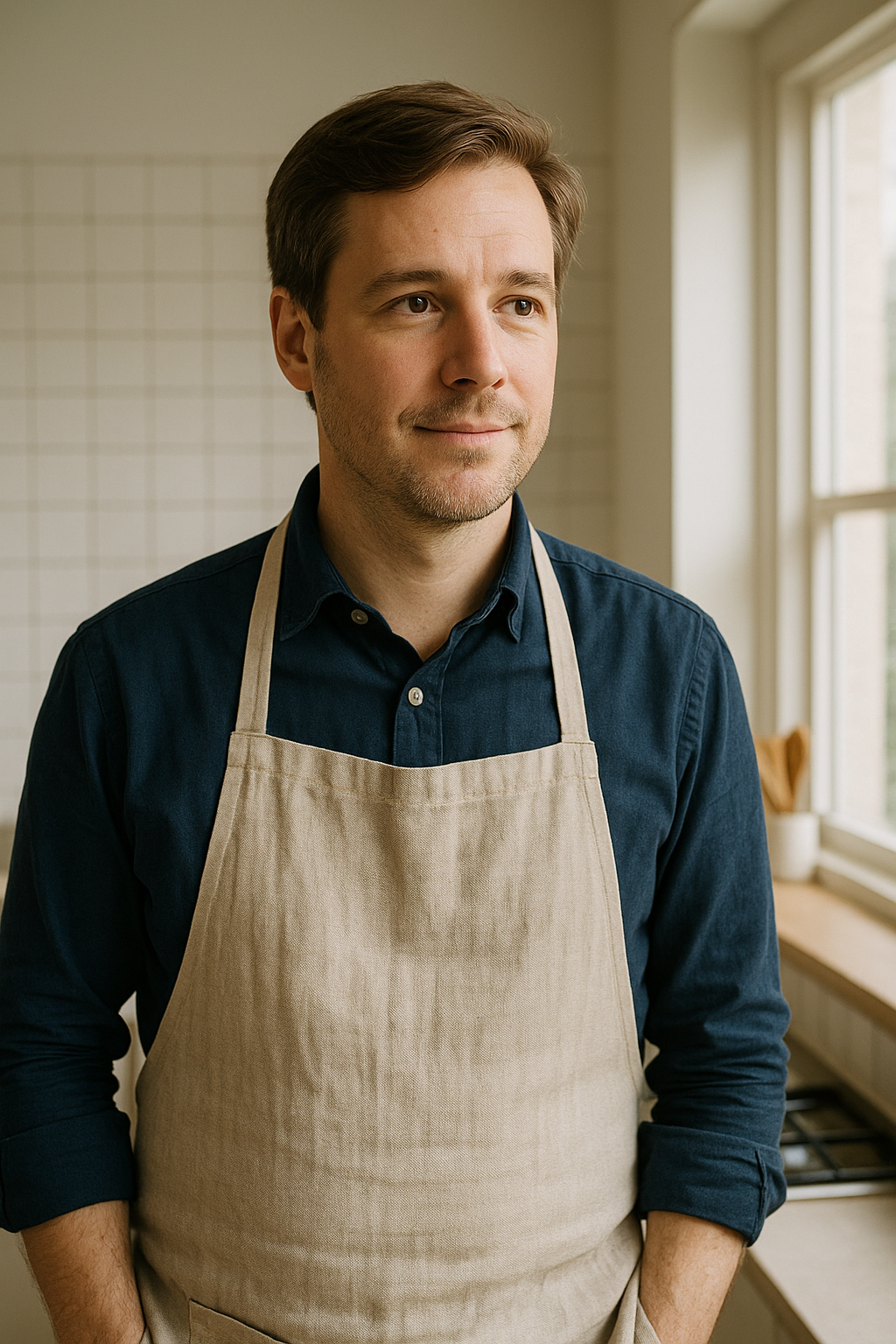
Hi, I’m Landon Brooks. I am the editor-in-chief of Cook and Design, but for the first decade of my working life I was actually a product designer in New York.