
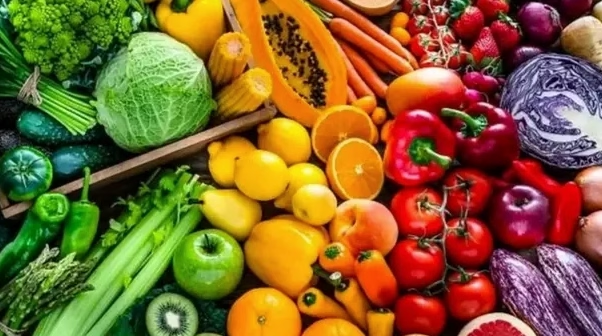
Why Organic Food Usually Costs More (and What that Price Really Buys)
When a shopper compares two apples at the grocery store, the price gap is the visible tip of a long chain of choices. At every stage — seed selection, soil building, harvest labour, certification, and distribution — organic systems often demand more time, specialised inputs, and paperwork. Those cumulative inputs are what market analysts and farmers describe as the organic premium.
One major driver is production intensity. Organic farmers forego most synthetic fertilizers and pesticides, which changes how fertility and pest pressure are managed. That usually means heavier reliance on mechanical cultivation, cover crops, manual weeding and longer rotations. These practices can reduce yields in the short term and increase labour needs, especially during transition years when the soil biology is still recovering.
Production inputs and yield dynamics
Scientific syntheses and meta-analyses find that organic yields are often lower than conventional ones, although the gap varies by crop and context. In many studies the average yield difference falls within a noticeable range, but diversified rotations, better soil management and certain climates narrow that gap. Reducing the differential is possible, yet it requires knowledge, investment and time — resources that cost money.
Lower yields are a straightforward cost converter: fewer pounds per acre means higher per-unit farm costs. Smaller farms, which make up a sizeable share of organic production, experience these effects more acutely because they can’t always spread fixed costs across large volumes.
Certification, compliance and supply-chain segregation
Certification is another visible cost. USDA organic certification involves documentation, annual inspections and record-keeping. Many producers use cost-share programs to offset some fees, but paperwork, transition-year losses and audits still add financial and time burdens. Processors and handlers also pay to keep organic streams physically segregated, which can mean dedicated equipment, extra cleaning protocols or smaller batch runs — all of which raise per-unit costs.
Beyond direct fees lies the opportunity cost: choosing organic often means different markets and marketing strategies. Smaller processors in the organic channel face higher per-unit overheads because the sector still relies on many speciality suppliers rather than highly consolidated commodity handlers.
These factors together create the market-level premium shoppers see. It is not simply an ideological surcharge: it is a traceable accounting of labour, lower short-term productivity, administrative burden, and logistic complexity. That said, when conventional commodity prices rise rapidly, the premium can compress or expand unpredictably. The result is a dynamic premium rather than a fixed number.
Key insight: The extra dollars attached to organic products reflect a bundle of tangible production and compliance costs, not an abstract value judgement.
How Much Does Organic Food Cost: Typical Price Premiums and Data Trends
Quantifying the premium requires looking at both farm-level economics and retail behaviour. Government and industry tracking show that organic retail prices vary widely by commodity: some fruits and vegetables carry modest premiums, while others are 20–60% higher at the shelf. Overall market data also show growth in dollar sales driven partly by pricing shifts rather than sheer unit growth.
At the macro level, the organic sector reached notable scale in recent years. U.S. certified organic sales approached $70 billion in 2023, putting the channel into mainstream grocery budgets while supply chains remained relatively specialised. Analysts caution that headline revenue growth mixes unit increases with price effects.
Numbers that matter
Researchers summarize a few recurring patterns. Organic yields in many comparative studies fall roughly in a range that translates to a 15–25% or larger production shortfall in the short run for certain crops. Retail premiums commonly reported by market analysts appear in bands rather than fixed percentages, with processed organic goods sometimes reflecting additional cost pressures from organic inputs like sugar or feed.
| Factor 📊 | Typical impact 🔍 | Notes ✨ |
|---|---|---|
| Yield gap 🌾 | ~15–25% lower in many studies | Varies by crop, climate and management |
| Retail price premium 🛒 | 20–60% for some produce | Wider range for specialty items and processed goods |
| Certification & compliance 📁 | Hundreds to thousands in upfront costs | Cost-share programs often cover only part |
| Market size 💵 | $70B+ in U.S. sales (2023) | Dollar growth driven by price and selective unit growth |
Policy and trade developments also tilt the numbers. Tariffs, import restrictions or unexpected tariff changes on key organic ingredients — for example, organic sugar for processed goods — can lift input prices and ripple into retail tags. These shocks demonstrate that the premium is not only a function of farm practices but also of global supply chains and policy choices.
Analytical context matters: a 20% premium on a $1 apple seems small, but repeated across an entire weekly basket it compounds. For mid-sized households, that cumulative effect is what shapes shopping patterns and whether people substitute back to conventional options when budgets tighten.
Key insight: Price data show consistent premiums but also reveal volatility tied to policy, input supply and how fast conventional prices move.
Practical Examples: Farmers, Processors, and the True Cost on the Shelf
Real-world stories make the abstract numbers tangible. Consider three profiles: a small regional dairy weighing certification choices, a large Midwestern family farm scaling organic row crops, and a hypothetical urban family balancing groceries on a single income.
At a small dairy, operators often face a dilemma: their practices meet many environmental goals, yet the formal USDA organic certification requires added documentation and occasional practice changes. Those costs can tip the balance between staying sustainable and seeking the organic label. Some choose to remain uncertified while continuing conservation practices; others pay the premium to access differentiated markets.
Case study: scaling organic in the heartland
Large-scale organic operations show another side. Farms that scale must invest in equipment, labour systems that handle organic rotations and often build separate storage and processing capacity. A family-run Iowa operation that committed to scale invested heavily in harvest and storage modifications, and it also developed a direct-to-retail marketing strategy to capture stronger margins. The conversion years reduced net yields, but targeted marketing and volume spread fixed costs over more units.
The lesson is twofold: scaling can reduce per-unit costs but requires capital and managerial attention. The capital intensity and planning explain why some larger operations succeed while smaller ones struggle to capture the same efficiencies.
Shopping stories: how families respond
On the consumer side, a fictional city-dwelling household — the Parkers — illustrates typical trade-offs. They prioritize organic for high-residue produce, buy bulk organic staples like beans and rice, and supplement with conventional seasonal vegetables. During an unexpected budget squeeze they temporarily shifted some items back to conventional brands, showing how elastic demand can be. This selective approach kept their overall grocery spend stable while maintaining values around animal welfare and pesticide reduction.
Processors and specialty suppliers provide another angle. Many small processors pay a structural premium because they handle smaller, segregated lots and source organic inputs that are not always available in commodity volumes. That cost shows up in shelf prices for processed items like organic granola or sauces.
Key insight: Individual strategies — at farm and household levels — shape real costs: scale helps, but it requires capital and market access; selective consumer buying reduces household impact while supporting demand.
How Shoppers Can Lower the Cost of Eating Organic: Smart Strategies and Pantry Math
For shoppers feeling the pinch, practical tactics can make organic eating more affordable. The core principle is targeted buying: get organic where it changes exposures or aligns strongly with values, and buy conventional where the difference is small or seasonal pricing favours it.
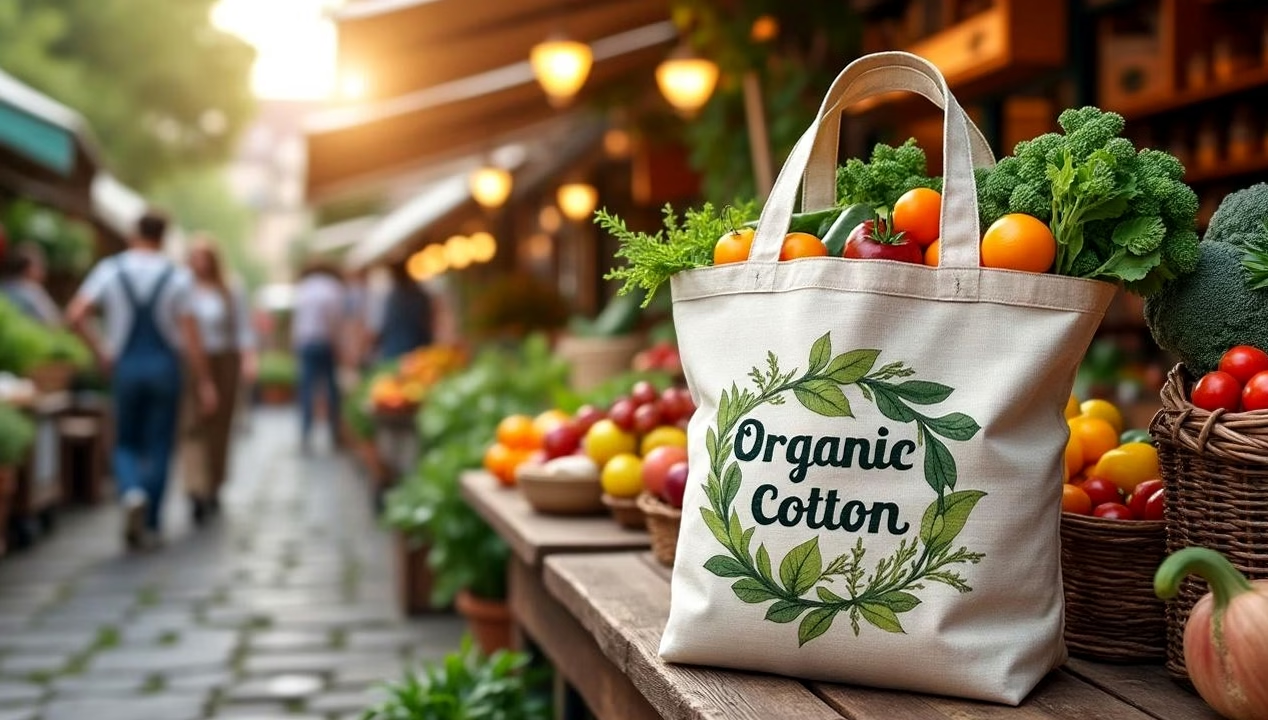
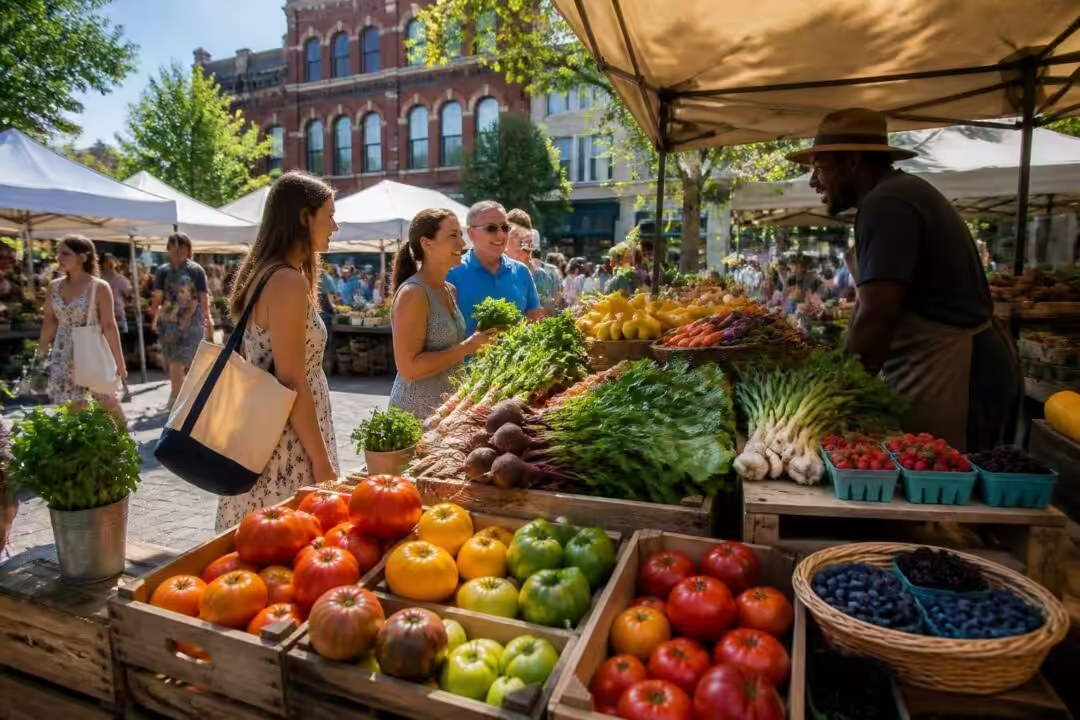
Seasonality and local sourcing change the math. Farmers’ markets and CSAs often sell organic produce at more competitive prices because of shorter supply chains and lower retail margins. Community buying — co-ops or shared bulk purchases — reduces per-family prices for staples.
Actionable list: ways to reduce costs
- 🛒 Prioritise high-residue produce — buy organic for items with higher pesticide residues to reduce exposure without buying everything organic.
- 🌱 Buy seasonal and local — found at markets and CSAs; often cheaper and fresher than year-round supermarket organics.
- 📦 Buy staples in bulk — beans, rice, oats and flours are cheaper per serving when purchased in larger quantities.
- 🤝 Join a co-op or cooperative purchase — collective buying power lowers cost and supports local producers.
- 🧾 Practice pantry math — measure price per ounce or per serving rather than per package to compare real value.
Another useful tactic is to mix brands: private-label supermarket organics can undercut specialty brands on price while meeting certification standards. Subscribers to meal-kit services or box CSA models often report predictable weekly costs because those packages reduce decision friction and can be budgeted into monthly expenses.
For families on restricted budgets, prioritisation and planning matter more than ideal purchases. The Parkers’ example shows that keeping a modest core of organic staples and choosing seasonal produce at markets allows the benefits of organic buying without a steep monthly premium.
Key insight: Smart, selective buying — seasonal, bulk, and cooperative — reduces the household premium while preserving the core benefits shoppers seek.
Policy, Industry Solutions, and What Would Make Organic More Affordable
Reducing the premium at scale is as much a systems problem as a household one. Policies that lower the up-front burdens of conversion, investments that shore up inputs like organic seed and feed, and research that narrows yield gaps all change the arithmetic for producers and consumers.
Where public intervention matters most
cost-share programs and transition payments shorten the painful early years of conversion by offsetting certification fees and income losses. Technical assistance programs help farmers adopt diversified rotations and soil-building practices that can close yield gaps over time. Expanding these programs and simplifying paperwork increases uptake and enlarges the certified supply.
Supply-chain investments also matter. Supporting scale-appropriate infrastructure — shared processing, cooperative warehousing and aggregated marketing — lets smaller producers spread overhead and lower per-unit costs. Public grants or low-interest loans for cooperative facilities are practical levers.
Trade, research and market signalling
Trade policy can either stabilise input prices or inject volatility. Maintaining predictable import channels for key organic inputs and avoiding abrupt tariffs helps processors plan and keeps shelf prices steadier. At the same time, targeted research into fertility management and integrated pest control — especially research that translates directly to regional contexts — can help narrow the yield gap without sacrificing ecological aims.
Finally, transparency and consumer education close the loop. Clear labelling about why a product costs more (certification, local production, animal welfare) enables shoppers to make informed trade-offs. Industry collaboration around shared certification services or pooled logistics can also lower costs without diluting standards.
Key insight: Strategic policy, cooperative infrastructure and research investments can shrink the organic premium while preserving the environmental and social goals that justify it.

Hi, I’m Landon Brooks. I am the editor-in-chief of Cook and Design, but for the first decade of my working life I was actually a product designer in New York.





8 Comments
Landon, the yield gap and input costs remind me of debugging: hidden complexity surfaces in the final price. Thanks for unpacking it.
Just as treating symptoms misses the root cause, cutting corners on soil biology prices in long-term costs.
Good breakdown. The yield gap is the real kicker—per-unit costs scale non-linearly. Reminds me of tech debt.
Good breakdown, Landon. The yield gap reads like infrastructure costs—hidden but structural. Thanks for mapping the premium.
Underrated analogy: yield gaps are like runtime overhead—you pay for stability and longer-term sustainability.
Landon, your cost-chain breakdown mirrors urban infrastructure: upfront investments, long-term gains.
That price gap is honest design—every input has a place. Efficient, but not cheap.
The yield gap is like a technical debt—short-term inefficiency that might pay off in system resilience.
Les commentaires sont fermes.