The Secret Oil Behind Waffle House Scrambled Eggs: Why Butter-Flavored Shortening Wins 🧈✨
Waffle House scrambled eggs have a very particular signature: a rich, buttery aroma, a soft curd, and a savory finish that feels far more “diner-perfect” than what most home cooks get on a weekday morning. The secret isn’t mystical, and it isn’t just “better eggs.” It’s largely about a specialized fat designed for griddles that run hot and run constantly.
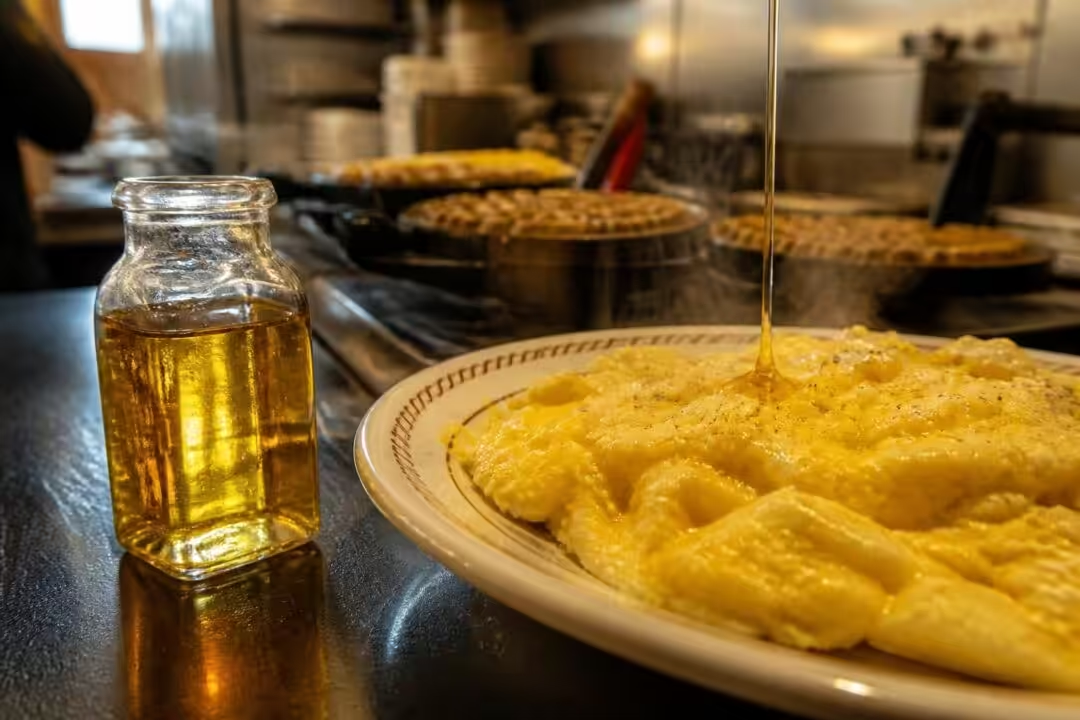
Multiple behind-the-counter accounts shared online over the years point to butter-flavored pan and griddle shortening, specifically Ventura Foods’ Kaola Gold Zero Trans Fat Shortening, a product that has since been renamed Phase Gold. In practical terms, this kind of shortening is engineered to behave like butter in taste and browning, while behaving like an oil blend in stability. That combination is the heart of the Waffle House experience.
What makes this fat so effective is how it fits the reality of a busy diner. A commercial griddle stays at a consistent temperature for long stretches, with frequent cycles of food hitting the surface: eggs, hash browns, bacon, toast. Regular butter, while delicious, has a relatively low smoke point compared with many refined oils, and it can burn quickly. Burnt butter doesn’t just taste bitter; it can also leave dark residues on a cooktop that affect later orders.
Phase Gold (formerly Kaola Gold) is described as a blend of oils such as soybean, cottonseed, hydrogenated coconut, canola, palm, and corn, plus components that contribute to texture and performance. It’s also known for including beta carotene, which supports that familiar golden hue diners associate with “buttery” food. That color cue matters more than many people admit: the eyes “taste” first, and a warm yellow gloss signals comfort before a fork even lifts. 😋
To make the idea concrete, imagine a Saturday at a high-volume location off an interstate exit. The cook needs a fat that can be spread fast, won’t scorch, and won’t turn an entire batch of eggs into something that tastes like over-toasted milk solids. A butter-flavored shortening is a tool that keeps quality consistent, order after order, even when the pace is relentless. That’s the kind of product that turns a simple egg scramble into a repeat craving.
In the next section, the focus shifts from what’s on the griddle to what’s in the bowl—because fat is only half the story when texture is the real obsession.
How Waffle House Gets Fluffy Scrambled Eggs: Aeration, Speed, and the Blender Technique 🍳💨
Even with the right griddle fat, scrambled eggs can still turn out flat or rubbery if the mixture isn’t prepared to trap air and set gently. One widely discussed method connected to Waffle House-style eggs is using a blender to whip the eggs until they look frothy and aerated. That small step changes the entire structure: more air bubbles mean a lighter curd, and a slightly “lifted” bite when the eggs hit the heat.
In a busy diner, speed is a flavor. A blender doesn’t just mix; it standardizes. It ensures each batch gets the same level of agitation, so the cook isn’t relying on the mood of someone’s wrist with a fork at 7:15 a.m. During rush periods, consistency is what protects the reputation of a “simple” dish. Customers don’t call scrambled eggs “memorable” because eggs are exotic; they call them memorable because every plate arrives with the same comforting softness.
To illustrate how aeration changes results, consider a fictional but realistic scenario: a short-order cook named Mara is training a new hire on a griddle that has been running for hours. The trainee cracks eggs into a cup and gives them a few lazy stirs. The scramble hits the hot surface and instantly tightens, producing large, squeaky curds. Mara does the same order but blends the eggs until foamy; on the griddle, the mixture sets into smaller, tender curds that look fuller on the plate. The customer experiences that as “fluffier,” even though the ingredient list is still basically eggs plus cooking fat.
There’s also an important nuance: Waffle House-style fluffiness is not the same as adding milk or cream. Many home recipes rely on dairy, but dairy introduces extra water and milk sugars that can change browning and sometimes weep liquid if the heat is off. The aeration method targets texture without relying on add-ins that can complicate consistency. It’s technique-forward rather than ingredient-heavy, and that’s a very diner way of thinking.
For anyone recreating the effect at home, the lesson is simple: incorporate more air before the eggs ever touch heat. A blender is efficient, but a whisk can get surprisingly close if used vigorously for long enough. The key sign is visual: the eggs should look lighter in color and slightly foamy on top. That foam is trapped potential—tiny pockets that expand just enough to keep the curd tender rather than dense.
Texture also depends on how quickly the cook moves once the eggs are on the griddle. A fast stir early on forms small curds; waiting too long forms larger chunks. That’s why Waffle House eggs feel “uniform”: the movement is deliberate and timed. The next section digs into the version that many fans order most—the cheesy variation—and why it behaves differently even when the same oil and technique are used.
Cheese N’ Eggs Secrets: The 1:1 American Cheese-to-Egg Ratio and Creamy Density 🧀🔥
Waffle House fans often talk about two different pleasures: the airy scramble and the Cheese N’ Eggs style that lands more like a creamy pillow than a cloud. That distinction matters because cheese changes the physics of eggs. When melted American cheese is folded into hot curds, it brings emulsifiers and fats that smooth the texture, turning “fluffy” into velvety and dense. The bite becomes richer, and the eggs feel almost sauced without adding a separate sauce.
One of the most repeated insider-style details is a bold guideline: a 1:1 slice-to-egg ratio for American cheese. That sounds excessive until it’s tasted in context. American cheese is formulated to melt evenly, so it integrates without splitting or turning greasy in the way some cheddars can. On a hot griddle, it becomes the ultimate binder—coating the curds, rounding sharp eggy notes, and pushing the flavor toward pure comfort food.
To keep this from becoming a muddled mess, timing is everything. If cheese goes in too early, the eggs can tighten and overcook while the cheese finishes melting. If it goes in too late, the cheese clumps and never fully emulsifies. The sweet spot is when the eggs are mostly set but still glossy, so the residual heat finishes the melt. That’s when the scramble takes on the signature sheen that makes people glance at the plate and think, “That’s the one.” 😍
The oil choice still matters here. Butter-flavored shortening provides a stable, savory base note that supports the cheese without burning. With real butter on high heat, milk solids can brown too quickly and create flavors that fight the mild, creamy profile of American cheese. With a griddle shortening, the background stays consistent: buttery aroma, clean finish, no harsh bitterness. In a dish this simple, removing “off-notes” is half the craft.
A practical home recreation approach can be described with a focused checklist. The goal isn’t to imitate every detail of a commercial kitchen; it’s to replicate the experience: creamy, salty, and comforting. The following list highlights the most impactful choices, ranked by what changes the final plate the most.
- 🍳 Aerate the eggs until frothy (blender or vigorous whisking) for a lighter curd foundation.
- 🧈 Use a butter-flavored shortening or a high-heat buttery alternative to avoid burnt flavors.
- 🧀 Choose American cheese for reliable melting and a smooth, emulsified texture.
- ⏱️ Add cheese when eggs are mostly set but still glossy, so it melts into the curds instead of clumping.
- 🔥 Keep heat moderate; high heat speeds cooking but increases toughness and reduces creaminess.
For readers who want an even more “diner-like” feel, plating matters too. A warm plate keeps cheese from seizing up, and a quick fold rather than constant stirring preserves that creamy body. The next section zooms out to compare the fats involved—why butter behaves the way it does, and why an engineered griddle shortening is such a logical choice for a chain built on speed and consistency.
Kaola Gold (Phase Gold) vs Butter: Smoke Point, Flavor Engineering, and Diner Consistency 🥘📈
Butter is the romantic choice for eggs, and in a calm home kitchen it can be unbeatable. But a diner environment is not calm. The griddle is a production line, and ingredients must perform under stress. That is where butter-flavored griddle shortening—like Ventura Foods’ Kaola Gold, now commonly referenced as Phase Gold—earns its reputation. The product is built to deliver a familiar buttery profile while tolerating the high, steady temperatures that would punish regular butter.
Butter contains water and milk solids. When butter hits high heat, water evaporates and milk solids can brown rapidly, pushing into burnt territory. That’s why browned butter can be amazing in a controlled recipe, yet disastrous when repeated nonstop on a hot surface for hours. In contrast, a shortening/oil blend is more stable, and its flavoring system is designed to keep that “butter impression” consistent without relying on fragile milk solids.
The blend associated with Kaola/Phase Gold is frequently described as combining several oils—soybean, cottonseed, hydrogenated coconut, canola, palm, and corn—plus ingredients that help with binding and flavor delivery. Another notable component is beta carotene, used to reinforce a golden-yellow color. That color is part of brand expectation: customers anticipate “golden” eggs and “golden” hash browns, and the visual continuity strengthens the overall experience.
Below is a practical comparison table that frames why a chain might choose a griddle shortening over butter, especially when eggs are cooked all day and the equipment rarely cools down. The table doesn’t claim that one is morally “better,” only that each fits a different cooking reality.
| Factor | Butter 🧈 | Butter-Flavored Griddle Shortening (Kaola/Phase Gold) 🍳 |
|---|---|---|
| Heat tolerance 🔥 | Lower; can brown/burn quickly on constant high heat | Higher; designed for sustained griddle temps |
| Flavor consistency 🎯 | Can shift as milk solids toast or scorch | Stable buttery profile across many batches |
| Color impact 🟡 | Natural yellow, but browning can darken residues | Often reinforced with beta carotene for a golden look |
| Griddle cleanliness 🧽 | Burnt solids can build up faster | Typically leaves fewer burnt milk-solid residues |
| Best use case ✅ | Home cooking, controlled heat, small batches | High-volume service, repeatable results, fast turnaround |
In 2026, diners are also more ingredient-aware than they were a decade ago, and many people ask what oils are used and why. That curiosity doesn’t change the kitchen math: chains optimize for repeatability, cost control, and griddle performance. The “secret oil” is less about hiding something and more about using a professional product that behaves the same at 6 a.m. and midnight.
Next comes the most practical question: how to replicate the Waffle House effect at home without restaurant-size containers, while still capturing the same buttery aroma and craveable texture.
Recreating Waffle House Scrambled Eggs at Home: Substitutions, Tools, and Real-World Practice 🍽️🔧
Home cooks often discover the first obstacle immediately: the exact product discussed by enthusiasts—Kaola Gold/Phase Gold—is commonly sold in large, foodservice-oriented quantities. That doesn’t mean the flavor profile is unattainable; it means replication works best when it focuses on function: a buttery-tasting fat that can handle heat, plus an egg technique that builds air and sets softly.
A realistic approach starts with choosing the closest accessible substitute. Many grocery stores carry butter-flavored shortenings or griddle-ready fats marketed for frying and baking. The goal is to find a product that delivers a buttery aroma without scorching quickly. If that’s not available, a blend can work: a small amount of butter for flavor combined with a neutral, higher-heat oil to buffer against burning. The method matters here: the fat should be hot enough to coat the pan and sizzle softly, not so hot that it smokes aggressively.
Tool choice is the second lever. A blender is the fastest way to mimic diner aeration, but a whisk can still deliver excellent results with effort. The mix should be beaten until it turns a bit lighter and shows visible foam. A fork works in a pinch, yet it usually can’t incorporate enough air to mimic that “lifted” diner bite. A small hand mixer can also be a clever compromise for a home kitchen because it whips quickly and is easy to clean.
To make this concrete, consider a small at-home test run that a curious cook might do on a Sunday morning. Two batches are made side by side: one whisked for 15 seconds, one whisked for a full minute until frothy. Both are cooked in the same pan with the same fat. The short-whisk batch sets into larger, heavier curds. The frothy batch sets into smaller curds and appears to “fill” the plate more, even though the egg count is identical. That’s the diner trick: air is an ingredient, and it’s free.
Cheesy eggs are even easier to “nail” at home because American cheese is widely available and forgiving. The main caution is restraint with heat. If the pan is too hot, the eggs tighten before the cheese melts smoothly. If the pan is too cool, the eggs can turn watery. Medium heat and constant attention win. A final fold off-heat for a few seconds can finish melting without overcooking.
Some cooks also add a tiny touch of acid—like a drop of vinegar or lemon juice—to encourage tenderness. The effect should be subtle, not tangy. Acid can slightly alter how proteins set, helping avoid toughness when cooking goes a little long. It’s not a required step for Waffle House-style eggs, but it’s a useful “insurance policy” for anyone still learning timing.
The most reliable home workflow combines everything into a repeatable routine: preheat pan, add butter-like fat, whip eggs until foamy, cook on moderate heat, and—if going cheesy—add American cheese near the end for that creamy, cohesive finish. Once that routine becomes muscle memory, the plate starts to taste less like “scrambled eggs” and more like the distinct diner experience people crave. The next exploration naturally becomes about pairing: the same fat-and-griddle logic that shapes eggs also influences hash browns and other classics, tying the whole meal together. 🍳🥔

Hi, I’m Landon Brooks. I am the editor-in-chief of Cook and Design, but for the first decade of my working life I was actually a product designer in New York.